Finding ideas for movement
Students start the year exploring where dance ideas come from. They pull from their own lives, stories they have read, and things they have seen, then turn those ideas into short movement pieces.
This is the year dance becomes intentional. Students draw on their own experiences and ideas to shape short pieces with a clear beginning, middle, and end. They sharpen their movement with practice, then perform with attention to how the audience reads it. By spring, students can choreograph a short dance, explain what it means, and give thoughtful feedback on a classmate's work.
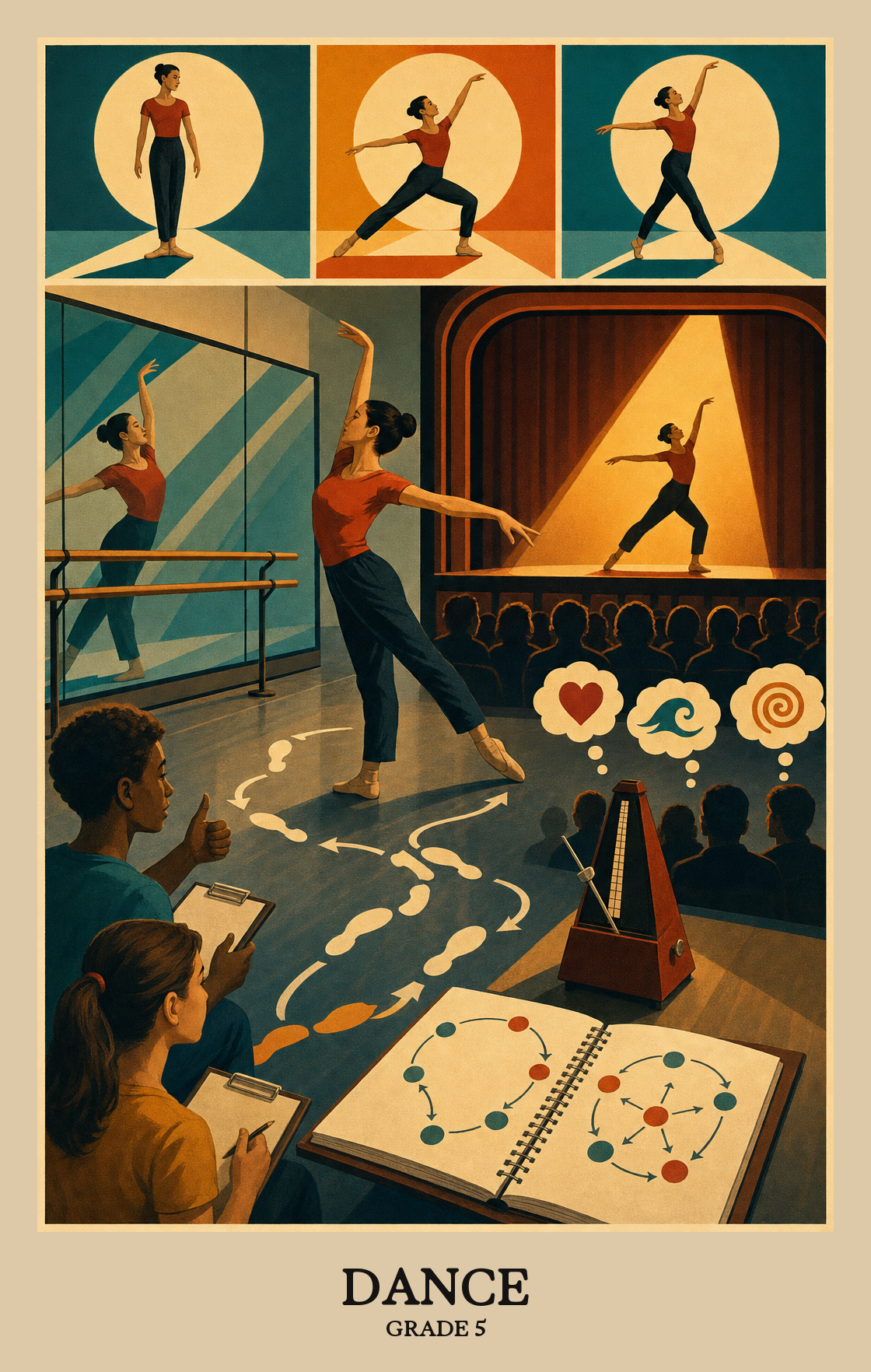
Students start the year exploring where dance ideas come from. They pull from their own lives, stories they have read, and things they have seen, then turn those ideas into short movement pieces.
Students learn to organize movement into something that holds together. They try out ideas, choose what works, and shape short dances with a clear beginning, middle, and end.
Students focus on how they move. They practice balance, control, and timing, and learn how rehearsal makes a dance look sharper and feel more confident on stage.
Students put their work in front of others. They think about what their dance is saying and how choices like speed, energy, and space help an audience feel that meaning.
Students become thoughtful audience members. They notice what a dance is about, talk about what the choreographer might have meant, and use clear reasons to say what is working.
Students look at how dance fits into history and different communities. They see how movement carries traditions and ideas, and connect what they are learning to dances from other places and time periods.
Students connect something they know or have lived through to a dance they create or study. The movement becomes a way to express a real idea or memory, not just follow steps.
Students look at a dance and ask where it came from. They connect the movements to the culture, time period, or community that shaped it.
| Standard | Definition | Code |
|---|---|---|
| Synthesize and relate knowledge and personal experiences to make art | Students connect something they know or have lived through to a dance they create or study. The movement becomes a way to express a real idea or memory, not just follow steps. | DA:Cn10.5 |
| Relate artistic ideas and works with societal, cultural | Students look at a dance and ask where it came from. They connect the movements to the culture, time period, or community that shaped it. | DA:Cn11.5 |
Students brainstorm movement ideas and start shaping them into a dance. They explore different ways a body can move before settling on what works best for their piece.
Students take a movement idea and shape it into a structured dance, making choices about order, transitions, and how each section connects to the whole piece.
Students review their own dances, make specific changes based on feedback, and bring the work to a finished state ready to share.
| Standard | Definition | Code |
|---|---|---|
| Generate and conceptualize artistic ideas and work | Students brainstorm movement ideas and start shaping them into a dance. They explore different ways a body can move before settling on what works best for their piece. | DA:Cr1.5 |
| Organize and develop artistic ideas and work | Students take a movement idea and shape it into a structured dance, making choices about order, transitions, and how each section connects to the whole piece. | DA:Cr2.5 |
| Refine and complete artistic work | Students review their own dances, make specific changes based on feedback, and bring the work to a finished state ready to share. | DA:Cr3.5 |
Students choose which dances to perform and explain why those pieces are worth presenting. They think critically about the artistic choices behind each selection.
Students practice a dance piece repeatedly, adjusting footwork, timing, and body position until the performance is ready to share with an audience.
Students perform a dance with clear intent, making choices about movement, timing, and expression so the audience understands what the piece is about.
| Standard | Definition | Code |
|---|---|---|
| Analyze, interpret, and select artistic work for presentation | Students choose which dances to perform and explain why those pieces are worth presenting. They think critically about the artistic choices behind each selection. | DA:Pr4.5 |
| Develop and refine artistic techniques and work for presentation | Students practice a dance piece repeatedly, adjusting footwork, timing, and body position until the performance is ready to share with an audience. | DA:Pr5.5 |
| Convey meaning through the presentation of artistic work | Students perform a dance with clear intent, making choices about movement, timing, and expression so the audience understands what the piece is about. | DA:Pr6.5 |
Students watch a dance and explain what they notice: how the dancer moves, how the piece is put together, and what choices the choreographer made.
Students watch a dance and explain what the choreographer was trying to say. They look at movement choices, like speed or shape, and describe what feeling or idea those choices express.
Students use a set of criteria, like a checklist of what makes a dance work well, to judge a performance and explain what they noticed.
| Standard | Definition | Code |
|---|---|---|
| Perceive and analyze artistic work | Students watch a dance and explain what they notice: how the dancer moves, how the piece is put together, and what choices the choreographer made. | DA:Re7.5 |
| Interpret intent and meaning in artistic work | Students watch a dance and explain what the choreographer was trying to say. They look at movement choices, like speed or shape, and describe what feeling or idea those choices express. | DA:Re8.5 |
| Apply criteria to evaluate artistic work | Students use a set of criteria, like a checklist of what makes a dance work well, to judge a performance and explain what they noticed. | DA:Re9.5 |
Students make up short dances, practice movement skills like balance and timing, and perform for classmates. They also watch dances and talk about what the choreographer was trying to say. The focus is on creating and expressing ideas through movement, not just learning routines.
Put on music and ask the dancer to invent a short movement that shows a feeling or tells part of a story. Watch a dance clip together and talk about what it made you feel and why. Five or ten minutes of this builds the same skills students practice in class.
No. The work centers on making and shaping movement, not on technique from a specific style like ballet. Curiosity, willingness to try ideas, and the ability to give thoughtful feedback to a classmate matter more than prior lessons.
Early units usually build movement vocabulary and short improvisations so students have raw material. Middle units focus on shaping that material into longer pieces with clear intent. Later units bring in performance polish and structured peer feedback using shared criteria.
A student can take an idea, image, or personal experience and turn it into a short dance with a clear beginning, middle, and end. They can perform it with focus and talk about another dancer's work using specific observations rather than just liking or disliking it.
Refining a draft dance is often the hardest part. Students tend to make a first version and call it done. Plan extra time for revision cycles where dancers test an idea, get feedback against criteria, and rework a section before showing it again.
Students look at how dances come from real places, communities, and time periods, and they connect what they see to their own lives. A planning move that works well is pairing each making unit with one short study of a dance from a specific culture or era.
Teachers use shared criteria such as clarity of the idea, use of space and timing, focus during performance, and the quality of feedback a student gives to others. Students learn the criteria up front and apply them to their own work and to classmates' work.
They should be ready to work on longer group pieces, use more specific movement vocabulary, and give and receive feedback that points to evidence in the dance. Comfort with showing in-progress work to peers is a strong sign of readiness.