Listening with a musician's ear
Students start the year by listening closely to songs and short pieces. They notice the beat, the mood, and how the music is put together, and they begin using music words to describe what they hear.
This is the year music turns into a craft students can talk about, not just play. Students come up with their own short musical ideas, shape them with a clear beginning and end, and rework them based on feedback. They also learn to listen with purpose, explaining what a piece is trying to say and why it works. By spring, students can perform a prepared piece and describe the choices behind it.
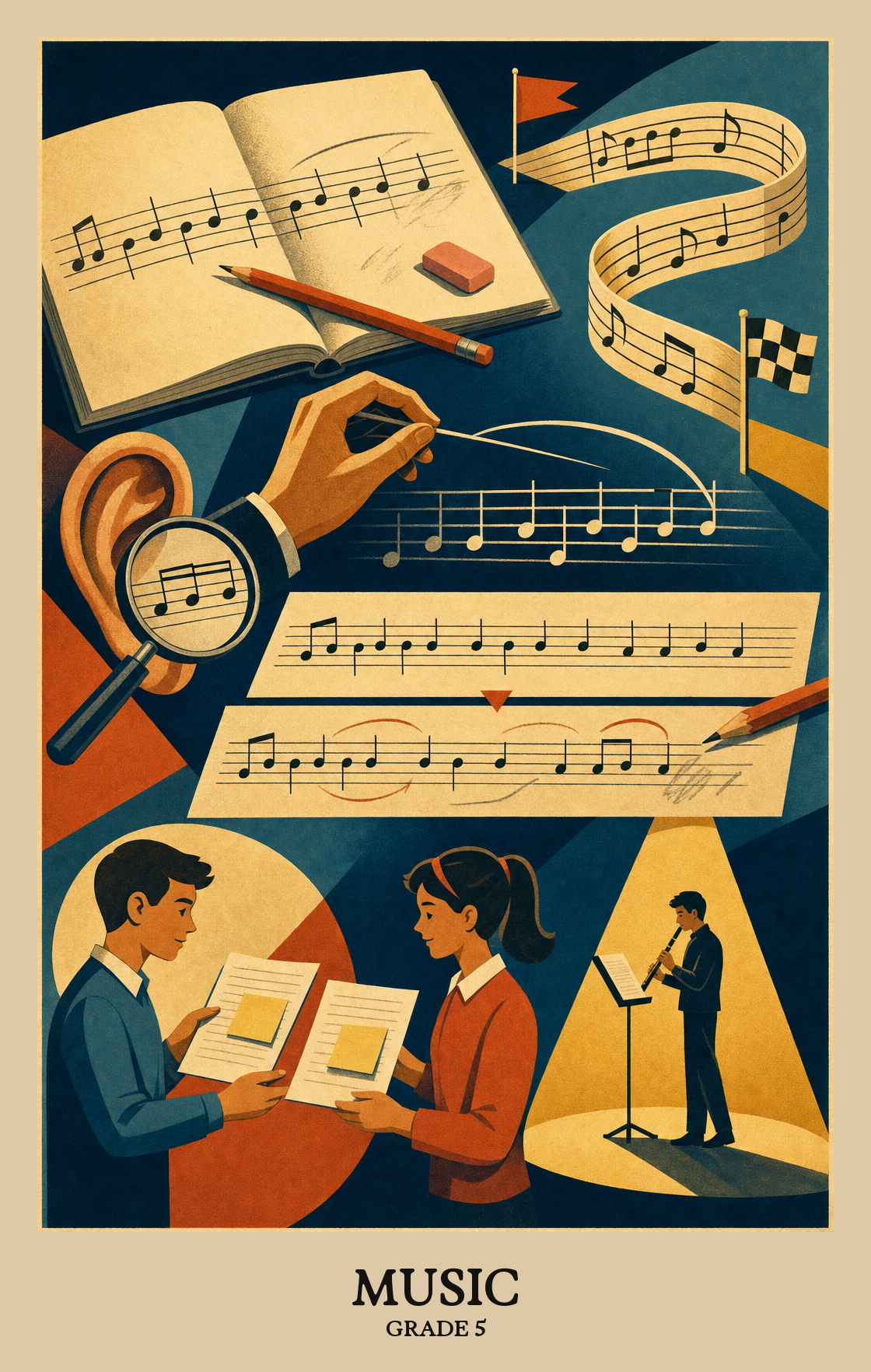
Students start the year by listening closely to songs and short pieces. They notice the beat, the mood, and how the music is put together, and they begin using music words to describe what they hear.
Students try out their own short rhythms and melodies on voice or instruments. They play with ideas, keep what sounds good, and start writing pieces down so they can practice them again later.
Students pick music to perform and rehearse it carefully. They work on cleaner singing or playing, steady timing, and small choices like louder, softer, faster, or slower that make a piece feel a certain way.
Students share finished pieces with classmates or an audience and reflect on how it went. They use simple checklists to judge their own work and connect songs to history, culture, or their own lives.
Students connect what they know and what they've lived through to the music they create or perform. Personal memories, other subjects, and outside interests all shape the choices students make in their work.
Students connect a piece of music to the time and place it came from. Knowing who made it, when, and why helps them understand what the music means and why it still matters.
| Standard | Definition | Code |
|---|---|---|
| Synthesize and relate knowledge and personal experiences to make art | Students connect what they know and what they've lived through to the music they create or perform. Personal memories, other subjects, and outside interests all shape the choices students make in their work. | MU:Cn10.5 |
| Relate artistic ideas and works with societal, cultural | Students connect a piece of music to the time and place it came from. Knowing who made it, when, and why helps them understand what the music means and why it still matters. | MU:Cn11.5 |
Students brainstorm and develop original musical ideas, exploring different rhythms, melodies, or sounds to spark a new piece or performance.
Students take a musical idea they've started and shape it into something more complete, deciding how to arrange the parts so the piece holds together.
Students revisit a piece of music they composed, fix parts that feel off, and decide when the work is ready to share.
| Standard | Definition | Code |
|---|---|---|
| Generate and conceptualize artistic ideas and work | Students brainstorm and develop original musical ideas, exploring different rhythms, melodies, or sounds to spark a new piece or performance. | MU:Cr1.5 |
| Organize and develop artistic ideas and work | Students take a musical idea they've started and shape it into something more complete, deciding how to arrange the parts so the piece holds together. | MU:Cr2.5 |
| Refine and complete artistic work | Students revisit a piece of music they composed, fix parts that feel off, and decide when the work is ready to share. | MU:Cr3.5 |
Students choose a piece of music to perform and explain why it suits their skills and the audience. They look closely at the music before playing or singing it.
Students practice a piece of music repeatedly, fixing technical problems and making deliberate choices about how it should sound before performing it for an audience.
Students perform a piece of music with intention, making choices about dynamics, tempo, or expression to communicate a specific feeling or idea to the audience.
| Standard | Definition | Code |
|---|---|---|
| Analyze, interpret, and select artistic work for presentation | Students choose a piece of music to perform and explain why it suits their skills and the audience. They look closely at the music before playing or singing it. | MU:Pr4.5 |
| Develop and refine artistic techniques and work for presentation | Students practice a piece of music repeatedly, fixing technical problems and making deliberate choices about how it should sound before performing it for an audience. | MU:Pr5.5 |
| Convey meaning through the presentation of artistic work | Students perform a piece of music with intention, making choices about dynamics, tempo, or expression to communicate a specific feeling or idea to the audience. | MU:Pr6.5 |
Students listen to a piece of music and describe what they notice: how the rhythm shifts, where the melody repeats, and what the composer seems to be doing on purpose.
Students listen to a piece of music and explain what they think the composer or performer was feeling or trying to say. They support their reading of the music with details they can actually hear.
Students listen to a piece of music and use a set of criteria to explain why it works well or where it falls short. They back up their opinion with specific reasons, not just personal taste.
| Standard | Definition | Code |
|---|---|---|
| Perceive and analyze artistic work | Students listen to a piece of music and describe what they notice: how the rhythm shifts, where the melody repeats, and what the composer seems to be doing on purpose. | MU:Re7.5 |
| Interpret intent and meaning in artistic work | Students listen to a piece of music and explain what they think the composer or performer was feeling or trying to say. They support their reading of the music with details they can actually hear. | MU:Re8.5 |
| Apply criteria to evaluate artistic work | Students listen to a piece of music and use a set of criteria to explain why it works well or where it falls short. They back up their opinion with specific reasons, not just personal taste. | MU:Re9.5 |
Students make up their own short pieces, practice songs and instruments for performances, and listen carefully to music to figure out how it works. They also talk about why a piece sounds the way it does and what the composer was probably going for.
Play different kinds of music in the car and ask what students notice about the beat, mood, or instruments. Ask them to teach a song or rhythm they learned that week. Five minutes of listening and talking is plenty.
Effort and practice matter most at this age. Students are expected to try ideas, revise them, and stick with a piece long enough to make it better. Steady practice at home, even ten minutes a few times a week, makes a real difference.
Most teachers weave all three into every unit rather than teaching them in blocks. A typical unit starts with listening and analysis, moves into a short composition or arrangement, and ends with a performance students can reflect on. Save bigger creative projects for later in the year once routines are solid.
Refining work is the hardest part. Students often want to call a first draft finished. Build in short revision cycles where students record themselves, listen back, and change one specific thing before performing again.
Students can plan a short piece, practice it with a clear goal in mind, and perform it for an audience. They can also listen to a piece of music and explain what the composer did and whether it worked, using musical reasons rather than just liking or disliking it.
Ask what part feels boring: the listening, the practice, or the performing. Then connect music at home to something they already like, such as a movie soundtrack or a favorite song, and ask what the music adds to it. Curiosity usually returns once the music feels personal.