Moving and exploring the body
Students start the year discovering how their bodies move through space. They try big and small movements, fast and slow, and learn to dance without bumping into friends.
This is the year students learn that their bodies can tell a story. Students explore how to move in space, copy simple shapes and rhythms, and make up their own movements to match a feeling or idea. They start to watch others dance and say what they noticed. By spring, students can perform a short movement they made up and explain what it means to them.
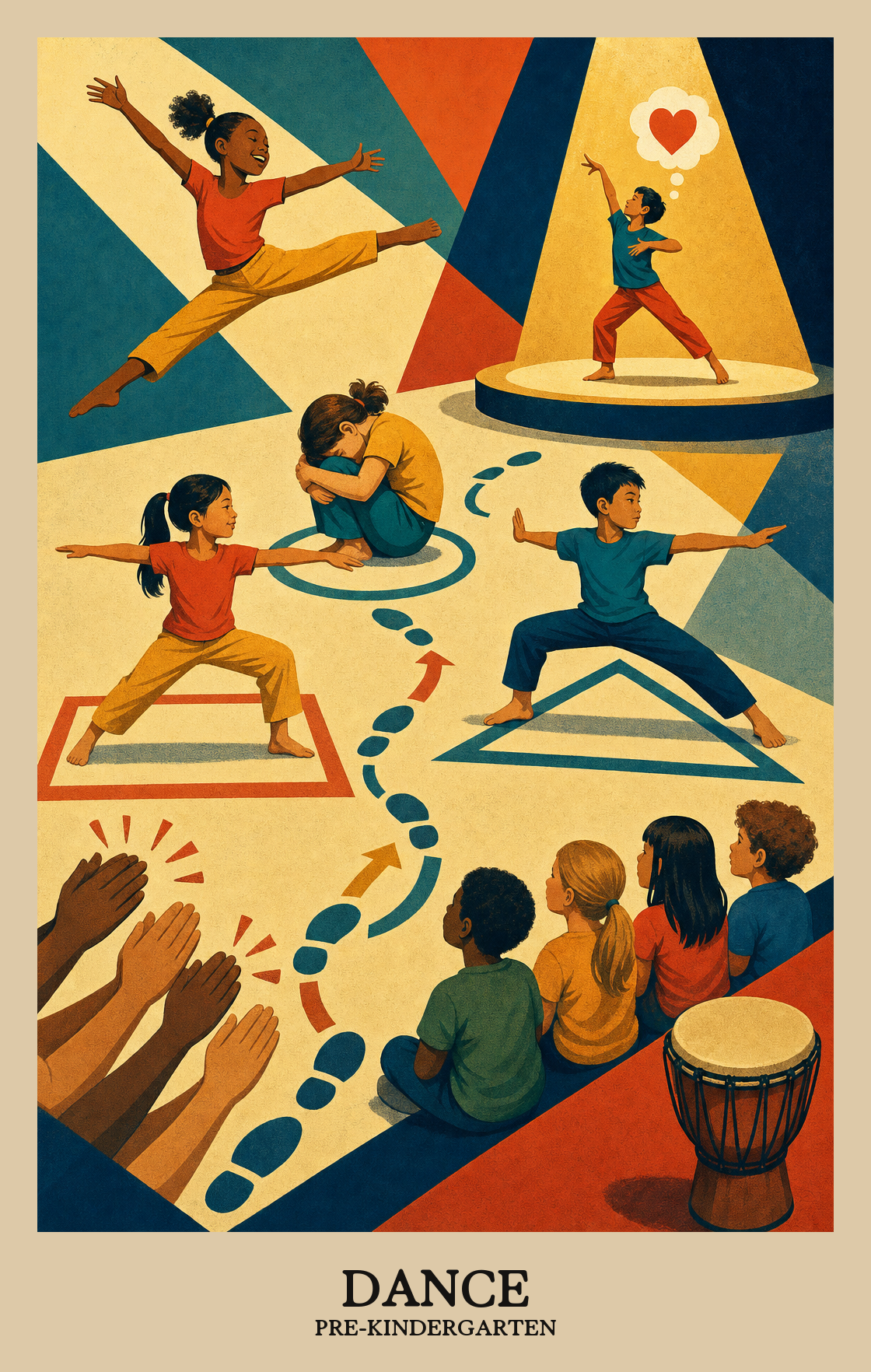
Students start the year discovering how their bodies move through space. They try big and small movements, fast and slow, and learn to dance without bumping into friends.
Students begin turning ideas into movement. A storm, a favorite animal, or a feeling can become a short dance they invent on their own or with a partner.
Students practice a short dance and show it to classmates. They learn what it feels like to be the dancer and what it feels like to watch quietly from the audience.
Students notice what happens in dances they see and try movements from different cultures and stories. They start using simple words to say what they liked and why.
Students connect something from their own life to a dance they make or perform. A memory, a feeling, or something they noticed can become the starting point for movement.
Dancing is tied to where people come from and when they lived. Students begin to notice that different dances tell stories about real communities and traditions.
| Standard | Definition | Code |
|---|---|---|
| Synthesize and relate knowledge and personal experiences to make art | Students connect something from their own life to a dance they make or perform. A memory, a feeling, or something they noticed can become the starting point for movement. | DA:Cn10.pk |
| Relate artistic ideas and works with societal, cultural | Dancing is tied to where people come from and when they lived. Students begin to notice that different dances tell stories about real communities and traditions. | DA:Cn11.pk |
Students come up with ideas for movement and dance, turning what they imagine into something they can actually do with their bodies.
Students pick a movement or short sequence and practice it until it feels like their own. They start turning ideas into a real dance.
Students pick a dance move they made up and practice it until it feels just right. They learn that making something good takes more than one try.
| Standard | Definition | Code |
|---|---|---|
| Generate and conceptualize artistic ideas and work | Students come up with ideas for movement and dance, turning what they imagine into something they can actually do with their bodies. | DA:Cr1.pk |
| Organize and develop artistic ideas and work | Students pick a movement or short sequence and practice it until it feels like their own. They start turning ideas into a real dance. | DA:Cr2.pk |
| Refine and complete artistic work | Students pick a dance move they made up and practice it until it feels just right. They learn that making something good takes more than one try. | DA:Cr3.pk |
Students choose which movements or short dances to show others. They practice picking what feels ready to share.
Students practice a dance move, then try it again to make it look better before showing it to others.
Students show a feeling or idea by moving their body in a simple dance or movement. The movement itself is the message.
| Standard | Definition | Code |
|---|---|---|
| Analyze, interpret, and select artistic work for presentation | Students choose which movements or short dances to show others. They practice picking what feels ready to share. | DA:Pr4.pk |
| Develop and refine artistic techniques and work for presentation | Students practice a dance move, then try it again to make it look better before showing it to others. | DA:Pr5.pk |
| Convey meaning through the presentation of artistic work | Students show a feeling or idea by moving their body in a simple dance or movement. The movement itself is the message. | DA:Pr6.pk |
Students watch a dance and say what they notice, like how the dancer moves fast or slow, or uses their arms. It is the beginning of learning to really look at art, not just see it.
Students describe what a dance makes them think or feel, and say why they think the dancer was trying to show that.
Students look at a dance and say what they liked and why. They start to notice that some movements feel exciting, strong, or just right for the music.
| Standard | Definition | Code |
|---|---|---|
| Perceive and analyze artistic work | Students watch a dance and say what they notice, like how the dancer moves fast or slow, or uses their arms. It is the beginning of learning to really look at art, not just see it. | DA:Re7.pk |
| Interpret intent and meaning in artistic work | Students describe what a dance makes them think or feel, and say why they think the dancer was trying to show that. | DA:Re8.pk |
| Apply criteria to evaluate artistic work | Students look at a dance and say what they liked and why. They start to notice that some movements feel exciting, strong, or just right for the music. | DA:Re9.pk |
Students move their bodies on purpose to music, stories, and ideas. They try out fast and slow, high and low, and copy shapes they see. Most of the year is about exploring how the body can move, not learning set routines.
Put on music for five minutes after dinner and move together. Pretend to be animals, weather, or characters from a favorite book. Shy students warm up faster when a grown-up looks a little silly first, and when no one is watching or grading.
No. The goal is body awareness and confidence, not ballet positions or memorized routines. Skipping, stomping, swaying, spinning, and freezing in a shape all count as real progress at this age.
Start with body parts and personal space, then add levels and speed, then shapes and pathways. Bring in feelings and stories around the middle of the year. End with short pieces students can show to a buddy class or family.
Personal space and stopping on a signal. Four-year-olds get excited and drift into each other. Short freeze games, spots on the floor, and a clear music-off cue are worth revisiting every few weeks.
Tie movement to a story being read aloud, a season, a feeling, or a class theme like animals or community helpers. Ask students to show the shape of a letter, the path of a caterpillar, or how a character feels. The link makes the dance more meaningful and the topic stickier.
By spring, students should move safely in a shared space, copy a simple movement, hold a shape, and stop when the music stops. They should also be able to say one thing they liked about a classmate's dance.
Try "What did your body do today?" or "Show me a shape you made." Asking students to demonstrate works better than asking them to explain. A 30-second living-room performance tells you more than a long conversation.