Imagining characters and stories
Students start the year by making up characters and pretend situations from their own lives. They turn small ideas, like a lost pet or a trip to the store, into short scenes they can act out with classmates.
This is the year make-believe play turns into real storytelling on purpose. Students invent characters and short scenes, then practice them so an audience can follow along. They also start watching plays with a thinking eye, talking about what a story meant and why a choice worked. By spring, students can act out a small scene with a clear character and share what they noticed in someone else's performance.
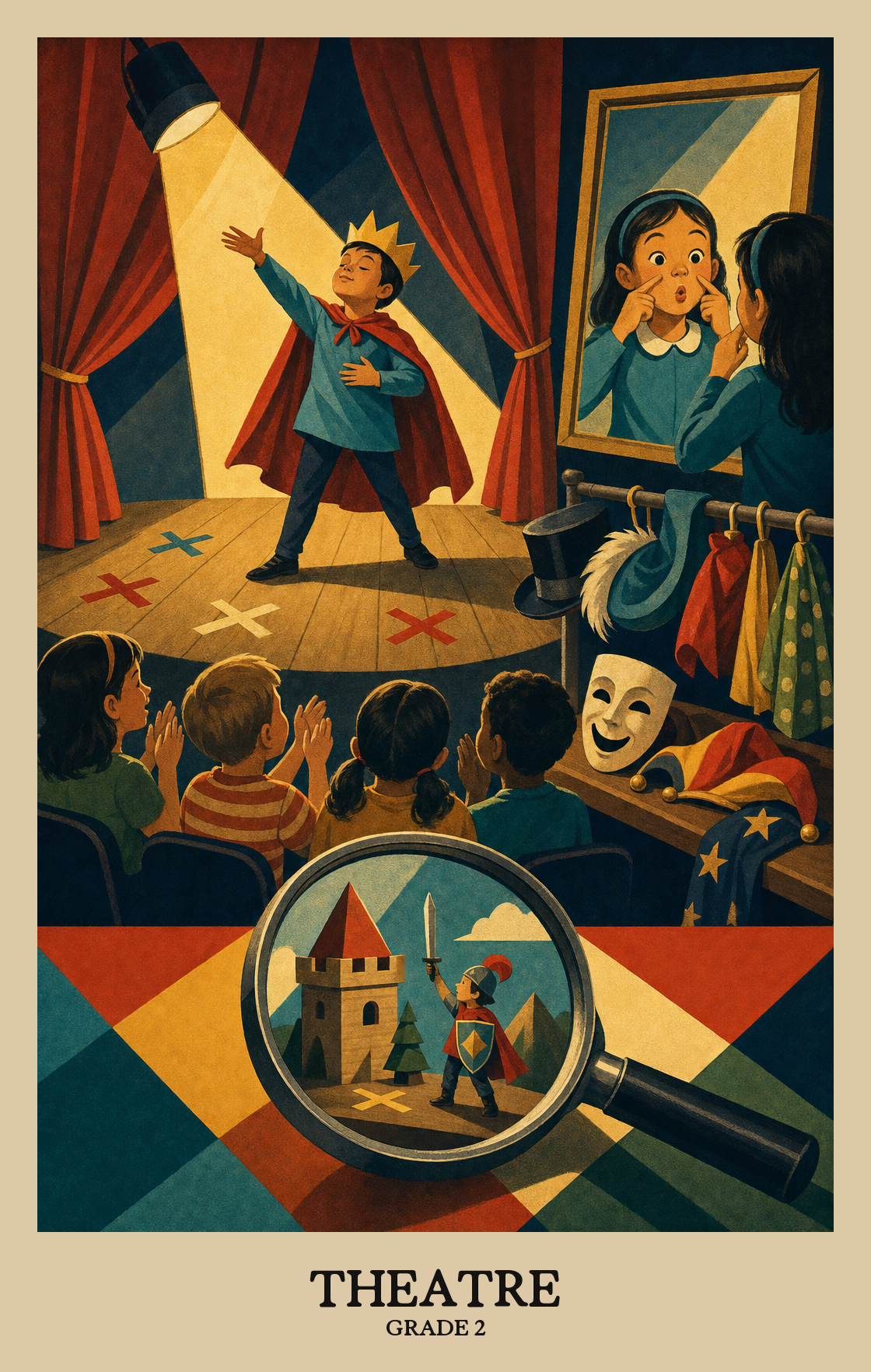
Students start the year by making up characters and pretend situations from their own lives. They turn small ideas, like a lost pet or a trip to the store, into short scenes they can act out with classmates.
Students work in small groups to shape a scene from start to finish. They decide who is in it, what happens, and how it ends, then practice the parts and try out changes that make the scene clearer.
Students learn how to use voice, face, and movement so an audience can follow along. They rehearse a short piece and perform it for the class, paying attention to being heard and staying in character.
Students watch classmates and short performances and talk about what they noticed. They share what the story meant to them, connect it to their own lives, and offer kind, specific feedback about what worked.
Students connect what they already know and have lived through to the characters and stories they perform. Real feelings and memories make their acting more honest.
Students look at a play, costume, or performance and talk about when and where it came from. Connecting art to real places, times, and people helps students understand both the art and the world it came from.
| Standard | Definition | Code |
|---|---|---|
| Synthesize and relate knowledge and personal experiences to make art | Students connect what they already know and have lived through to the characters and stories they perform. Real feelings and memories make their acting more honest. | TH:Cn10.2 |
| Relate artistic ideas and works with societal, cultural | Students look at a play, costume, or performance and talk about when and where it came from. Connecting art to real places, times, and people helps students understand both the art and the world it came from. | TH:Cn11.2 |
Students come up with ideas for characters and scenes, then sketch out a short story to act out. They decide who a character is, how that character moves, and what the character wants.
Students take an idea for a story or character and shape it into a short scene, choosing what happens, who speaks, and how the action moves from beginning to end.
Students revisit a short scene or character choice, make at least one change that improves it, and practice until the performance feels ready to share.
| Standard | Definition | Code |
|---|---|---|
| Generate and conceptualize artistic ideas and work | Students come up with ideas for characters and scenes, then sketch out a short story to act out. They decide who a character is, how that character moves, and what the character wants. | TH:Cr1.2 |
| Organize and develop artistic ideas and work | Students take an idea for a story or character and shape it into a short scene, choosing what happens, who speaks, and how the action moves from beginning to end. | TH:Cr2.2 |
| Refine and complete artistic work | Students revisit a short scene or character choice, make at least one change that improves it, and practice until the performance feels ready to share. | TH:Cr3.2 |
Students choose which character or scene to perform and explain why it fits the story. They practice making decisions about how to share their work with an audience.
Students practice and improve their acting, movement, or voice before performing for an audience. Rehearsal helps them make their work clearer and more confident.
Students act out a scene or story so the audience understands what is happening and feels something. Every choice, from how loud to speak to where to stand, helps carry the meaning to the people watching.
| Standard | Definition | Code |
|---|---|---|
| Analyze, interpret, and select artistic work for presentation | Students choose which character or scene to perform and explain why it fits the story. They practice making decisions about how to share their work with an audience. | TH:Pr4.2 |
| Develop and refine artistic techniques and work for presentation | Students practice and improve their acting, movement, or voice before performing for an audience. Rehearsal helps them make their work clearer and more confident. | TH:Pr5.2 |
| Convey meaning through the presentation of artistic work | Students act out a scene or story so the audience understands what is happening and feels something. Every choice, from how loud to speak to where to stand, helps carry the meaning to the people watching. | TH:Pr6.2 |
Students look at a short performance or scene and describe what they notice, like how a character moves, speaks, or feels. They start to explain why those choices matter.
Students look at a scene or performance and explain what they think the actors were trying to show. They share what the story or moment meant to them and point to specific details that gave them that idea.
Students look at a scene or performance and explain what worked and what did not, using specific reasons tied to the story, the acting, or how the stage looked.
| Standard | Definition | Code |
|---|---|---|
| Perceive and analyze artistic work | Students look at a short performance or scene and describe what they notice, like how a character moves, speaks, or feels. They start to explain why those choices matter. | TH:Re7.2 |
| Interpret intent and meaning in artistic work | Students look at a scene or performance and explain what they think the actors were trying to show. They share what the story or moment meant to them and point to specific details that gave them that idea. | TH:Re8.2 |
| Apply criteria to evaluate artistic work | Students look at a scene or performance and explain what worked and what did not, using specific reasons tied to the story, the acting, or how the stage looked. | TH:Re9.2 |
Students act out stories, play characters, and build short scenes with classmates. Most of the work happens through pretend play, movement, and voice rather than memorized scripts. The focus is on imagining a situation and showing it to others.
Read picture books out loud and take turns being different characters. Ask what a character is feeling and why, then act out a short scene together. Five minutes of pretend play after a story does more than any worksheet.
Not yet. At this age the work is mostly improvised or read from a short script. Students focus on using their voice and body to show a character, not on memorizing a part word for word.
Start with imagination and pretend play, then move into building short scenes from familiar stories. Add simple staging and audience awareness in the middle of the year. End with a small performance and a reflection on what worked.
Staying in character when classmates are watching, and speaking loudly enough to be heard. Both improve with short, repeated practice rather than one big lesson. Quick warm-ups at the start of class help more than a long unit.
Students can invent a character, hold a short scene with a partner, and explain what their character wanted. They can also watch a classmate perform and say one specific thing that worked. That mix of making and responding is the bar.
Shy students often do well in small groups or as part of a frozen picture before they speak in front of the class. Practice at home with puppets, stuffed animals, or a parent as the audience. Comfort grows with low-pressure repetition.
Acting out a story helps students understand characters, feelings, and what happens next. After a scene, ask what the character wanted and what got in the way. Those are the same questions teachers ask during reading.