Finding ideas to move
Students start the year turning everyday experiences, stories, and pictures into short movement ideas. Parents may hear them describe a dance they made up about a memory or a place.
This is the year dance starts to carry real meaning. Students take an idea, a story, or something from their own lives and shape it into a short dance with a clear beginning, middle, and end. They practice steps until the movement looks sharp on stage, and they learn to watch other dancers and say what worked. By spring, students can perform a rehearsed piece and explain what it was about.
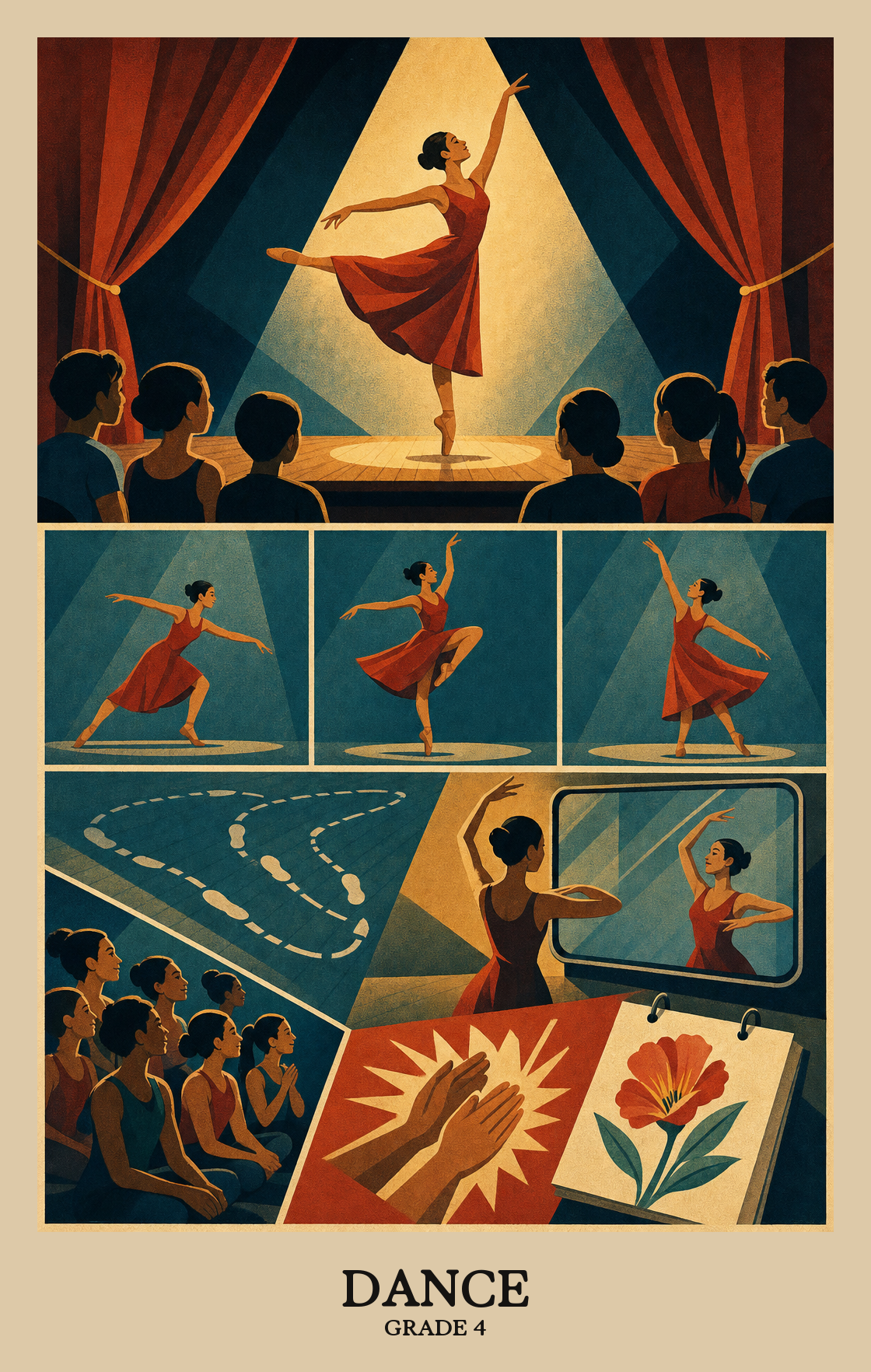
Students start the year turning everyday experiences, stories, and pictures into short movement ideas. Parents may hear them describe a dance they made up about a memory or a place.
Students learn to organize their movements with a clear beginning, middle, and end. They practice choosing which moves to keep, change, or drop so a dance holds together.
Students work on cleaner footwork, balance, and timing so their dances read clearly to an audience. They rehearse with intention and learn what makes a performance feel ready to share.
Students look closely at dances from different cultures and time periods. They describe what they notice, talk about what a dance might mean, and use simple criteria to say what worked and why.
Students connect their own memories and experiences to the dances they create or study. Personal stories become part of the work itself.
Students look at a dance and ask where it came from. They connect the movements to the culture, time period, or community that shaped it.
| Standard | Definition | Code |
|---|---|---|
| Synthesize and relate knowledge and personal experiences to make art | Students connect their own memories and experiences to the dances they create or study. Personal stories become part of the work itself. | DA:Cn10.4 |
| Relate artistic ideas and works with societal, cultural | Students look at a dance and ask where it came from. They connect the movements to the culture, time period, or community that shaped it. | DA:Cn11.4 |
Students brainstorm movement ideas and start shaping them into a dance. They experiment with how the body can move to express a feeling, story, or image.
Students take a rough movement idea and shape it into a finished short dance, making choices about order, timing, and how the piece fits together.
Students review a dance they made, make specific improvements, and bring it to a finished, repeatable form they can perform for others.
| Standard | Definition | Code |
|---|---|---|
| Generate and conceptualize artistic ideas and work | Students brainstorm movement ideas and start shaping them into a dance. They experiment with how the body can move to express a feeling, story, or image. | DA:Cr1.4 |
| Organize and develop artistic ideas and work | Students take a rough movement idea and shape it into a finished short dance, making choices about order, timing, and how the piece fits together. | DA:Cr2.4 |
| Refine and complete artistic work | Students review a dance they made, make specific improvements, and bring it to a finished, repeatable form they can perform for others. | DA:Cr3.4 |
Students choose a dance or movement piece to perform and explain why it fits the moment, the audience, or the idea they want to share.
Students practice and improve a dance piece until it's ready to perform, focusing on how their body moves and how the piece looks to an audience.
Students perform a dance they've rehearsed and think about what feeling or idea the movement is meant to give the audience.
| Standard | Definition | Code |
|---|---|---|
| Analyze, interpret, and select artistic work for presentation | Students choose a dance or movement piece to perform and explain why it fits the moment, the audience, or the idea they want to share. | DA:Pr4.4 |
| Develop and refine artistic techniques and work for presentation | Students practice and improve a dance piece until it's ready to perform, focusing on how their body moves and how the piece looks to an audience. | DA:Pr5.4 |
| Convey meaning through the presentation of artistic work | Students perform a dance they've rehearsed and think about what feeling or idea the movement is meant to give the audience. | DA:Pr6.4 |
Students watch a dance and describe what they notice, from how the dancer moves to how the whole piece is put together.
Students explain what a dance is trying to say and why the choreographer made specific choices, such as a repeated movement or a sudden change in speed.
Students pick a piece of dance and judge it using specific criteria, like whether the movements match the music or tell a clear story. They explain what works and what could be stronger.
| Standard | Definition | Code |
|---|---|---|
| Perceive and analyze artistic work | Students watch a dance and describe what they notice, from how the dancer moves to how the whole piece is put together. | DA:Re7.4 |
| Interpret intent and meaning in artistic work | Students explain what a dance is trying to say and why the choreographer made specific choices, such as a repeated movement or a sudden change in speed. | DA:Re8.4 |
| Apply criteria to evaluate artistic work | Students pick a piece of dance and judge it using specific criteria, like whether the movements match the music or tell a clear story. They explain what works and what could be stronger. | DA:Re9.4 |
Students make up short dances of their own, learn steps and shapes from a teacher, and perform small pieces for classmates. They also watch dances and talk about what the movement seems to be saying. The year mixes creating, performing, and responding to dance.
Push the furniture back and put on a song. Ask students to make up a short movement that shows a feeling or a story, then watch it and say one thing that worked. Five minutes a few times a week is plenty.
No. The goal at this age is not talent. Students are learning to use their body to show ideas, copy steps accurately, and talk about what they see. Curiosity matters more than skill.
A common arc is to start with the basics of body, space, time, and energy, then move into short choreography projects, and finish with a small sharing where students perform and give feedback. Build in time for revision between drafts.
Students can build a short dance with a clear beginning, middle, and end, perform it with focus, and explain the choices they made. They can also watch a peer's dance and give specific feedback using shared words like shape, level, and tempo.
Students link movement to stories, history, and their own lives. A dance might show a scene from a book, a moment from a culture being studied, or a personal memory. These connections give the movement a reason and make it easier to talk about.
Giving useful feedback and revising a dance after it has been made. Students often want to call a first draft finished. Short, repeated cycles of perform, respond, and adjust help more than long single projects.
Ask students to show a short dance they made, then ask why they chose those moves. A student who is ready can answer with specifics, accept a small suggestion, and try the dance again with a change.