Listening and noticing music
Students start the year by listening closely to different kinds of music and describing what they hear. They notice things like fast or slow, loud or soft, and how a song makes them feel.
This is the year music gets more deliberate. Students start making real choices when they sing, play, and compose, picking ideas on purpose and then going back to polish them. They also begin to notice why a piece sounds the way it does and how it connects to a time or place. By spring, students can perform a short piece they helped shape and explain what they were going for.
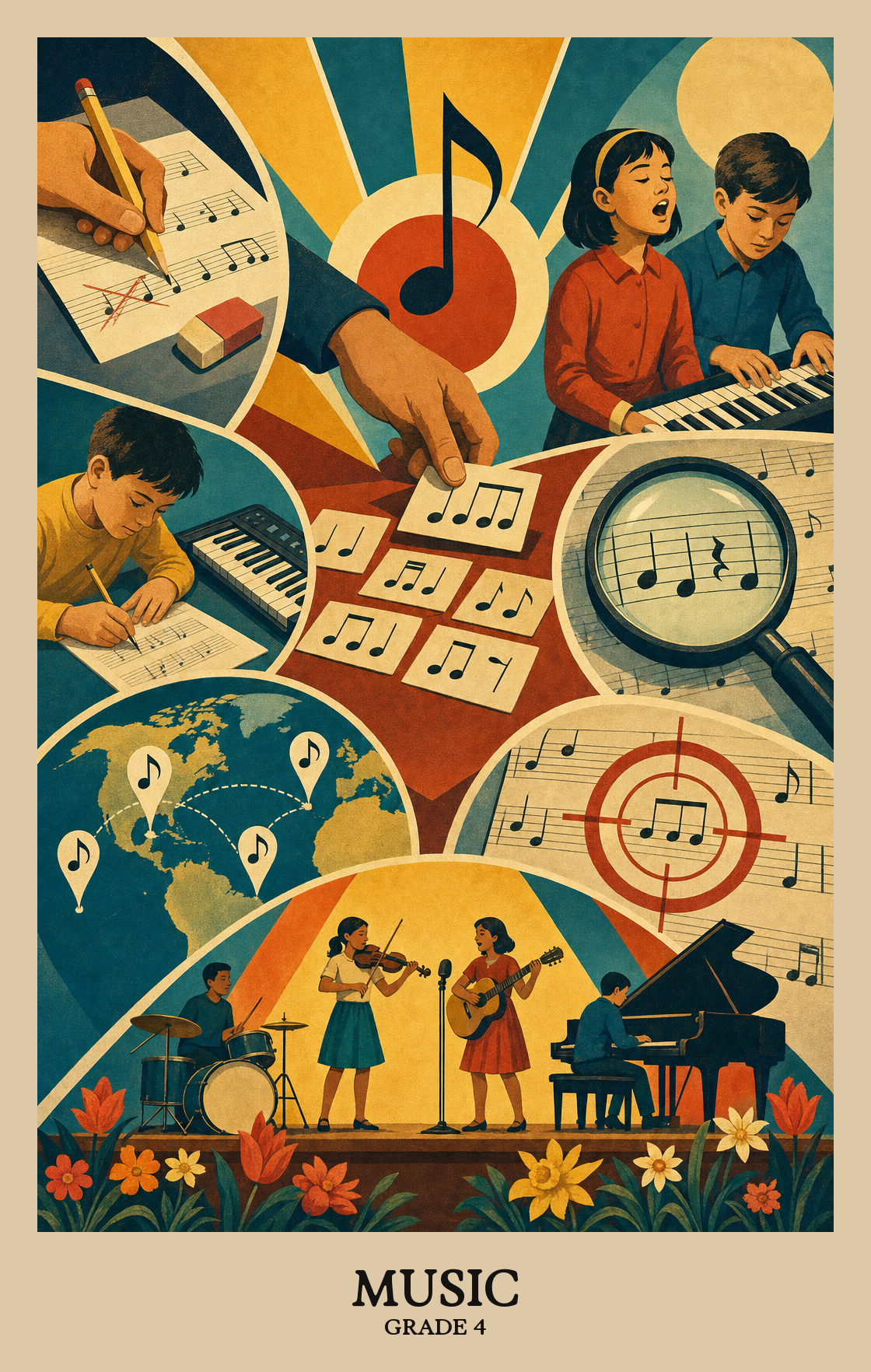
Students start the year by listening closely to different kinds of music and describing what they hear. They notice things like fast or slow, loud or soft, and how a song makes them feel.
Students try out their own musical ideas using voices, instruments, or simple rhythms. They play with patterns and pick the ones they like best to keep working on.
Students take a rough idea and turn it into something worth performing. They practice the tricky parts, decide what they want the audience to feel, and clean up the rough edges.
Students perform pieces alone or with classmates and think about why they chose them. They focus on playing or singing clearly and showing the mood of the music.
Students connect songs to where they come from and the people who made them. They talk about how music fits into holidays, history, and daily life, and what makes a piece work well.
Students connect what they already know and have lived through to the music they create or perform. Personal experience shapes the choices they make as young musicians.
Students look at a song or piece of music and ask where it came from: what country, time period, or community shaped it. That context helps explain why the music sounds the way it does.
| Standard | Definition | Code |
|---|---|---|
| Synthesize and relate knowledge and personal experiences to make art | Students connect what they already know and have lived through to the music they create or perform. Personal experience shapes the choices they make as young musicians. | MU:Cn10.4 |
| Relate artistic ideas and works with societal, cultural | Students look at a song or piece of music and ask where it came from: what country, time period, or community shaped it. That context helps explain why the music sounds the way it does. | MU:Cn11.4 |
Students come up with original musical ideas, like inventing a simple melody or rhythm pattern, and start shaping those ideas into something they could perform or share.
Students take a musical idea, such as a short melody or rhythm pattern, and shape it into something more complete by arranging the parts in an order that makes sense.
Students revisit a piece of music they composed, make changes to improve it, and prepare a finished version to share.
| Standard | Definition | Code |
|---|---|---|
| Generate and conceptualize artistic ideas and work | Students come up with original musical ideas, like inventing a simple melody or rhythm pattern, and start shaping those ideas into something they could perform or share. | MU:Cr1.4 |
| Organize and develop artistic ideas and work | Students take a musical idea, such as a short melody or rhythm pattern, and shape it into something more complete by arranging the parts in an order that makes sense. | MU:Cr2.4 |
| Refine and complete artistic work | Students revisit a piece of music they composed, make changes to improve it, and prepare a finished version to share. | MU:Cr3.4 |
Students choose a piece of music to perform and explain why it fits the moment, the audience, or the mood they want to create.
Students practice a piece of music repeatedly to fix mistakes and improve tone, rhythm, and expression before performing it for an audience.
Students perform a song or piece with a clear purpose in mind, making choices about dynamics, tone, and expression so the music feels intentional to the audience.
| Standard | Definition | Code |
|---|---|---|
| Analyze, interpret, and select artistic work for presentation | Students choose a piece of music to perform and explain why it fits the moment, the audience, or the mood they want to create. | MU:Pr4.4 |
| Develop and refine artistic techniques and work for presentation | Students practice a piece of music repeatedly to fix mistakes and improve tone, rhythm, and expression before performing it for an audience. | MU:Pr5.4 |
| Convey meaning through the presentation of artistic work | Students perform a song or piece with a clear purpose in mind, making choices about dynamics, tone, and expression so the music feels intentional to the audience. | MU:Pr6.4 |
Students listen to a piece of music and describe what they notice: the rhythm, the instruments, how the mood shifts. Then they explain what makes it work.
Students listen to a piece of music and explain what the composer or performer was trying to express, using details from the music itself to support their thinking.
Students listen to a piece of music and use specific criteria to judge what makes it work well or fall short. They explain their thinking with reasons tied to what they actually heard.
| Standard | Definition | Code |
|---|---|---|
| Perceive and analyze artistic work | Students listen to a piece of music and describe what they notice: the rhythm, the instruments, how the mood shifts. Then they explain what makes it work. | MU:Re7.4 |
| Interpret intent and meaning in artistic work | Students listen to a piece of music and explain what the composer or performer was trying to express, using details from the music itself to support their thinking. | MU:Re8.4 |
| Apply criteria to evaluate artistic work | Students listen to a piece of music and use specific criteria to judge what makes it work well or fall short. They explain their thinking with reasons tied to what they actually heard. | MU:Re9.4 |
Students sing, play simple instruments, read basic rhythms and notes, and make up short pieces of their own. They also listen to music from different times and places and talk about what they hear. By the end of the year, students can perform a piece, explain choices they made, and give thoughtful feedback to others.
Play music together in the car or kitchen and ask what stands out: the beat, the mood, the loud and quiet parts. Clap rhythms back and forth, or have students sing a favorite song and tap a steady beat. Five minutes a few times a week builds the same skills used in class.
No. At this age, music class is about steady practice, not talent. Singing in the car, drumming on a table, or making up silly songs all count. Praise the effort and the trying out of ideas, not just the finished sound.
Not really. Voice, clapping, and household objects work fine for what students practice this year. If there is a keyboard, recorder, or ukulele around, encourage short tries rather than long sessions. A quiet space to sing or tap without being teased matters more than any instrument.
Start with steady beat, simple rhythms, and singing in tune, then layer in reading notes on the staff and basic form. Bring composing in once students have a small set of rhythms and pitches to work with. Save longer performance pieces and peer feedback for the back half of the year, when students have the vocabulary to talk about choices.
Keeping a steady beat under a changing rhythm, matching pitch in a group, and reading rhythms with rests tend to slip. Build in short warm-ups every class rather than full reteach days. Composing also stalls when students have too many choices, so give tight limits at first.
Students use simple criteria like steady beat, clear tone, and matching the mood of the piece. They practice saying what worked and what could change, using specific moments in the music. Modeling the language early in the year makes peer feedback much more useful by spring.
Pair songs with the time or place students are studying in social studies, and talk about why people made that music. Use math links for rhythm and fractions, and reading links for lyrics and story songs. A short discussion each unit is enough to make the connection stick.
By spring, students should keep a steady beat, sing a familiar song in tune, read simple rhythms, and perform a short piece for others. They should also be able to say one thing they like about a piece of music and one thing they would change. If those feel comfortable, they are ready.