Healthy habits at home and school
Students start the year learning what keeps bodies and minds well. They look at sleep, food, handwashing, and exercise, and notice how daily choices add up over a week.
These are the years health class shifts from simple rules like washing hands to thinking through choices on their own. Students learn how friends, family, and ads sway what they eat, watch, and do, and they practice talking through problems with words instead of fists or silence. They start setting small goals, like drinking more water or getting to bed earlier, and tracking how it goes. By spring, students can walk through a decision step by step and explain where to find trustworthy health information.
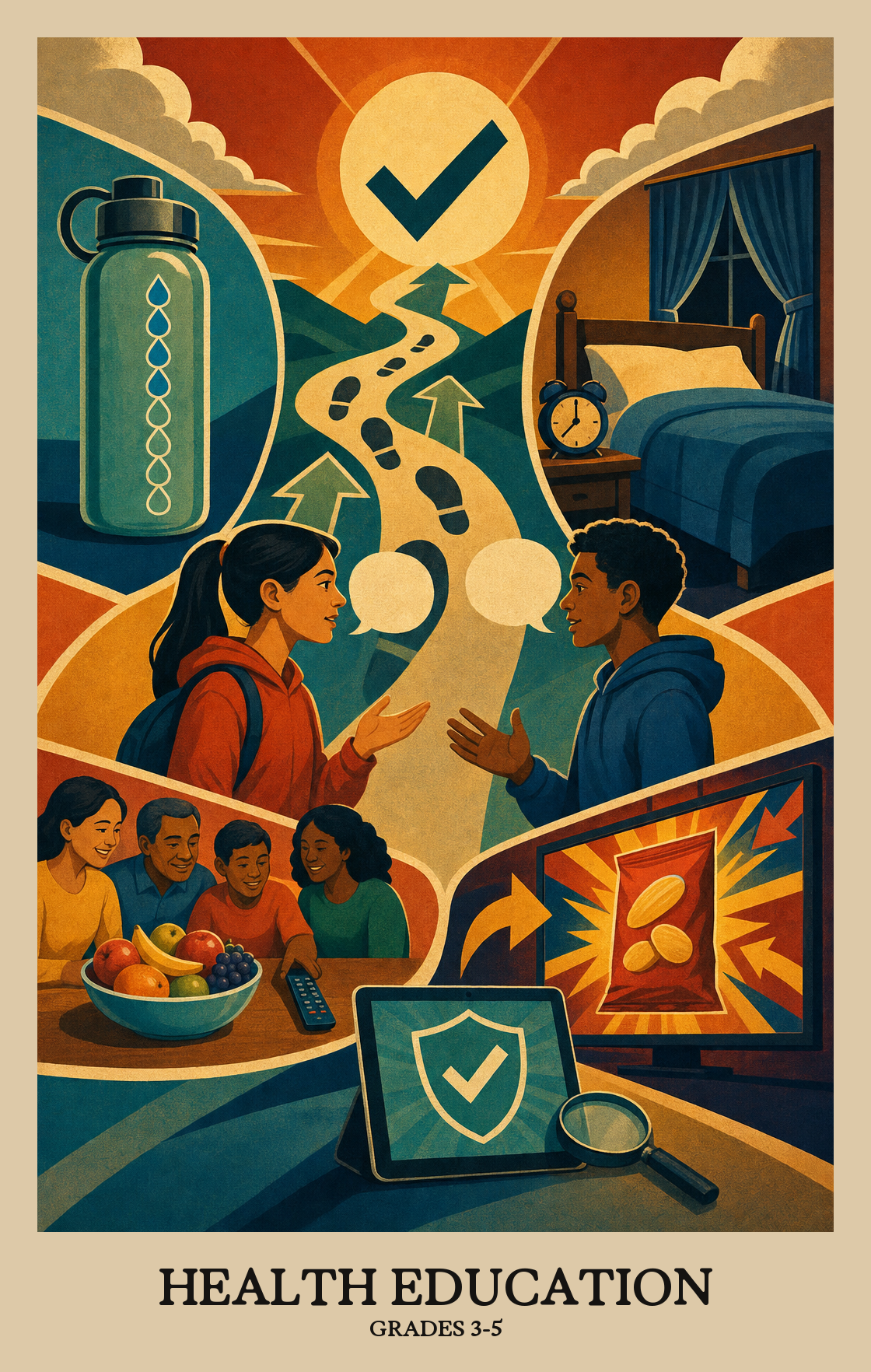
Students start the year learning what keeps bodies and minds well. They look at sleep, food, handwashing, and exercise, and notice how daily choices add up over a week.
Students look at the people and messages around them, from family and friends to ads and screens. They start to notice how those influences nudge what they eat, watch, and do.
Students learn where to go when they have a health question or a worry. They practice telling a reliable source, like a parent, nurse, or doctor, from a shaky one online.
Students practice the words for asking for help, saying no, and working through a disagreement. They walk through small decisions step by step instead of guessing.
Students set a small health goal, like drinking more water or getting to bed on time, and track how it goes. They also practice speaking up for safer, healthier choices for themselves and classmates.
Students take basic health facts (like how germs spread or why sleep matters) and use them to make real choices that keep themselves and the people around them healthy.
Students look at what shapes their health choices, like ads, friends, family, and habits, and think about whether those influences are helping or hurting them and the people around them.
Students learn to find trustworthy sources of health information, like a school nurse, a doctor, or a reliable website. They practice using those sources to answer real health questions for themselves and others.
Students practice the conversations that keep them and the people around them healthier. That means asking for help, saying no to risky situations, and listening when a friend is struggling.
Students practice a step-by-step process for making choices about their health, like deciding what to eat, how to handle stress, or how to respond when a friend is making an unhealthy choice.
Students pick a health goal, break it into steps, and track their progress. They also think about how reaching that goal can help the people around them.
Students practice real health habits, like washing hands, getting enough sleep, or helping a friend make a safe choice. The focus is on actions students can take every day to stay well and look out for others.
Students learn to speak up for healthy choices, for themselves and the people around them. That might mean encouraging a friend to get enough sleep or asking an adult for help when something feels unsafe.
| Standard | Definition | Code |
|---|---|---|
| Use functional knowledge of health concepts to support health and well-being of… Grades 3-5 | Students take basic health facts (like how germs spread or why sleep matters) and use them to make real choices that keep themselves and the people around them healthy. | DE-HE.1.3-5 |
| Analyze influences that affect health and well-being of self and others Grades 3-5 | Students look at what shapes their health choices, like ads, friends, family, and habits, and think about whether those influences are helping or hurting them and the people around them. | DE-HE.2.3-5 |
| Access valid and reliable resources to support health and well-being of self… Grades 3-5 | Students learn to find trustworthy sources of health information, like a school nurse, a doctor, or a reliable website. They practice using those sources to answer real health questions for themselves and others. | DE-HE.3.3-5 |
| Use interpersonal communication skills to support health and well-being of self… Grades 3-5 | Students practice the conversations that keep them and the people around them healthier. That means asking for help, saying no to risky situations, and listening when a friend is struggling. | DE-HE.4.3-5 |
| Use a decision-making process to support health and well-being of self and… Grades 3-5 | Students practice a step-by-step process for making choices about their health, like deciding what to eat, how to handle stress, or how to respond when a friend is making an unhealthy choice. | DE-HE.5.3-5 |
| Use a goal-setting process to support health and well-being of self and others Grades 3-5 | Students pick a health goal, break it into steps, and track their progress. They also think about how reaching that goal can help the people around them. | DE-HE.6.3-5 |
| Demonstrate practices and behaviors to support health and well-being of self… Grades 3-5 | Students practice real health habits, like washing hands, getting enough sleep, or helping a friend make a safe choice. The focus is on actions students can take every day to stay well and look out for others. | DE-HE.7.3-5 |
| Advocate to promote health and well-being of self and others Grades 3-5 | Students learn to speak up for healthy choices, for themselves and the people around them. That might mean encouraging a friend to get enough sleep or asking an adult for help when something feels unsafe. | DE-HE.8.3-5 |
Students learn habits that keep their bodies and minds well, like eating, sleep, exercise, hygiene, and getting along with others. They also start spotting how friends, family, and screens shape their choices. The focus is on real situations students face every day.
Talk through small daily choices out loud: what is for breakfast, how much sleep students got, how they handled a tough moment with a friend. Five minutes at dinner or bedtime is enough. Hearing an adult think through a choice teaches students to do the same.
Start with the functional knowledge under standard one, then layer in influences, resources, and communication as students gain vocabulary. Save decision-making, goal-setting, and advocacy for later units when students can apply earlier skills. Each unit should end with students doing something, not just listing facts.
Students should name habits that support their health, find a trusted adult or reliable source when they have a question, and talk through a choice before making it. They should also be able to set a small health goal and track it over a week or two.
Keep questions short and specific. Instead of asking how school went, ask who they sat with at lunch or what made them frustrated today. Naming the feeling is the first step, and students often open up more during a walk or car ride than face to face.
Decision-making and accessing reliable resources tend to lag. Students can list steps but freeze when a real situation comes up, and many default to the first website or video they see. Build in short practice scenarios across units instead of saving them for one lesson.
Use short performance tasks tied to standards seven and eight: a goal log, a role-play of a tough conversation, a poster that advocates for a habit. These show whether students can apply what they know. Save written checks for vocabulary and core concepts.
Yes, under the influences and decision-making standards. Students look at how ads, games, and group chats shape what they want, eat, and believe about themselves. At home, ask what they saw online today and what they thought about it.