Pretending and playing characters
Students start the year by playing pretend on purpose. They take on simple roles like a parent, a puppy, or a firefighter, and use their own experiences to bring the character to life.
This is the year pretending becomes a shared activity. Students step into characters, act out simple stories, and use their voices and bodies to show how someone feels. They build short scenes with classmates and try ideas more than once to make them better. By spring, students can take on a role in a class story and talk about what happened and why a character acted that way.
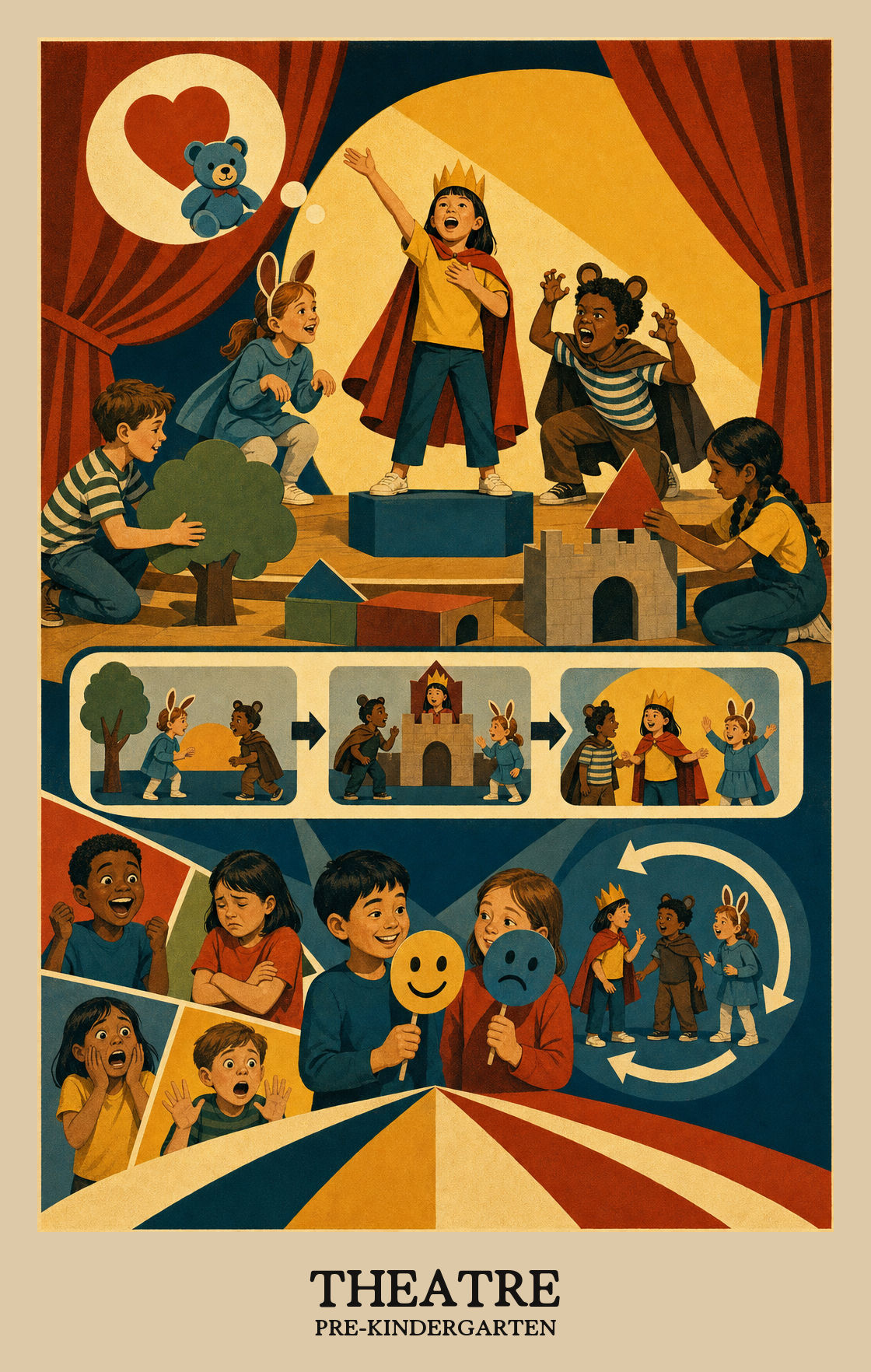
Students start the year by playing pretend on purpose. They take on simple roles like a parent, a puppy, or a firefighter, and use their own experiences to bring the character to life.
Students invent short story ideas with classmates. They decide who the characters are, where the story happens, and what happens next, often using puppets, props, or dress-up clothes.
Students take a story idea and work on it more than once. They try different voices, movements, and endings, and start to notice what makes a scene clearer or funnier for the audience.
Students perform a short scene or story for classmates or family. They practice speaking so others can hear them and remember what happens first, next, and last.
Students watch classmates perform and sometimes a short play or puppet show. They talk about what they saw, how it made them feel, and what they liked best.
Students connect something from their own life, like a pet, a trip, or a feeling, to a character or story they act out. Real memories make the pretend play richer.
Students connect what they see in a play or performance to their own lives and experiences. Sharing what a story reminds them of helps them understand art and each other.
| Standard | Definition | Code |
|---|---|---|
| Synthesize and relate knowledge and personal experiences to make art | Students connect something from their own life, like a pet, a trip, or a feeling, to a character or story they act out. Real memories make the pretend play richer. | TH:Cn10.pk |
| Relate artistic ideas and works with societal, cultural | Students connect what they see in a play or performance to their own lives and experiences. Sharing what a story reminds them of helps them understand art and each other. | TH:Cn11.pk |
Students practice coming up with ideas for pretend play and simple stories, choosing characters, places, and basic plot details to act out.
Students use play and imagination to build a simple story or scene, choosing who the characters are and what happens next.
Students practice a short scene or song more than once, then decide when it feels ready to share.
| Standard | Definition | Code |
|---|---|---|
| Generate and conceptualize artistic ideas and work | Students practice coming up with ideas for pretend play and simple stories, choosing characters, places, and basic plot details to act out. | TH:Cr1.pk |
| Organize and develop artistic ideas and work | Students use play and imagination to build a simple story or scene, choosing who the characters are and what happens next. | TH:Cr2.pk |
| Refine and complete artistic work | Students practice a short scene or song more than once, then decide when it feels ready to share. | TH:Cr3.pk |
Students choose a character or action to act out and practice showing it to others. This is the start of learning how to prepare and share a performance.
Students practice a song, movement, or short scene more than once to get it ready to share with others.
Students act out a character or story for others to watch, using voice, movement, and expression to show what the story means.
| Standard | Definition | Code |
|---|---|---|
| Analyze, interpret, and select artistic work for presentation | Students choose a character or action to act out and practice showing it to others. This is the start of learning how to prepare and share a performance. | TH:Pr4.pk |
| Develop and refine artistic techniques and work for presentation | Students practice a song, movement, or short scene more than once to get it ready to share with others. | TH:Pr5.pk |
| Convey meaning through the presentation of artistic work | Students act out a character or story for others to watch, using voice, movement, and expression to show what the story means. | TH:Pr6.pk |
Students look at a short play or puppet show and talk about what they noticed, what happened, and how it made them feel.
Students look at a scene or puppet show and say what they think the character is feeling or doing. They start to notice that choices in a performance, like a costume or a voice, tell part of the story.
Students look at a classmate's drawing or performance and say what they liked and why. They start learning that opinions about art can be explained with a reason.
| Standard | Definition | Code |
|---|---|---|
| Perceive and analyze artistic work | Students look at a short play or puppet show and talk about what they noticed, what happened, and how it made them feel. | TH:Re7.pk |
| Interpret intent and meaning in artistic work | Students look at a scene or puppet show and say what they think the character is feeling or doing. They start to notice that choices in a performance, like a costume or a voice, tell part of the story. | TH:Re8.pk |
| Apply criteria to evaluate artistic work | Students look at a classmate's drawing or performance and say what they liked and why. They start learning that opinions about art can be explained with a reason. | TH:Re9.pk |
Most of the work is pretend play. Students act out stories, take on characters like a parent or a puppy, and use their voices and bodies to show feelings. There is no script to memorize and no stage to manage.
Play pretend together for ten minutes a day. Act out a favorite story, use stuffed animals as characters, or put on a silly voice for the wolf or the bear. Ask what the character is feeling and why.
The goal is not acting talent. Pretend play helps students try on feelings, practice listening, and tell a story with a beginning and an end. Those same skills show up later in reading, writing, and getting along with classmates.
Start with simple imitation and pretend play in the fall, like moving like a cat or talking like a giant. Move into short story dramatizations by winter. By spring, students can plan a short scene with a partner and share it with the class.
Students can take on a pretend role, stay in it for a short scene, and use voice and body to show a feeling. They can also watch a classmate perform and say something they noticed or liked.
Skip the audience and just play. Sit on the floor and act out a story with two stuffed animals, or trade silly voices in the car. Confidence in front of others comes later, after lots of low-pressure pretend time.
Pick familiar tales and folk stories from the families in the class and act them out. Talk about where the story comes from and who tells it. This builds the habit of linking a performance to real people and places.
Keep prompts concrete and kind. Ask what a classmate did with their voice, face, or body, and what feeling that showed. Two or three quick observations after a scene is plenty at this age.