Building the ensemble
Students start the year learning to work as a theatre group. They try out warm-ups, improv games, and short scenes, and begin pulling from their own experiences to shape characters.
This is the year theatre work gets more deliberate. Students build characters from their own experiences and from the time and place a story comes from, then shape scenes through real rehearsal choices about voice, body, and staging. They learn to talk about a performance with specific reasons, not just whether they liked it. By spring, students can rehearse a scene, perform it for an audience, and explain the choices behind it.
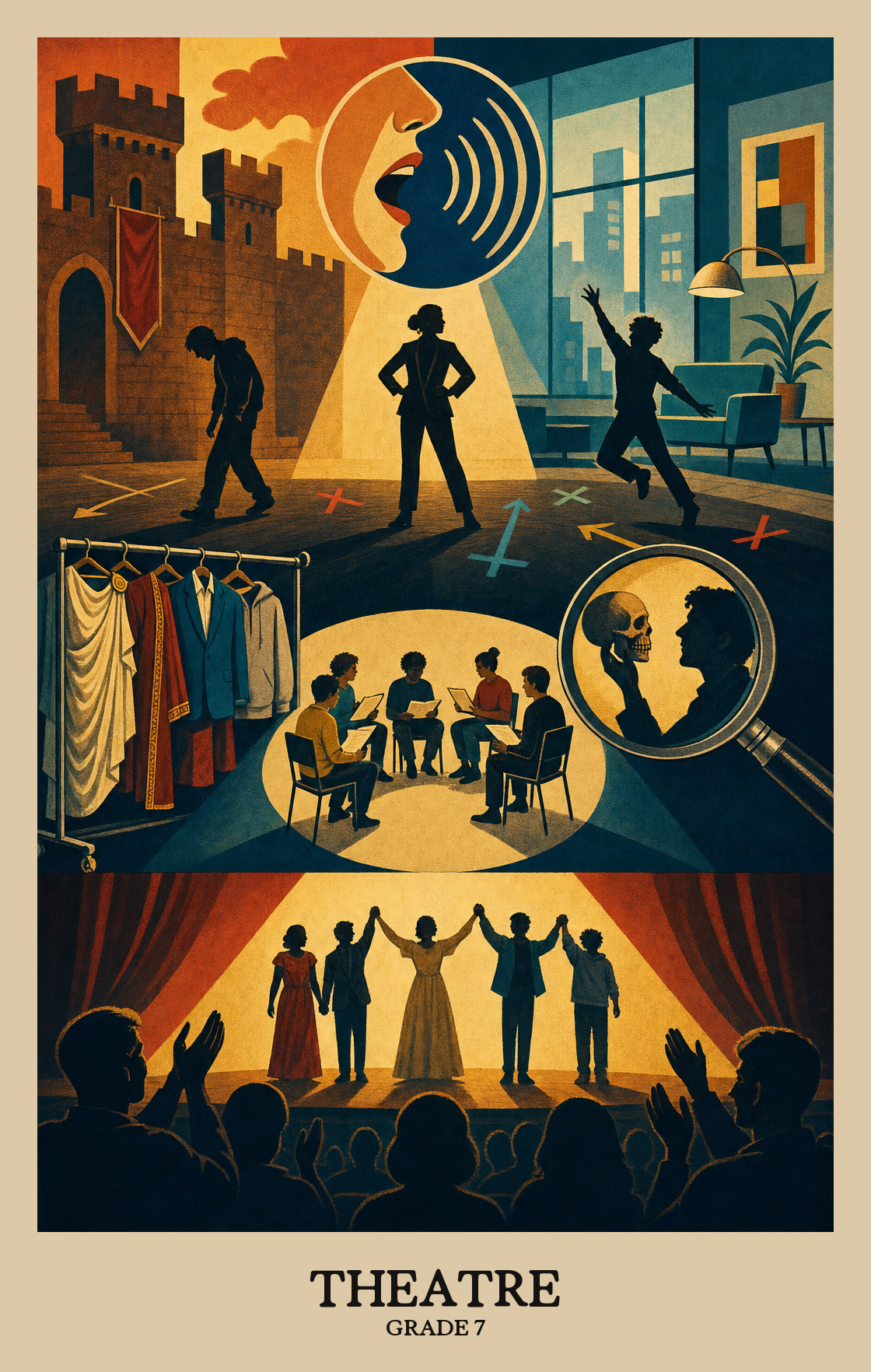
Students start the year learning to work as a theatre group. They try out warm-ups, improv games, and short scenes, and begin pulling from their own experiences to shape characters.
Students move from quick exercises to scenes they plan out. They draft ideas, choose what to keep, and revise the story so it makes sense to an audience.
Students focus on the craft of performing. They practice voice, movement, and choices about where to stand and how to react, and they pick which pieces are ready to show.
Students read and watch plays from different times and places. They look at what the writer was responding to and connect those ideas to their own lives and community.
Students bring a piece to performance and then talk about the work. They learn to give specific feedback to classmates using clear criteria instead of just saying what they liked.
Students draw on their own memories and outside knowledge to shape the choices they make in a scene or performance. Personal experience becomes raw material for the work.
Students look at a play or performance and ask where it came from: what was happening in the world, who made it, and why it mattered then. That context changes how the work reads today.
| Standard | Definition | Code |
|---|---|---|
| Synthesize and relate knowledge and personal experiences to make art | Students draw on their own memories and outside knowledge to shape the choices they make in a scene or performance. Personal experience becomes raw material for the work. | TH:Cn10.7 |
| Relate artistic ideas and works with societal, cultural | Students look at a play or performance and ask where it came from: what was happening in the world, who made it, and why it mattered then. That context changes how the work reads today. | TH:Cn11.7 |
Students brainstorm and develop original ideas for a theatre piece, experimenting with character, story, and setting before committing to a direction.
Students take a rough idea for a scene or character and shape it into something stageable, making choices about dialogue, movement, and setting until the piece holds together.
Students revisit a scene or script they've drafted, then revise the dialogue, staging, or character choices until the piece is ready to perform or share.
| Standard | Definition | Code |
|---|---|---|
| Generate and conceptualize artistic ideas and work | Students brainstorm and develop original ideas for a theatre piece, experimenting with character, story, and setting before committing to a direction. | TH:Cr1.7 |
| Organize and develop artistic ideas and work | Students take a rough idea for a scene or character and shape it into something stageable, making choices about dialogue, movement, and setting until the piece holds together. | TH:Cr2.7 |
| Refine and complete artistic work | Students revisit a scene or script they've drafted, then revise the dialogue, staging, or character choices until the piece is ready to perform or share. | TH:Cr3.7 |
Students pick a scene or monologue to perform and explain why it suits their skills and the story they want to tell.
Students practice and improve their acting, movement, and vocal choices to get a scene or performance ready to share with an audience.
Students perform a scene or monologue with a clear purpose, making deliberate choices about voice, movement, and focus so the audience understands what the piece is about.
| Standard | Definition | Code |
|---|---|---|
| Analyze, interpret, and select artistic work for presentation | Students pick a scene or monologue to perform and explain why it suits their skills and the story they want to tell. | TH:Pr4.7 |
| Develop and refine artistic techniques and work for presentation | Students practice and improve their acting, movement, and vocal choices to get a scene or performance ready to share with an audience. | TH:Pr5.7 |
| Convey meaning through the presentation of artistic work | Students perform a scene or monologue with a clear purpose, making deliberate choices about voice, movement, and focus so the audience understands what the piece is about. | TH:Pr6.7 |
Students watch or read a scene and explain what choices the playwright or actor made, and why those choices shape how the story feels.
Students analyze a scene or performance to explain what the playwright or director was trying to say and why specific choices, like lighting, blocking, or dialogue, support that meaning.
Students judge a scene or performance against a clear set of criteria, explaining what worked, what didn't, and why, using specific details from what they watched or performed.
| Standard | Definition | Code |
|---|---|---|
| Perceive and analyze artistic work | Students watch or read a scene and explain what choices the playwright or actor made, and why those choices shape how the story feels. | TH:Re7.7 |
| Interpret intent and meaning in artistic work | Students analyze a scene or performance to explain what the playwright or director was trying to say and why specific choices, like lighting, blocking, or dialogue, support that meaning. | TH:Re8.7 |
| Apply criteria to evaluate artistic work | Students judge a scene or performance against a clear set of criteria, explaining what worked, what didn't, and why, using specific details from what they watched or performed. | TH:Re9.7 |
Students build scenes from their own ideas, rehearse them, and perform for classmates. They also watch plays and short clips, then talk about what worked and why. Expect a mix of acting, writing, designing, and giving feedback.
Start small. Read a short scene out loud together and trade parts. Ask what the character wants and how their voice or face might show it. Five minutes of low-stakes practice at the kitchen table builds more confidence than a big rehearsal.
A common arc is to start with ensemble and improv, move into scene work and character building, then spend the back half on a longer rehearsed piece. Weave in viewing and written response throughout so analysis grows alongside performance.
There is real writing. Students draft short scenes, write character notes, and respond to plays they watch. Strong writing usually leads to stronger performances because the ideas behind the scene are clearer.
Giving specific feedback and revising a scene based on it. Students often jump to opinion before evidence. Teaching a simple structure for what they noticed and what they suggest pays off across every unit.
Be the audience and the line reader. Ask one question after a run-through: what is this character trying to get? Avoid directing. The point is to give students a safe room to try things out loud.
By spring, students should be able to develop a character from a script, take a scene through rehearsal and revision, and write a short response that uses evidence from a performance. Comfort with collaboration matters as much as stage skill.
Sometimes. For short scenes and final performances, memorization is usually expected. For early drafts and improv work, scripts in hand are fine. Running lines in the car or before bed for a few minutes is the easiest way to help.