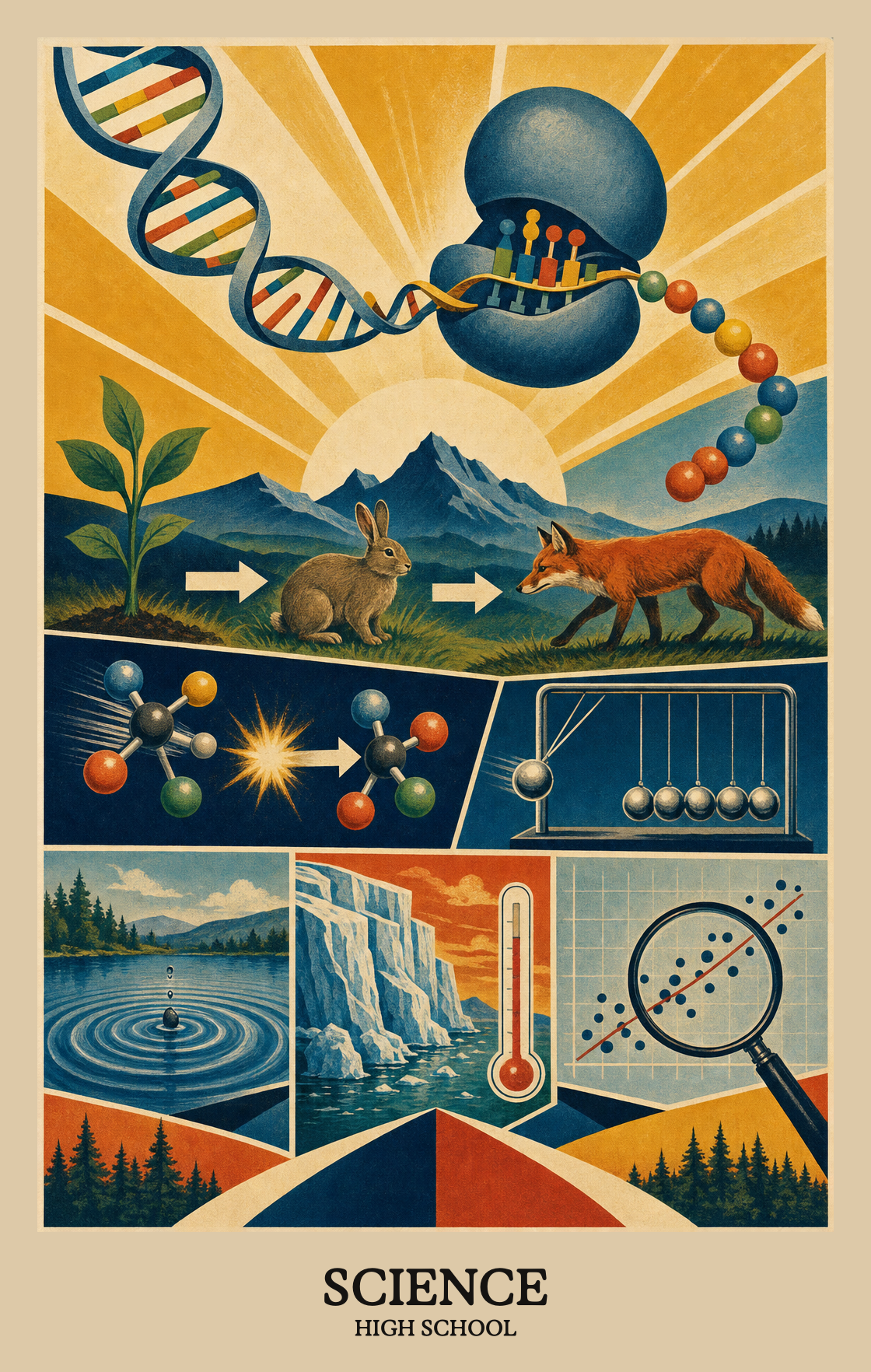
High school is when science stops being a tour of topics and starts asking students to build explanations from evidence. Students trace how DNA codes for proteins, how energy moves through ecosystems, how atoms bond and react, and how forces and waves behave. They also study the bigger picture, from the life of a star to climate change on Earth. By spring, students can read a graph, weigh the evidence behind a claim, and explain a real scientific idea in their own words.
How the year usually goes. Every school and district set their own curriculum, so treat this as a guide, not official pacing.
1
Matter and the atom
Students start with the building blocks of everything around them. They use the periodic table to predict how elements behave, track what happens during chemical reactions, and explain why some materials hold together more tightly than others.
2
Forces, motion, and energy
Students move into physics. They use math to describe how objects push, pull, speed up, and collide, and they follow energy as it shifts from one form to another in circuits, collisions, and everyday devices.
3
Waves, light, and information
Students study how waves carry energy and information through phones, lenses, and the light we see. They compare wave and particle ideas about light and look at how everyday technology sends and stores data.
4
Cells, genetics, and inheritance
Students dig into how living things work at the smallest scale. They trace how DNA shapes proteins, how cells divide and specialize, and how traits pass from parents to children with variation along the way.
5
Ecosystems and evolution
Students zoom out to populations and habitats. They use data and math to study how matter and energy move through ecosystems, why populations rise and fall, and how natural selection shapes species over long stretches of time.
6
Earth, space, and human impact
Students end the year with the big picture. They study the life of stars, the history of Earth, and the systems that drive weather and climate, then weigh real design choices about energy, resources, and protecting the planet.
Mastery Learning Standards
The required skills a student should display by the end of Grade 11.
Students build a model showing how nuclear fusion in the Sun's core generates energy that travels to Earth as light and heat, then use that model to explain where the Sun sits in its roughly 10-billion-year life.
Students explain the Big Bang theory using real astronomical evidence: the way distant galaxies are moving apart, the light spectra from stars, and what matter in the universe is made of.
Stars act as element factories, fusing hydrogen into heavier atoms like carbon and iron over billions of years. Students explain how those elements scatter into space when a star dies, eventually forming new stars, planets, and everything on Earth.
Students use math to predict where planets, moons, and other objects will be in their orbits. They apply equations that describe gravity and motion to calculate future positions in the solar system.
Students look at rock ages and locations across continents and ocean floors to piece together how Earth's crust has shifted over millions of years. The goal is to explain why rocks in different places formed when they did.
Students use evidence from ancient rocks, meteorites, and the surfaces of other planets to piece together how Earth formed and what its earliest history looked like.
Students explain why the moon's phases, eclipses, tides, and seasons repeat on predictable schedules. They use real evidence to show that Earth, the moon, and the sun move in regular patterns that drive each cycle.
Students build and explain a model showing how slow processes deep inside Earth and faster ones at the surface, like eruptions or erosion, work together over millions of years to shape mountain ranges, ocean trenches, and ocean floors.
Students design and run experiments to see how water behaves and how it shapes the land around us, wearing down rock, moving soil, and carving the features we see on Earth's surface.
Students build a model using real numbers to track how carbon moves between the ocean, air, rocks, and living things. The model shows how much carbon shifts between each part of Earth's system and why those flows matter for climate.
Students build a written argument explaining how life and Earth's environment have shaped each other over billions of years. Think volcanoes changing the atmosphere, or organisms producing the oxygen we breathe today.
Students study weather maps and data to explain why storms form, temperatures drop, or skies clear. The focus is on how colliding air masses, like a cold front pushing into warm air, drive the weather changes people see day to day.
Students gather evidence to explain how natural resources, natural hazards, and climate shifts have shaped where and how people live, work, and build communities over time.
Students compare real proposals for mining or energy development, weighing what each plan costs against what it delivers. The goal is to judge which option does the most good with the least harm or expense.
Students build a working computer model that shows how decisions about land, water, or energy use ripple into population growth and wildlife diversity. Change one variable and watch the rest shift.
Students look at a real design (a water filter, a carbon capture system, a wetland buffer) and judge whether it actually reduces harm to the environment, then suggest how to make it work better.
Students study real climate data and computer model results to predict how quickly Earth's climate is changing and what that means for sea levels, storms, ecosystems, and other Earth systems.
Standard
Definition
Code
How the Sun makes and sends energy
High School
Students build a model showing how nuclear fusion in the Sun's core generates energy that travels to Earth as light and heat, then use that model to explain where the Sun sits in its roughly 10-billion-year life.
Students explain the Big Bang theory using real astronomical evidence: the way distant galaxies are moving apart, the light spectra from stars, and what matter in the universe is made of.
Stars act as element factories, fusing hydrogen into heavier atoms like carbon and iron over billions of years. Students explain how those elements scatter into space when a star dies, eventually forming new stars, planets, and everything on Earth.
Students use math to predict where planets, moons, and other objects will be in their orbits. They apply equations that describe gravity and motion to calculate future positions in the solar system.
Students look at rock ages and locations across continents and ocean floors to piece together how Earth's crust has shifted over millions of years. The goal is to explain why rocks in different places formed when they did.
Students use evidence from ancient rocks, meteorites, and the surfaces of other planets to piece together how Earth formed and what its earliest history looked like.
Students explain why the moon's phases, eclipses, tides, and seasons repeat on predictable schedules. They use real evidence to show that Earth, the moon, and the sun move in regular patterns that drive each cycle.
Students build and explain a model showing how slow processes deep inside Earth and faster ones at the surface, like eruptions or erosion, work together over millions of years to shape mountain ranges, ocean trenches, and ocean floors.
Students design and run experiments to see how water behaves and how it shapes the land around us, wearing down rock, moving soil, and carving the features we see on Earth's surface.
Students build a model using real numbers to track how carbon moves between the ocean, air, rocks, and living things. The model shows how much carbon shifts between each part of Earth's system and why those flows matter for climate.
Students build a written argument explaining how life and Earth's environment have shaped each other over billions of years. Think volcanoes changing the atmosphere, or organisms producing the oxygen we breathe today.
Students study weather maps and data to explain why storms form, temperatures drop, or skies clear. The focus is on how colliding air masses, like a cold front pushing into warm air, drive the weather changes people see day to day.
Students gather evidence to explain how natural resources, natural hazards, and climate shifts have shaped where and how people live, work, and build communities over time.
Students compare real proposals for mining or energy development, weighing what each plan costs against what it delivers. The goal is to judge which option does the most good with the least harm or expense.
Students build a working computer model that shows how decisions about land, water, or energy use ripple into population growth and wildlife diversity. Change one variable and watch the rest shift.
Students look at a real design (a water filter, a carbon capture system, a wetland buffer) and judge whether it actually reduces harm to the environment, then suggest how to make it work better.
Students study real climate data and computer model results to predict how quickly Earth's climate is changing and what that means for sea levels, storms, ecosystems, and other Earth systems.
Students build a model showing how nuclear fusion in the Sun's core generates energy that travels to Earth as light and heat, then use that model to explain where the Sun sits in its roughly 10-billion-year life.
Students explain the Big Bang theory using real astronomical evidence: the way distant galaxies are moving apart, the light spectra from stars, and what matter in the universe is made of.
Stars act as element factories, fusing hydrogen into heavier atoms like carbon and iron over billions of years. Students explain how those elements scatter into space when a star dies, eventually forming new stars, planets, and everything on Earth.
Students use math to predict where planets, moons, and other objects will be in their orbits. They apply equations that describe gravity and motion to calculate future positions in the solar system.
Students look at rock ages and locations across continents and ocean floors to piece together how Earth's crust has shifted over millions of years. The goal is to explain why rocks in different places formed when they did.
Students use evidence from ancient rocks, meteorites, and the surfaces of other planets to piece together how Earth formed and what its earliest history looked like.
Students explain why the moon's phases, eclipses, tides, and seasons repeat on predictable schedules. They use real evidence to show that Earth, the moon, and the sun move in regular patterns that drive each cycle.
Students build and explain a model showing how slow processes deep inside Earth and faster ones at the surface, like eruptions or erosion, work together over millions of years to shape mountain ranges, ocean trenches, and ocean floors.
Students design and run experiments to see how water behaves and how it shapes the land around us, wearing down rock, moving soil, and carving the features we see on Earth's surface.
Students build a model using real numbers to track how carbon moves between the ocean, air, rocks, and living things. The model shows how much carbon shifts between each part of Earth's system and why those flows matter for climate.
Students build a written argument explaining how life and Earth's environment have shaped each other over billions of years. Think volcanoes changing the atmosphere, or organisms producing the oxygen we breathe today.
Students study weather maps and data to explain why storms form, temperatures drop, or skies clear. The focus is on how colliding air masses, like a cold front pushing into warm air, drive the weather changes people see day to day.
Students gather evidence to explain how natural resources, natural hazards, and climate shifts have shaped where and how people live, work, and build communities over time.
Students compare real proposals for mining or energy development, weighing what each plan costs against what it delivers. The goal is to judge which option does the most good with the least harm or expense.
Students build a working computer model that shows how decisions about land, water, or energy use ripple into population growth and wildlife diversity. Change one variable and watch the rest shift.
Students look at a real design (a water filter, a carbon capture system, a wetland buffer) and judge whether it actually reduces harm to the environment, then suggest how to make it work better.
Students study real climate data and computer model results to predict how quickly Earth's climate is changing and what that means for sea levels, storms, ecosystems, and other Earth systems.
Standard
Definition
Code
How the Sun makes and sends energy
High School
Students build a model showing how nuclear fusion in the Sun's core generates energy that travels to Earth as light and heat, then use that model to explain where the Sun sits in its roughly 10-billion-year life.
Students explain the Big Bang theory using real astronomical evidence: the way distant galaxies are moving apart, the light spectra from stars, and what matter in the universe is made of.
Stars act as element factories, fusing hydrogen into heavier atoms like carbon and iron over billions of years. Students explain how those elements scatter into space when a star dies, eventually forming new stars, planets, and everything on Earth.
Students use math to predict where planets, moons, and other objects will be in their orbits. They apply equations that describe gravity and motion to calculate future positions in the solar system.
Students look at rock ages and locations across continents and ocean floors to piece together how Earth's crust has shifted over millions of years. The goal is to explain why rocks in different places formed when they did.
Students use evidence from ancient rocks, meteorites, and the surfaces of other planets to piece together how Earth formed and what its earliest history looked like.
Students explain why the moon's phases, eclipses, tides, and seasons repeat on predictable schedules. They use real evidence to show that Earth, the moon, and the sun move in regular patterns that drive each cycle.
Students build and explain a model showing how slow processes deep inside Earth and faster ones at the surface, like eruptions or erosion, work together over millions of years to shape mountain ranges, ocean trenches, and ocean floors.
Students design and run experiments to see how water behaves and how it shapes the land around us, wearing down rock, moving soil, and carving the features we see on Earth's surface.
Students build a model using real numbers to track how carbon moves between the ocean, air, rocks, and living things. The model shows how much carbon shifts between each part of Earth's system and why those flows matter for climate.
Students build a written argument explaining how life and Earth's environment have shaped each other over billions of years. Think volcanoes changing the atmosphere, or organisms producing the oxygen we breathe today.
Students study weather maps and data to explain why storms form, temperatures drop, or skies clear. The focus is on how colliding air masses, like a cold front pushing into warm air, drive the weather changes people see day to day.
Students gather evidence to explain how natural resources, natural hazards, and climate shifts have shaped where and how people live, work, and build communities over time.
Students compare real proposals for mining or energy development, weighing what each plan costs against what it delivers. The goal is to judge which option does the most good with the least harm or expense.
Students build a working computer model that shows how decisions about land, water, or energy use ripple into population growth and wildlife diversity. Change one variable and watch the rest shift.
Students look at a real design (a water filter, a carbon capture system, a wetland buffer) and judge whether it actually reduces harm to the environment, then suggest how to make it work better.
Students study real climate data and computer model results to predict how quickly Earth's climate is changing and what that means for sea levels, storms, ecosystems, and other Earth systems.
Students pick a real-world problem, like clean water access or energy supply, and define exactly what a good solution must do and what limits it must stay within, including numbers where possible.
Students take a big, messy real-world problem and split it into smaller pieces that are each solvable on their own. The goal is to design a solution by tackling those smaller parts one at a time.
Students weigh competing factors like cost, safety, and real-world impact to judge whether an engineering solution actually solves the problem. No single answer is perfect, so students decide which trade-offs are worth making.
Standard
Definition
Code
Defining what a real-world solution must do
High School
Students pick a real-world problem, like clean water access or energy supply, and define exactly what a good solution must do and what limits it must stay within, including numbers where possible.
Students take a big, messy real-world problem and split it into smaller pieces that are each solvable on their own. The goal is to design a solution by tackling those smaller parts one at a time.
Students weigh competing factors like cost, safety, and real-world impact to judge whether an engineering solution actually solves the problem. No single answer is perfect, so students decide which trade-offs are worth making.
Students pick a real-world problem, like clean water access or energy supply, and define exactly what a good solution must do and what limits it must stay within, including numbers where possible.
Students take a big, messy real-world problem and split it into smaller pieces that are each solvable on their own. The goal is to design a solution by tackling those smaller parts one at a time.
Students weigh competing factors like cost, safety, and real-world impact to judge whether an engineering solution actually solves the problem. No single answer is perfect, so students decide which trade-offs are worth making.
Standard
Definition
Code
Defining what a real-world solution must do
High School
Students pick a real-world problem, like clean water access or energy supply, and define exactly what a good solution must do and what limits it must stay within, including numbers where possible.
Students take a big, messy real-world problem and split it into smaller pieces that are each solvable on their own. The goal is to design a solution by tackling those smaller parts one at a time.
Students weigh competing factors like cost, safety, and real-world impact to judge whether an engineering solution actually solves the problem. No single answer is perfect, so students decide which trade-offs are worth making.
DNA holds the instructions for building proteins, and proteins do the actual work inside cells. Students explain how the sequence of bases in DNA determines the shape and function of each protein the body makes.
Cells group into tissues, tissues into organs, and organs into systems that keep the body running. Students build or interpret a diagram showing how each level depends on the one below it.
Students design and run an experiment to show how the body keeps itself stable, like how sweating cools you down or how insulin controls blood sugar when levels get too high or too low.
Cells copy themselves through a process called mitosis, and then those copies develop into different types of cells with different jobs. Students use diagrams or models to show how one cell becomes many specialized cells.
Students show how plants capture sunlight and convert it into sugar, using a diagram or model to trace energy from the sun into a form the plant can store and use later.
Students trace how the atoms in sugar, plus a few extras like nitrogen and sulfur, get rearranged inside cells to build amino acids and other carbon-based molecules. They use evidence to build that explanation, then revise it when the evidence points somewhere new.
Cells break down food and oxygen to release usable energy. Students model how bonds in those molecules break apart and re-form into new compounds, showing where the energy goes in the process.
Students model how reproduction passes genetic information from parents to offspring, and how a fertilized egg develops into a full human being. The focus is on how life continues from one generation to the next.
Students use data and math to explain why a habitat can only support so many organisms. They look at living factors (like predators and food supply) and non-living ones (like water and temperature) to figure out what sets that limit.
Students use graphs and data to explain what drives population size and species variety in an ecosystem, then revise their explanations when new evidence changes the picture.
Students explain how matter like carbon and water moves in cycles through living things and their environment, and how energy flows through a food web. They revise those explanations when new evidence changes the picture.
Students use graphs, equations, or data tables to show how matter (like carbon or nitrogen) moves through an ecosystem and how energy passes from one organism to the next.
Students map how carbon moves through living things, air, water, and rock. They show what processes (like photosynthesis, decomposition, and burning fossil fuels) push carbon from one place to another.
Students look at real scientific data and decide whether the evidence supports the idea that ecosystems stay balanced under stable conditions. They also consider what happens when conditions shift and a different kind of ecosystem takes hold.
Students design and test a plan to reduce pollution, habitat loss, or another human impact on wildlife and ecosystems. They revise the plan based on evidence until it actually works better.
Students look at real examples from nature to figure out whether animals that live or hunt in groups survive and reproduce better than those that go it alone.
Students explain why offspring aren't identical copies of their parents. They trace genetic variation to four sources: the shuffling that happens during reproduction, copying errors in DNA, mutations from environmental exposure, and deliberate changes made through genetic engineering.
Students use probability and data to explain why traits like eye color or height vary across a population. They look at patterns in real groups to understand why some traits are common and others are rare.
Students gather evidence from fossils, DNA comparisons, and anatomy to build a case that all living things share common ancestors. The goal is to explain how that evidence fits together, not just list it.
Students explain how evolution works by connecting four real causes: populations can grow fast, offspring inherit random genetic differences, living things compete for food and space, and the ones best suited to their environment survive to reproduce more.
Students use basic probability and population data to explain why a helpful inherited trait spreads over generations. If a trait helps an organism survive and reproduce, more offspring carry it, and its share of the population grows over time.
Students gather evidence to explain how traits that help survival get passed down more often, gradually shifting what a population looks like over generations.
Students look at real evidence to explain why a change in habitat can cause one species to thrive, push another toward extinction, and sometimes give rise to an entirely new species over time.
Standard
Definition
Code
How DNA builds the proteins cells need
High School
DNA holds the instructions for building proteins, and proteins do the actual work inside cells. Students explain how the sequence of bases in DNA determines the shape and function of each protein the body makes.
Cells group into tissues, tissues into organs, and organs into systems that keep the body running. Students build or interpret a diagram showing how each level depends on the one below it.
Students design and run an experiment to show how the body keeps itself stable, like how sweating cools you down or how insulin controls blood sugar when levels get too high or too low.
Cells copy themselves through a process called mitosis, and then those copies develop into different types of cells with different jobs. Students use diagrams or models to show how one cell becomes many specialized cells.
Students show how plants capture sunlight and convert it into sugar, using a diagram or model to trace energy from the sun into a form the plant can store and use later.
Students trace how the atoms in sugar, plus a few extras like nitrogen and sulfur, get rearranged inside cells to build amino acids and other carbon-based molecules. They use evidence to build that explanation, then revise it when the evidence points somewhere new.
Cells break down food and oxygen to release usable energy. Students model how bonds in those molecules break apart and re-form into new compounds, showing where the energy goes in the process.
Students model how reproduction passes genetic information from parents to offspring, and how a fertilized egg develops into a full human being. The focus is on how life continues from one generation to the next.
Students use data and math to explain why a habitat can only support so many organisms. They look at living factors (like predators and food supply) and non-living ones (like water and temperature) to figure out what sets that limit.
Students use graphs and data to explain what drives population size and species variety in an ecosystem, then revise their explanations when new evidence changes the picture.
Students explain how matter like carbon and water moves in cycles through living things and their environment, and how energy flows through a food web. They revise those explanations when new evidence changes the picture.
Students use graphs, equations, or data tables to show how matter (like carbon or nitrogen) moves through an ecosystem and how energy passes from one organism to the next.
Students map how carbon moves through living things, air, water, and rock. They show what processes (like photosynthesis, decomposition, and burning fossil fuels) push carbon from one place to another.
Students look at real scientific data and decide whether the evidence supports the idea that ecosystems stay balanced under stable conditions. They also consider what happens when conditions shift and a different kind of ecosystem takes hold.
Students design and test a plan to reduce pollution, habitat loss, or another human impact on wildlife and ecosystems. They revise the plan based on evidence until it actually works better.
Students look at real examples from nature to figure out whether animals that live or hunt in groups survive and reproduce better than those that go it alone.
Students explain why offspring aren't identical copies of their parents. They trace genetic variation to four sources: the shuffling that happens during reproduction, copying errors in DNA, mutations from environmental exposure, and deliberate changes made through genetic engineering.
Students use probability and data to explain why traits like eye color or height vary across a population. They look at patterns in real groups to understand why some traits are common and others are rare.
Students gather evidence from fossils, DNA comparisons, and anatomy to build a case that all living things share common ancestors. The goal is to explain how that evidence fits together, not just list it.
Students explain how evolution works by connecting four real causes: populations can grow fast, offspring inherit random genetic differences, living things compete for food and space, and the ones best suited to their environment survive to reproduce more.
Students use basic probability and population data to explain why a helpful inherited trait spreads over generations. If a trait helps an organism survive and reproduce, more offspring carry it, and its share of the population grows over time.
Students gather evidence to explain how traits that help survival get passed down more often, gradually shifting what a population looks like over generations.
Students look at real evidence to explain why a change in habitat can cause one species to thrive, push another toward extinction, and sometimes give rise to an entirely new species over time.
DNA holds the instructions for building proteins, and proteins do the actual work inside cells. Students explain how the sequence of bases in DNA determines the shape and function of each protein the body makes.
Cells group into tissues, tissues into organs, and organs into systems that keep the body running. Students build or interpret a diagram showing how each level depends on the one below it.
Students design and run an experiment to show how the body keeps itself stable, like how sweating cools you down or how insulin controls blood sugar when levels get too high or too low.
Cells copy themselves through a process called mitosis, and then those copies develop into different types of cells with different jobs. Students use diagrams or models to show how one cell becomes many specialized cells.
Students show how plants capture sunlight and convert it into sugar, using a diagram or model to trace energy from the sun into a form the plant can store and use later.
Students trace how the atoms in sugar, plus a few extras like nitrogen and sulfur, get rearranged inside cells to build amino acids and other carbon-based molecules. They use evidence to build that explanation, then revise it when the evidence points somewhere new.
Cells break down food and oxygen to release usable energy. Students model how bonds in those molecules break apart and re-form into new compounds, showing where the energy goes in the process.
Students model how reproduction passes genetic information from parents to offspring, and how a fertilized egg develops into a full human being. The focus is on how life continues from one generation to the next.
Students use data and math to explain why a habitat can only support so many organisms. They look at living factors (like predators and food supply) and non-living ones (like water and temperature) to figure out what sets that limit.
Students use graphs and data to explain what drives population size and species variety in an ecosystem, then revise their explanations when new evidence changes the picture.
Students explain how matter like carbon and water moves in cycles through living things and their environment, and how energy flows through a food web. They revise those explanations when new evidence changes the picture.
Students use graphs, equations, or data tables to show how matter (like carbon or nitrogen) moves through an ecosystem and how energy passes from one organism to the next.
Students map how carbon moves through living things, air, water, and rock. They show what processes (like photosynthesis, decomposition, and burning fossil fuels) push carbon from one place to another.
Students look at real scientific data and decide whether the evidence supports the idea that ecosystems stay balanced under stable conditions. They also consider what happens when conditions shift and a different kind of ecosystem takes hold.
Students design and test a plan to reduce pollution, habitat loss, or another human impact on wildlife and ecosystems. They revise the plan based on evidence until it actually works better.
Students look at real examples from nature to figure out whether animals that live or hunt in groups survive and reproduce better than those that go it alone.
Students explain why offspring aren't identical copies of their parents. They trace genetic variation to four sources: the shuffling that happens during reproduction, copying errors in DNA, mutations from environmental exposure, and deliberate changes made through genetic engineering.
Students use probability and data to explain why traits like eye color or height vary across a population. They look at patterns in real groups to understand why some traits are common and others are rare.
Students gather evidence from fossils, DNA comparisons, and anatomy to build a case that all living things share common ancestors. The goal is to explain how that evidence fits together, not just list it.
Students explain how evolution works by connecting four real causes: populations can grow fast, offspring inherit random genetic differences, living things compete for food and space, and the ones best suited to their environment survive to reproduce more.
Students use basic probability and population data to explain why a helpful inherited trait spreads over generations. If a trait helps an organism survive and reproduce, more offspring carry it, and its share of the population grows over time.
Students gather evidence to explain how traits that help survival get passed down more often, gradually shifting what a population looks like over generations.
Students look at real evidence to explain why a change in habitat can cause one species to thrive, push another toward extinction, and sometimes give rise to an entirely new species over time.
Standard
Definition
Code
How DNA builds the proteins cells need
High School
DNA holds the instructions for building proteins, and proteins do the actual work inside cells. Students explain how the sequence of bases in DNA determines the shape and function of each protein the body makes.
Cells group into tissues, tissues into organs, and organs into systems that keep the body running. Students build or interpret a diagram showing how each level depends on the one below it.
Students design and run an experiment to show how the body keeps itself stable, like how sweating cools you down or how insulin controls blood sugar when levels get too high or too low.
Cells copy themselves through a process called mitosis, and then those copies develop into different types of cells with different jobs. Students use diagrams or models to show how one cell becomes many specialized cells.
Students show how plants capture sunlight and convert it into sugar, using a diagram or model to trace energy from the sun into a form the plant can store and use later.
Students trace how the atoms in sugar, plus a few extras like nitrogen and sulfur, get rearranged inside cells to build amino acids and other carbon-based molecules. They use evidence to build that explanation, then revise it when the evidence points somewhere new.
Cells break down food and oxygen to release usable energy. Students model how bonds in those molecules break apart and re-form into new compounds, showing where the energy goes in the process.
Students model how reproduction passes genetic information from parents to offspring, and how a fertilized egg develops into a full human being. The focus is on how life continues from one generation to the next.
Students use data and math to explain why a habitat can only support so many organisms. They look at living factors (like predators and food supply) and non-living ones (like water and temperature) to figure out what sets that limit.
Students use graphs and data to explain what drives population size and species variety in an ecosystem, then revise their explanations when new evidence changes the picture.
Students explain how matter like carbon and water moves in cycles through living things and their environment, and how energy flows through a food web. They revise those explanations when new evidence changes the picture.
Students use graphs, equations, or data tables to show how matter (like carbon or nitrogen) moves through an ecosystem and how energy passes from one organism to the next.
Students map how carbon moves through living things, air, water, and rock. They show what processes (like photosynthesis, decomposition, and burning fossil fuels) push carbon from one place to another.
Students look at real scientific data and decide whether the evidence supports the idea that ecosystems stay balanced under stable conditions. They also consider what happens when conditions shift and a different kind of ecosystem takes hold.
Students design and test a plan to reduce pollution, habitat loss, or another human impact on wildlife and ecosystems. They revise the plan based on evidence until it actually works better.
Students look at real examples from nature to figure out whether animals that live or hunt in groups survive and reproduce better than those that go it alone.
Students explain why offspring aren't identical copies of their parents. They trace genetic variation to four sources: the shuffling that happens during reproduction, copying errors in DNA, mutations from environmental exposure, and deliberate changes made through genetic engineering.
Students use probability and data to explain why traits like eye color or height vary across a population. They look at patterns in real groups to understand why some traits are common and others are rare.
Students gather evidence from fossils, DNA comparisons, and anatomy to build a case that all living things share common ancestors. The goal is to explain how that evidence fits together, not just list it.
Students explain how evolution works by connecting four real causes: populations can grow fast, offspring inherit random genetic differences, living things compete for food and space, and the ones best suited to their environment survive to reproduce more.
Students use basic probability and population data to explain why a helpful inherited trait spreads over generations. If a trait helps an organism survive and reproduce, more offspring carry it, and its share of the population grows over time.
Students gather evidence to explain how traits that help survival get passed down more often, gradually shifting what a population looks like over generations.
Students look at real evidence to explain why a change in habitat can cause one species to thrive, push another toward extinction, and sometimes give rise to an entirely new species over time.
Students use the periodic table to predict how an element will behave chemically, based on where it sits in the table. Elements in the same column share similar properties because their atoms have the same number of electrons in their outer shell.
Students learn why certain chemicals react with each other by studying how atoms bond, share, or swap electrons. They use patterns from the periodic table to predict what a reaction will produce, then revise their explanation when the evidence says otherwise.
Students design and run an experiment to figure out how the physical properties of a material, like how it melts or dissolves, reveal the strength of the forces holding its tiny particles together.
Chemical reactions either release or absorb energy depending on whether the bonds formed in the products are stronger or weaker than the bonds broken in the reactants. Students model how the difference in total bond energy determines whether a reaction gives off heat or requires it.
Students test what happens to reaction speed when temperature, concentration, or surface area changes. They use real evidence to explain why some reactions go faster or slower depending on the conditions.
Students adjust lab conditions (like temperature or pressure) to push a chemical reaction toward making more of the desired product. The focus is on applying Le Chatelier's principle to real system design.
In a chemical reaction, atoms don't appear or vanish. Students use equations and numbers to show that every atom present at the start is still there at the end, which is why the total mass stays the same.
Students build diagrams showing how an atom's nucleus splits apart, fuses with another, or sheds particles over time, and explain the energy released in each process.
Students use data from experiments to show how a gas behaves when pressure, volume, and temperature change together. Squeeze a gas, heat it, or expand it, and the combined gas law predicts exactly what happens next.
Students explain how solutions form and behave by pointing to real evidence, like why salt disappears in water or why some substances won't mix. The focus is on what happens at a scale you can see and measure.
Students design and run experiments to test how acids and bases behave differently, comparing properties like how they react with common materials or change the color of an indicator.
Some chemical reactions move electrons from one substance to another, and that movement converts energy from one form to another. Students use real experimental data to show how this transfer works.
Force, mass, and acceleration: Newton's Second Law
Students look at real data to show that when you push harder on an object, it speeds up faster, and when the object is heavier, it speeds up more slowly. The pattern holds across every case and can be written as a simple equation.
Students use math to show that when objects collide or push apart, the total momentum of the system stays the same as long as no outside force acts on it. Think billiard balls or two skaters pushing off each other.
Students design and test a device that cushions an object during a crash, then use data to improve it. The goal is to reduce the force the object absorbs on impact.
Students use math formulas to calculate two invisible forces: the gravitational pull between any two masses and the electric attraction or repulsion between charged objects. Both forces grow stronger as objects get closer or heavier.
Students run experiments to show that electricity flowing through a wire creates a magnetic field, and that a moving magnet can generate electricity. This is the science behind every electric motor and power generator.
Students explain how the arrangement of atoms or molecules inside a material determines what that material can do. A strong cable, a flexible plastic, or a heat-resistant coating each works because of choices made at a scale too small to see.
Students build a working model or calculation to track how energy shifts between parts of a system. If they know how much energy changed in one part and how much flowed in or out, they figure out what happened to the rest.
Macroscopic energy, like heat in a gas or tension in a spring, comes from two sources: how fast particles are moving and how far apart they are from each other. Students build models to show how these two types add up to the total energy in a system.
Students design and build a real device that converts one form of energy into another, like turning motion into electricity or heat into light, then test and improve it until it works within the given limits.
Students mix two substances at different temperatures and measure how heat moves between them until both reach the same temperature. The experiment shows that heat always flows from warmer to cooler, never the other way.
Students draw or diagram two objects, such as magnets or charged particles, to show how invisible electric or magnetic fields push or pull them and how that interaction changes each object's energy.
Students read data from a circuit to confirm that voltage, current, and resistance follow a predictable pattern: double the voltage and the current doubles, add more resistance and the current drops.
Students use math to show how waves behave, connecting how fast a wave travels, how often it repeats, and how long each cycle is. Think of sound through air or light through glass.
Students compare digital and analog ways of storing and sending information, such as music files versus cassette tapes, and decide which approach handles noise, copying, and long-term storage better.
Light behaves like a wave in some experiments and like a stream of particles in others. Students learn why both descriptions are correct and when physicists reach for one over the other.
Students read scientific articles and decide whether the evidence actually supports claims about how different types of radiation (radio waves, visible light, X-rays) affect the materials that absorb them. The focus is on spotting weak evidence and biased sources.
Students explain how real devices like radios, smartphones, and solar panels use wave behavior to send signals or collect energy. The focus is on connecting physics principles to technology students actually use.
Students use math and diagrams to figure out how lenses and mirrors bend light, predicting where an image will appear and how big it will be based on the object's position and the curve of the lens or mirror.
Standard
Definition
Code
Predicting element properties from the periodic table
High School
Students use the periodic table to predict how an element will behave chemically, based on where it sits in the table. Elements in the same column share similar properties because their atoms have the same number of electrons in their outer shell.
Students learn why certain chemicals react with each other by studying how atoms bond, share, or swap electrons. They use patterns from the periodic table to predict what a reaction will produce, then revise their explanation when the evidence says otherwise.
Students design and run an experiment to figure out how the physical properties of a material, like how it melts or dissolves, reveal the strength of the forces holding its tiny particles together.
Chemical reactions either release or absorb energy depending on whether the bonds formed in the products are stronger or weaker than the bonds broken in the reactants. Students model how the difference in total bond energy determines whether a reaction gives off heat or requires it.
Students test what happens to reaction speed when temperature, concentration, or surface area changes. They use real evidence to explain why some reactions go faster or slower depending on the conditions.
Students adjust lab conditions (like temperature or pressure) to push a chemical reaction toward making more of the desired product. The focus is on applying Le Chatelier's principle to real system design.
In a chemical reaction, atoms don't appear or vanish. Students use equations and numbers to show that every atom present at the start is still there at the end, which is why the total mass stays the same.
Students build diagrams showing how an atom's nucleus splits apart, fuses with another, or sheds particles over time, and explain the energy released in each process.
Students use data from experiments to show how a gas behaves when pressure, volume, and temperature change together. Squeeze a gas, heat it, or expand it, and the combined gas law predicts exactly what happens next.
Students explain how solutions form and behave by pointing to real evidence, like why salt disappears in water or why some substances won't mix. The focus is on what happens at a scale you can see and measure.
Students design and run experiments to test how acids and bases behave differently, comparing properties like how they react with common materials or change the color of an indicator.
Some chemical reactions move electrons from one substance to another, and that movement converts energy from one form to another. Students use real experimental data to show how this transfer works.
Force, mass, and acceleration: Newton's Second Law
High School
Students look at real data to show that when you push harder on an object, it speeds up faster, and when the object is heavier, it speeds up more slowly. The pattern holds across every case and can be written as a simple equation.
Students use math to show that when objects collide or push apart, the total momentum of the system stays the same as long as no outside force acts on it. Think billiard balls or two skaters pushing off each other.
Students design and test a device that cushions an object during a crash, then use data to improve it. The goal is to reduce the force the object absorbs on impact.
Students use math formulas to calculate two invisible forces: the gravitational pull between any two masses and the electric attraction or repulsion between charged objects. Both forces grow stronger as objects get closer or heavier.
Students run experiments to show that electricity flowing through a wire creates a magnetic field, and that a moving magnet can generate electricity. This is the science behind every electric motor and power generator.
Students explain how the arrangement of atoms or molecules inside a material determines what that material can do. A strong cable, a flexible plastic, or a heat-resistant coating each works because of choices made at a scale too small to see.
Students build a working model or calculation to track how energy shifts between parts of a system. If they know how much energy changed in one part and how much flowed in or out, they figure out what happened to the rest.
Macroscopic energy, like heat in a gas or tension in a spring, comes from two sources: how fast particles are moving and how far apart they are from each other. Students build models to show how these two types add up to the total energy in a system.
Students design and build a real device that converts one form of energy into another, like turning motion into electricity or heat into light, then test and improve it until it works within the given limits.
Students mix two substances at different temperatures and measure how heat moves between them until both reach the same temperature. The experiment shows that heat always flows from warmer to cooler, never the other way.
Students draw or diagram two objects, such as magnets or charged particles, to show how invisible electric or magnetic fields push or pull them and how that interaction changes each object's energy.
Students read data from a circuit to confirm that voltage, current, and resistance follow a predictable pattern: double the voltage and the current doubles, add more resistance and the current drops.
Students use math to show how waves behave, connecting how fast a wave travels, how often it repeats, and how long each cycle is. Think of sound through air or light through glass.
Students compare digital and analog ways of storing and sending information, such as music files versus cassette tapes, and decide which approach handles noise, copying, and long-term storage better.
Light behaves like a wave in some experiments and like a stream of particles in others. Students learn why both descriptions are correct and when physicists reach for one over the other.
Students read scientific articles and decide whether the evidence actually supports claims about how different types of radiation (radio waves, visible light, X-rays) affect the materials that absorb them. The focus is on spotting weak evidence and biased sources.
Students explain how real devices like radios, smartphones, and solar panels use wave behavior to send signals or collect energy. The focus is on connecting physics principles to technology students actually use.
Students use math and diagrams to figure out how lenses and mirrors bend light, predicting where an image will appear and how big it will be based on the object's position and the curve of the lens or mirror.
Students use the periodic table to predict how an element will behave chemically, based on where it sits in the table. Elements in the same column share similar properties because their atoms have the same number of electrons in their outer shell.
Students learn why certain chemicals react with each other by studying how atoms bond, share, or swap electrons. They use patterns from the periodic table to predict what a reaction will produce, then revise their explanation when the evidence says otherwise.
Students design and run an experiment to figure out how the physical properties of a material, like how it melts or dissolves, reveal the strength of the forces holding its tiny particles together.
Chemical reactions either release or absorb energy depending on whether the bonds formed in the products are stronger or weaker than the bonds broken in the reactants. Students model how the difference in total bond energy determines whether a reaction gives off heat or requires it.
Students test what happens to reaction speed when temperature, concentration, or surface area changes. They use real evidence to explain why some reactions go faster or slower depending on the conditions.
Students adjust lab conditions (like temperature or pressure) to push a chemical reaction toward making more of the desired product. The focus is on applying Le Chatelier's principle to real system design.
In a chemical reaction, atoms don't appear or vanish. Students use equations and numbers to show that every atom present at the start is still there at the end, which is why the total mass stays the same.
Students build diagrams showing how an atom's nucleus splits apart, fuses with another, or sheds particles over time, and explain the energy released in each process.
Students use data from experiments to show how a gas behaves when pressure, volume, and temperature change together. Squeeze a gas, heat it, or expand it, and the combined gas law predicts exactly what happens next.
Students explain how solutions form and behave by pointing to real evidence, like why salt disappears in water or why some substances won't mix. The focus is on what happens at a scale you can see and measure.
Students design and run experiments to test how acids and bases behave differently, comparing properties like how they react with common materials or change the color of an indicator.
Some chemical reactions move electrons from one substance to another, and that movement converts energy from one form to another. Students use real experimental data to show how this transfer works.
Force, mass, and acceleration: Newton's Second Law
Students look at real data to show that when you push harder on an object, it speeds up faster, and when the object is heavier, it speeds up more slowly. The pattern holds across every case and can be written as a simple equation.
Students use math to show that when objects collide or push apart, the total momentum of the system stays the same as long as no outside force acts on it. Think billiard balls or two skaters pushing off each other.
Students design and test a device that cushions an object during a crash, then use data to improve it. The goal is to reduce the force the object absorbs on impact.
Students use math formulas to calculate two invisible forces: the gravitational pull between any two masses and the electric attraction or repulsion between charged objects. Both forces grow stronger as objects get closer or heavier.
Students run experiments to show that electricity flowing through a wire creates a magnetic field, and that a moving magnet can generate electricity. This is the science behind every electric motor and power generator.
Students explain how the arrangement of atoms or molecules inside a material determines what that material can do. A strong cable, a flexible plastic, or a heat-resistant coating each works because of choices made at a scale too small to see.
Students build a working model or calculation to track how energy shifts between parts of a system. If they know how much energy changed in one part and how much flowed in or out, they figure out what happened to the rest.
Macroscopic energy, like heat in a gas or tension in a spring, comes from two sources: how fast particles are moving and how far apart they are from each other. Students build models to show how these two types add up to the total energy in a system.
Students design and build a real device that converts one form of energy into another, like turning motion into electricity or heat into light, then test and improve it until it works within the given limits.
Students mix two substances at different temperatures and measure how heat moves between them until both reach the same temperature. The experiment shows that heat always flows from warmer to cooler, never the other way.
Students draw or diagram two objects, such as magnets or charged particles, to show how invisible electric or magnetic fields push or pull them and how that interaction changes each object's energy.
Students read data from a circuit to confirm that voltage, current, and resistance follow a predictable pattern: double the voltage and the current doubles, add more resistance and the current drops.
Students use math to show how waves behave, connecting how fast a wave travels, how often it repeats, and how long each cycle is. Think of sound through air or light through glass.
Students compare digital and analog ways of storing and sending information, such as music files versus cassette tapes, and decide which approach handles noise, copying, and long-term storage better.
Light behaves like a wave in some experiments and like a stream of particles in others. Students learn why both descriptions are correct and when physicists reach for one over the other.
Students read scientific articles and decide whether the evidence actually supports claims about how different types of radiation (radio waves, visible light, X-rays) affect the materials that absorb them. The focus is on spotting weak evidence and biased sources.
Students explain how real devices like radios, smartphones, and solar panels use wave behavior to send signals or collect energy. The focus is on connecting physics principles to technology students actually use.
Students use math and diagrams to figure out how lenses and mirrors bend light, predicting where an image will appear and how big it will be based on the object's position and the curve of the lens or mirror.
Standard
Definition
Code
Predicting element properties from the periodic table
High School
Students use the periodic table to predict how an element will behave chemically, based on where it sits in the table. Elements in the same column share similar properties because their atoms have the same number of electrons in their outer shell.
Students learn why certain chemicals react with each other by studying how atoms bond, share, or swap electrons. They use patterns from the periodic table to predict what a reaction will produce, then revise their explanation when the evidence says otherwise.
Students design and run an experiment to figure out how the physical properties of a material, like how it melts or dissolves, reveal the strength of the forces holding its tiny particles together.
Chemical reactions either release or absorb energy depending on whether the bonds formed in the products are stronger or weaker than the bonds broken in the reactants. Students model how the difference in total bond energy determines whether a reaction gives off heat or requires it.
Students test what happens to reaction speed when temperature, concentration, or surface area changes. They use real evidence to explain why some reactions go faster or slower depending on the conditions.
Students adjust lab conditions (like temperature or pressure) to push a chemical reaction toward making more of the desired product. The focus is on applying Le Chatelier's principle to real system design.
In a chemical reaction, atoms don't appear or vanish. Students use equations and numbers to show that every atom present at the start is still there at the end, which is why the total mass stays the same.
Students build diagrams showing how an atom's nucleus splits apart, fuses with another, or sheds particles over time, and explain the energy released in each process.
Students use data from experiments to show how a gas behaves when pressure, volume, and temperature change together. Squeeze a gas, heat it, or expand it, and the combined gas law predicts exactly what happens next.
Students explain how solutions form and behave by pointing to real evidence, like why salt disappears in water or why some substances won't mix. The focus is on what happens at a scale you can see and measure.
Students design and run experiments to test how acids and bases behave differently, comparing properties like how they react with common materials or change the color of an indicator.
Some chemical reactions move electrons from one substance to another, and that movement converts energy from one form to another. Students use real experimental data to show how this transfer works.
Force, mass, and acceleration: Newton's Second Law
High School
Students look at real data to show that when you push harder on an object, it speeds up faster, and when the object is heavier, it speeds up more slowly. The pattern holds across every case and can be written as a simple equation.
Students use math to show that when objects collide or push apart, the total momentum of the system stays the same as long as no outside force acts on it. Think billiard balls or two skaters pushing off each other.
Students design and test a device that cushions an object during a crash, then use data to improve it. The goal is to reduce the force the object absorbs on impact.
Students use math formulas to calculate two invisible forces: the gravitational pull between any two masses and the electric attraction or repulsion between charged objects. Both forces grow stronger as objects get closer or heavier.
Students run experiments to show that electricity flowing through a wire creates a magnetic field, and that a moving magnet can generate electricity. This is the science behind every electric motor and power generator.
Students explain how the arrangement of atoms or molecules inside a material determines what that material can do. A strong cable, a flexible plastic, or a heat-resistant coating each works because of choices made at a scale too small to see.
Students build a working model or calculation to track how energy shifts between parts of a system. If they know how much energy changed in one part and how much flowed in or out, they figure out what happened to the rest.
Macroscopic energy, like heat in a gas or tension in a spring, comes from two sources: how fast particles are moving and how far apart they are from each other. Students build models to show how these two types add up to the total energy in a system.
Students design and build a real device that converts one form of energy into another, like turning motion into electricity or heat into light, then test and improve it until it works within the given limits.
Students mix two substances at different temperatures and measure how heat moves between them until both reach the same temperature. The experiment shows that heat always flows from warmer to cooler, never the other way.
Students draw or diagram two objects, such as magnets or charged particles, to show how invisible electric or magnetic fields push or pull them and how that interaction changes each object's energy.
Students read data from a circuit to confirm that voltage, current, and resistance follow a predictable pattern: double the voltage and the current doubles, add more resistance and the current drops.
Students use math to show how waves behave, connecting how fast a wave travels, how often it repeats, and how long each cycle is. Think of sound through air or light through glass.
Students compare digital and analog ways of storing and sending information, such as music files versus cassette tapes, and decide which approach handles noise, copying, and long-term storage better.
Light behaves like a wave in some experiments and like a stream of particles in others. Students learn why both descriptions are correct and when physicists reach for one over the other.
Students read scientific articles and decide whether the evidence actually supports claims about how different types of radiation (radio waves, visible light, X-rays) affect the materials that absorb them. The focus is on spotting weak evidence and biased sources.
Students explain how real devices like radios, smartphones, and solar panels use wave behavior to send signals or collect energy. The focus is on connecting physics principles to technology students actually use.
Students use math and diagrams to figure out how lenses and mirrors bend light, predicting where an image will appear and how big it will be based on the object's position and the curve of the lens or mirror.
The state tests students at this grade and subject take.
Regents
Regents Examination in Physical Setting/Chemistry
The end-of-course chemistry exam, typically taken in grade 10 or 11. Includes a written test and a separate lab requirement students must complete before sitting for the exam.
The end-of-course physics exam, typically taken in grade 11 or 12. Includes a written test and a separate lab requirement students must complete before sitting for the exam.
The alternate state test for students with the most significant cognitive disabilities. NYSAA replaces the Grade 3-8 tests and Regents exams in ELA, math, and science for the small group of students whose IEP teams qualify them.
What does high school science cover across the four years?
Students work through four big areas: living things, matter and energy, Earth and space, and engineering design. They build models, run investigations, analyze data, and use evidence to back up their claims. The work spans cells and DNA, atoms and chemical reactions, motion and energy, and how Earth and the universe change over time.
How can a parent help with science homework without remembering the content?
Ask students to explain the model or claim in their own words and point to the evidence behind it. If they get stuck, ask what the question is really asking and what they already know that connects to it. Talking it through out loud is often more useful than looking up the right answer.
Which topics tend to need the most reteaching?
Bonding and energy in chemical reactions, energy flow through ecosystems, and force and motion problems usually need a second pass. Students often memorize a definition without connecting it to a model or a graph. Plan a short revisit after the first unit assessment so misconceptions do not stack up later in the year.
How do I sequence a year that covers so much ground?
Anchor each quarter to a few core ideas rather than racing through every standard. Atoms and energy in the fall sets up chemistry, cells, and ecosystems later. Build engineering design into existing units instead of teaching it as a separate block, since the practice shows up across every domain.
How much math should students expect in science?
Quite a bit. Students use ratios, rates, graphs, and basic algebra to work with forces, reaction amounts, population growth, and orbital motion. If math feels shaky, practicing unit conversions and reading graphs at home pays off across every science class.
What can students do at home in 10 minutes a day to stay sharp?
Watch a short science news clip and ask what evidence backs up the claim. Sketch a quick diagram of something from class, like the water cycle or a cell, from memory. Reviewing one vocabulary word with a real example beats rereading the whole chapter.
How do I know a student is ready for college-level or AP science?
Look for students who can build an argument from data, not just recall facts. They should be able to read a graph, identify the variables, and explain what the pattern means. Comfort with algebra and writing a clear evidence-based paragraph matters more than memorizing every term.
Why does so much of science class involve writing and arguing?
Scientists do not just collect facts. They build explanations and defend them with evidence, and students are expected to do the same. Expect lab reports, claim-evidence-reasoning paragraphs, and discussions where students push back on each other's thinking.