Knowing yourself as an adult
Students look at how they show their feelings in different settings and what that does to the people around them. They name their own strengths and pick one thing they want to work on before graduation.
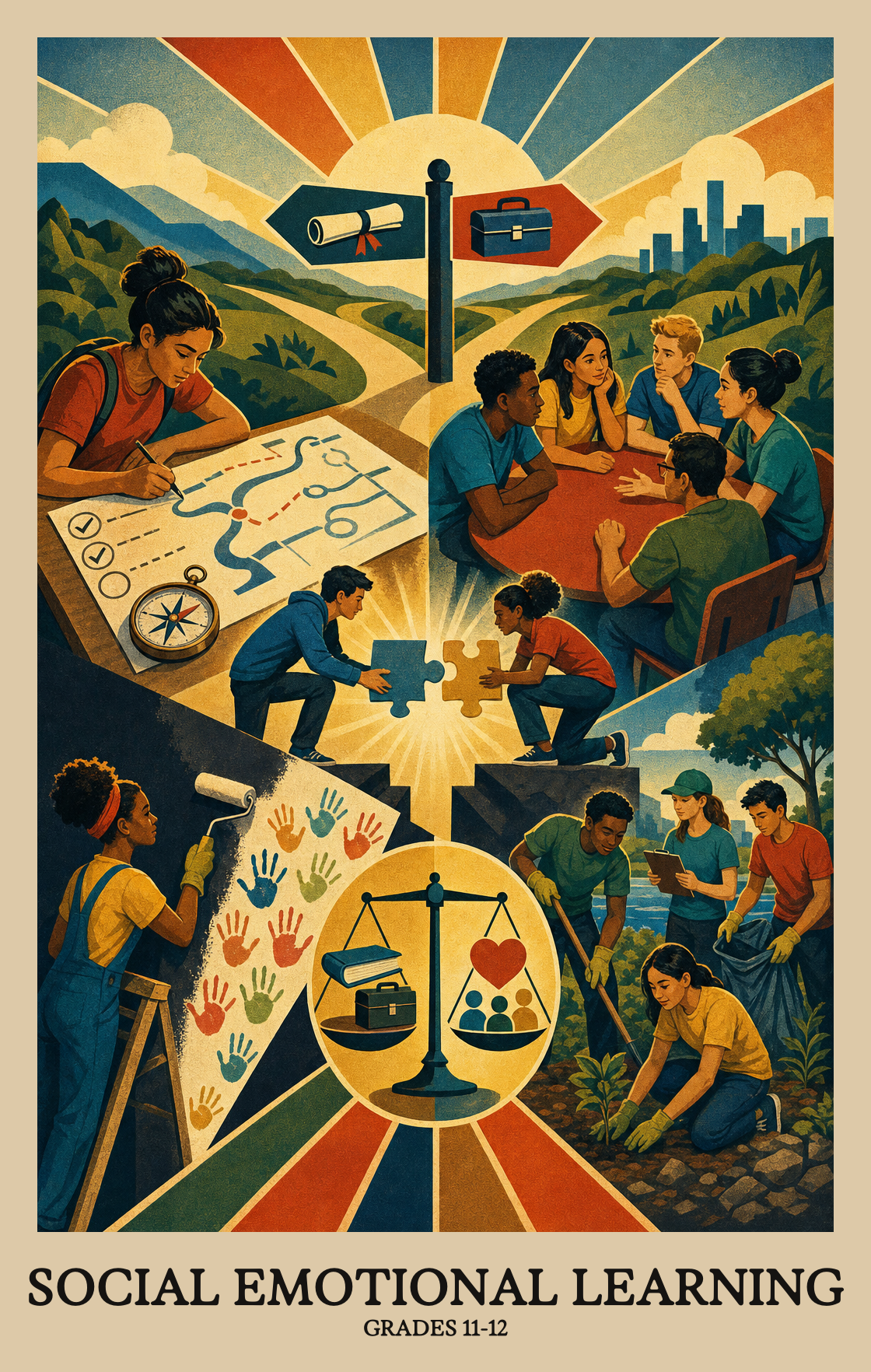
This is the year students start acting like the adults they are about to become. They name their own strengths and obstacles, then make a real plan for life after high school. Conversations get harder. Students work across differences, push back on prejudice, and weigh how today's choices shape college, career, and the people around them. By spring, they can lead a project that tackles a real problem at school or in their community.
Students look at how they show their feelings in different settings and what that does to the people around them. They name their own strengths and pick one thing they want to work on before graduation.
Students set goals for college, work, or whatever comes next. They map out what could get in the way, including unfair barriers, and decide which people and resources they can lean on.
Students practice listening to people whose lives look different from their own. They work in mixed groups, notice when someone is left out, and figure out how to speak up without making things worse.
Students take an honest look at how they argue, apologize, and repair things with friends and family. They practice negotiating so both sides feel heard.
Students slow down and weigh how a choice today shapes school, work, and relationships later. They also notice how outside pressure and group expectations push their decisions.
Students plan and carry out a project that tries to fix a real problem at school or in the neighborhood. They work with others, track what actually changes, and reflect on what they learned about themselves.
Students look at how the way they express feelings at work, online, or with friends changes how others respond and how they feel about themselves afterward.
Students practice naming how they feel in complicated moments, like a tough class, a conflict, or a job interview, and use that self-knowledge to speak up for what they need.
Students put a personal plan into action, taking steps to grow a strength or work through a challenge in a way that stays true to who they are.
Students look at clubs, causes, or local groups they belong to and consider how that involvement shapes who they are and what they want to do with their lives.
Students identify real resources, such as a counselor, a community program, or a policy, that can help them push through obstacles standing between them and their goals, including obstacles rooted in systemic inequality.
Students name what is getting in the way of a post-high-school goal, then practice specific strategies for pushing past it.
| Standard | Definition | Code |
|---|---|---|
| How your words affect others Grades 11-12 | Students look at how the way they express feelings at work, online, or with friends changes how others respond and how they feel about themselves afterward. | NY-SEL.1A.5a |
| Expressing emotions to advocate for yourself Grades 11-12 | Students practice naming how they feel in complicated moments, like a tough class, a conflict, or a job interview, and use that self-knowledge to speak up for what they need. | NY-SEL.1A.5b |
| Building on your strengths and challenges Grades 11-12 | Students put a personal plan into action, taking steps to grow a strength or work through a challenge in a way that stays true to who they are. | NY-SEL.1B.5a |
| How community shapes who you are Grades 11-12 | Students look at clubs, causes, or local groups they belong to and consider how that involvement shapes who they are and what they want to do with their lives. | NY-SEL.1B.5b |
| Finding resources that help you clear real obstacles Grades 11-12 | Students identify real resources, such as a counselor, a community program, or a policy, that can help them push through obstacles standing between them and their goals, including obstacles rooted in systemic inequality. | NY-SEL.1C.5a |
| Overcoming obstacles on the path after high school Grades 11-12 | Students name what is getting in the way of a post-high-school goal, then practice specific strategies for pushing past it. | NY-SEL.1C.5b |
Students consider how someone else's background shapes the way that person sees the world. They reflect on their own experiences to understand why others might think or feel differently than they do.
Students practice listening to and working alongside peers whose backgrounds and views differ from their own, putting those perspectives into words when the group talks through disagreements.
Students identify specific ways to build community that respect what different people bring to the group, including differences in background, culture, and identity.
Students practice recognizing when someone is being treated unfairly and think through what they can actually do about it. The focus is on why speaking up for others, not just yourself, matters to the whole group.
Students think through what it actually looks like to treat themselves and others with respect, and practice how to respond when someone faces stereotyping or a subtle put-down.
Students look back at how recent conversations or group situations went, notice what worked and what didn't, and make a plan to handle the harder moments better next time.
Students look back at their work in a community group and judge what actually changed because they were involved.
Students look back at how they've handled disagreements in the past, spot where they struggled, and make a specific plan to handle those moments better next time.
Students practice working through disagreements by finding solutions that respect everyone involved, including differences in background, identity, and belief.
| Standard | Definition | Code |
|---|---|---|
| Seeing life through someone else's eyes Grades 11-12 | Students consider how someone else's background shapes the way that person sees the world. They reflect on their own experiences to understand why others might think or feel differently than they do. | NY-SEL.2A.5a |
| Working with people different from you Grades 11-12 | Students practice listening to and working alongside peers whose backgrounds and views differ from their own, putting those perspectives into words when the group talks through disagreements. | NY-SEL.2A.5b |
| Building community across differences Grades 11-12 | Students identify specific ways to build community that respect what different people bring to the group, including differences in background, culture, and identity. | NY-SEL.2B.5a |
| Standing up against exclusion and injustice Grades 11-12 | Students practice recognizing when someone is being treated unfairly and think through what they can actually do about it. The focus is on why speaking up for others, not just yourself, matters to the whole group. | NY-SEL.2B.5b |
| Responding to stereotypes and microaggressions Grades 11-12 | Students think through what it actually looks like to treat themselves and others with respect, and practice how to respond when someone faces stereotyping or a subtle put-down. | NY-SEL.2B.5c |
| Improve how you communicate with others Grades 11-12 | Students look back at how recent conversations or group situations went, notice what worked and what didn't, and make a plan to handle the harder moments better next time. | NY-SEL.2C.5a |
| Measuring your impact in community groups Grades 11-12 | Students look back at their work in a community group and judge what actually changed because they were involved. | NY-SEL.2C.5b |
| Improving your own conflict-resolution skills Grades 11-12 | Students look back at how they've handled disagreements in the past, spot where they struggled, and make a specific plan to handle those moments better next time. | NY-SEL.2D.5a |
| Negotiating solutions that respect everyone involved Grades 11-12 | Students practice working through disagreements by finding solutions that respect everyone involved, including differences in background, identity, and belief. | NY-SEL.2D.5b |
Students look at how their surroundings, like school, family, or community, shape a decision before making it. They think through how that choice affects their own well-being and the people around them.
Students look at how social norms, peer pressure, and cultural background quietly push people toward certain choices. They consider why the same situation might lead to different decisions depending on where or how someone grew up.
Students examine how the choices they make now, about classes, jobs, friendships, and habits, shape what college, career, and personal paths are realistically open to them later.
Students look at real decisions made by individuals or groups and judge whether those decisions treated people fairly. They also consider how fairer choices could strengthen communities and encourage people to get involved in civic life.
Students work with classmates to plan and carry out a real project that solves an actual problem in their school, then look back together at what worked.
Students work with classmates to plan and carry out a real project that tackles a social justice issue in their school, town, or the wider world. They check how well the project worked when it's done.
| Standard | Definition | Code |
|---|---|---|
| Decisions that consider yourself and others Grades 11-12 | Students look at how their surroundings, like school, family, or community, shape a decision before making it. They think through how that choice affects their own well-being and the people around them. | NY-SEL.3A.5a |
| How society shapes what we decide Grades 11-12 | Students look at how social norms, peer pressure, and cultural background quietly push people toward certain choices. They consider why the same situation might lead to different decisions depending on where or how someone grew up. | NY-SEL.3A.5b |
| How today's choices shape your future Grades 11-12 | Students examine how the choices they make now, about classes, jobs, friendships, and habits, shape what college, career, and personal paths are realistically open to them later. | NY-SEL.3B.5a |
| Equity decisions and how they shape relationships Grades 11-12 | Students look at real decisions made by individuals or groups and judge whether those decisions treated people fairly. They also consider how fairer choices could strengthen communities and encourage people to get involved in civic life. | NY-SEL.3B.5b |
| Planning a civic project with your class Grades 11-12 | Students work with classmates to plan and carry out a real project that solves an actual problem in their school, then look back together at what worked. | NY-SEL.3C.5a |
| Civic project planning on social injustice Grades 11-12 | Students work with classmates to plan and carry out a real project that tackles a social justice issue in their school, town, or the wider world. They check how well the project worked when it's done. | NY-SEL.3C.5b |
Students work on knowing themselves as young adults, building real relationships, and making decisions that affect life after graduation. The work shifts from following rules to thinking about identity, fairness, and what kind of adult they want to be.
Have honest conversations about pressure, friendships, and plans after high school. Ask what students think instead of telling them what to do. When something hard happens at school or online, talk through how it felt and what they want to do next.
Students should name their strengths and stress points, work through disagreements without shutting down, and make choices with real consequences in mind. They should also be able to listen to people who see the world differently and stay in the conversation.
Students look at how today's choices shape tomorrow's options, from coursework to jobs to relationships. Talking through deadlines, money decisions, and backup plans at home gives students practice making the kind of calls they will make on their own soon.
Start with self-awareness and identity in the fall, move into relationships and conflict in the winter, and build toward decision-making and a capstone project in the spring. The capstone gives students a place to put everything together before they graduate.
Students pick a real issue in the school or community, plan a response, carry it out, and look honestly at what worked. The goal is not a perfect outcome but a clear record of planning, teamwork, and reflection on what changed.
Conflict resolution and responding to prejudice or microaggressions are usually the stickiest. Students often know what they should say in theory but freeze in the moment, so short practice scenarios across the year help more than one big lesson.
Students at this age should have choice in what they share and with whom. Offer private reflection, small-group options, and clear limits on what gets discussed publicly. Trust grows when students see that opting out of sharing is respected.
Look for growth over time in student reflections, group work, and the capstone project rather than a single score. Notice whether students name their own patterns, take feedback, and follow through on plans they set for themselves.