Sounds, letters, and first words
Students stretch single-syllable words into separate sounds and blend them back together. They learn the sounds for letter pairs like sh, ch, and th, and start reading short books out loud.
This is the year reading clicks. Students move from sounding out simple words to reading short books on their own, using blends, long vowels, and common sight words. They start writing real pieces with a beginning, middle, and end, sharing an opinion or telling a small story. By spring, students can read a short book aloud and write a few sentences that stick to one topic.
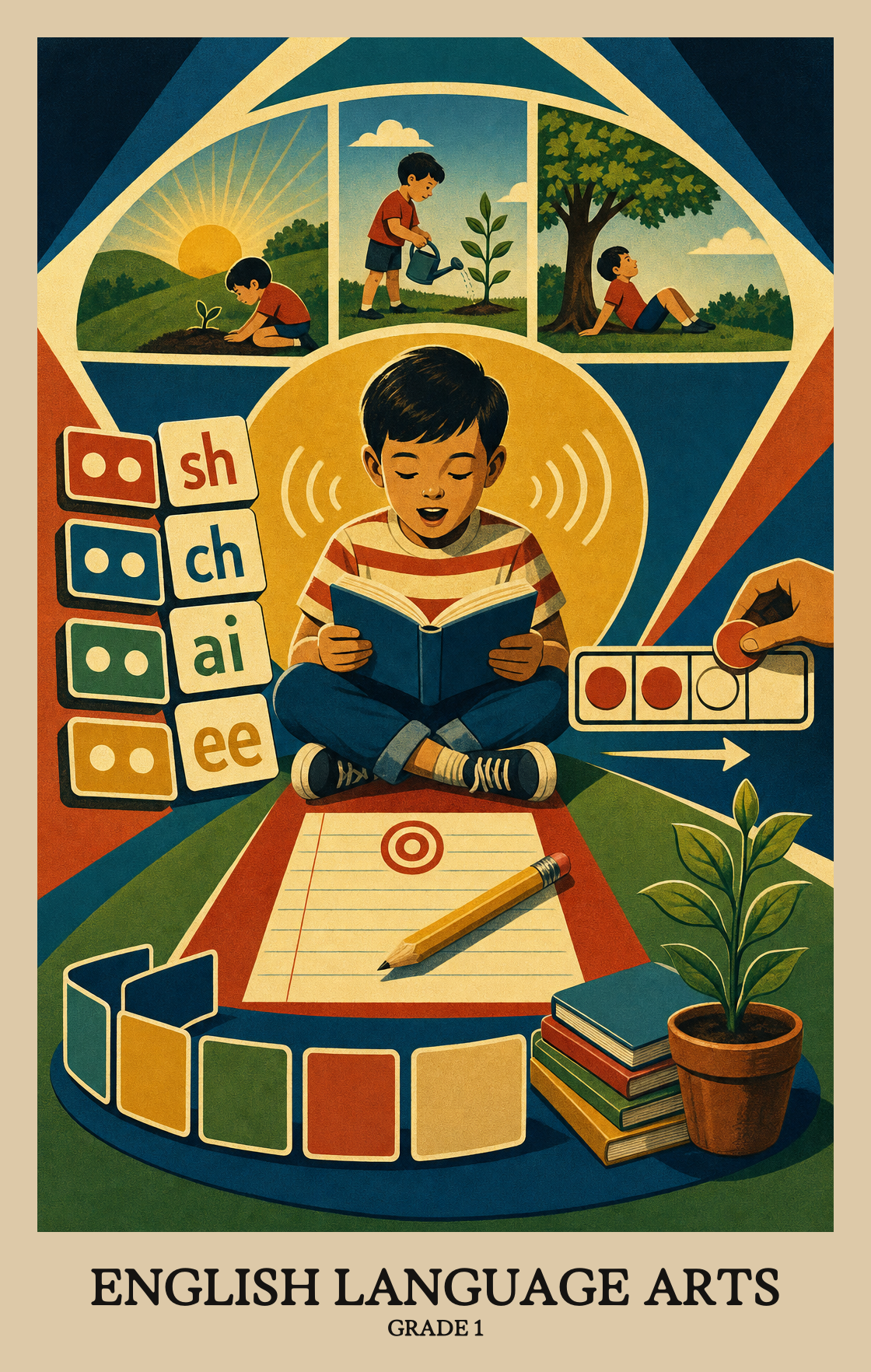
Students stretch single-syllable words into separate sounds and blend them back together. They learn the sounds for letter pairs like sh, ch, and th, and start reading short books out loud.
Students read both made-up stories and books that teach about real things. They notice the difference, point out the main idea, and talk about characters and what happens.
Students tackle words with silent e and vowel teams, and break two-syllable words into chunks. Reading starts to sound smoother, and students fix their own mistakes as they go.
Students use clues in a sentence to figure out new words and learn how words like peek, glance, and stare carry different shades of meaning. They take turns in group talks and ask questions to clear things up.
Students write three kinds of pieces: an opinion with reasons, a short report with facts, and a story about something that happened. They also gather information to answer their own questions.
Students figure out what an unfamiliar word means by using clues in the sentence, breaking the word apart, or asking for help. They learn that many words carry more than one meaning depending on how they're used.
Students sort words by what they have in common, like animals or foods, and learn how similar words differ in meaning, like the difference between "happy" and "thrilled."
Students practice using connecting words like "because," "and," and "but" to show how ideas relate. They build this habit through conversations, stories, and writing.
Students use the other words in a sentence to figure out what an unfamiliar word means, without stopping to look it up.
Students use common word parts like "re-" or "-ful" to figure out what an unfamiliar word means. Seeing "redo" or "helpful" teaches them that those pieces carry meaning they can apply to new words.
Students spot a base word like "look" and recognize how it changes when you add -s, -ed, or -ing to the end. This builds the habit of seeing familiar word parts inside new words.
Students sort words into groups, like putting "red" and "blue" with colors or "shirt" and "pants" with clothing. Grouping words this way helps students see what the words in each category have in common.
Students sort words into groups and name what makes each one specific. A duck is a bird that swims; a tiger is a large cat with stripes.
Students practice connecting words to real life by thinking about what a word like "cozy" actually feels like and where they'd find it, like a soft chair or a warm bed.
Students learn that words like "peek" and "stare" both mean looking, but in very different ways. They practice choosing the right word or acting it out to show they understand the difference.
| Standard | Definition | Code |
|---|---|---|
| Figure out what unfamiliar words mean | Students figure out what an unfamiliar word means by using clues in the sentence, breaking the word apart, or asking for help. They learn that many words carry more than one meaning depending on how they're used. | NY-1L4 |
| Word meanings and how words relate | Students sort words by what they have in common, like animals or foods, and learn how similar words differ in meaning, like the difference between "happy" and "thrilled." | NY-1L5 |
| Using words learned from books and talk | Students practice using connecting words like "because," "and," and "but" to show how ideas relate. They build this habit through conversations, stories, and writing. | NY-1L6 |
| Using context clues to figure out words | Students use the other words in a sentence to figure out what an unfamiliar word means, without stopping to look it up. | NY-1L4a |
| Common prefixes and suffixes as word clues | Students use common word parts like "re-" or "-ful" to figure out what an unfamiliar word means. Seeing "redo" or "helpful" teaches them that those pieces carry meaning they can apply to new words. | NY-1L4b |
| Root words and their endings | Students spot a base word like "look" and recognize how it changes when you add -s, -ed, or -ing to the end. This builds the habit of seeing familiar word parts inside new words. | NY-1L4c |
| Sorting words into groups by category | Students sort words into groups, like putting "red" and "blue" with colors or "shirt" and "pants" with clothing. Grouping words this way helps students see what the words in each category have in common. | NY-1L5a |
| Sorting words by what they are and do | Students sort words into groups and name what makes each one specific. A duck is a bird that swims; a tiger is a large cat with stripes. | NY-1L5b |
| Cozy words for home and school | Students practice connecting words to real life by thinking about what a word like "cozy" actually feels like and where they'd find it, like a soft chair or a warm bed. | NY-1L5c |
| Word shades: strong vs. weak word choices | Students learn that words like "peek" and "stare" both mean looking, but in very different ways. They practice choosing the right word or acting it out to show they understand the difference. | NY-1L5d |
Students ask and answer questions about the important details in a story or book they read. This could mean figuring out who is in the story, what happened, or why something occurred.
Students pick out what a text is mostly about and retell the details that matter most. Works for both stories and informational books.
Students describe who is in a story, where it takes place, and what happens. For nonfiction, they pick out the key facts and details the author includes.
Students pick out words in a story or article that describe how something feels, sounds, smells, tastes, or looks. These are the words that make writing vivid and specific.
Students learn to tell the difference between a story and a book that teaches facts. They practice naming what kind of book they are reading and explaining how stories and nonfiction books work differently.
Students look at the pictures and details in a book to figure out why the author wrote it or how the author wants readers to feel. The images and words work together to tell the full story.
Students use the pictures and details in a book to talk about what is happening, who the characters are, or what the text is about.
Students find the sentences, words, or pictures an author uses to back up the main idea. This skill works with both stories and nonfiction books.
Students link what they read to their own life or to other stories they know. A book about a rainy day might remind them of a time they splashed in puddles, or connect to another book they've read.
| Standard | Definition | Code |
|---|---|---|
| Asking and answering questions about a text | Students ask and answer questions about the important details in a story or book they read. This could mean figuring out who is in the story, what happened, or why something occurred. | NY-1R1 |
| Finding the main idea and key details | Students pick out what a text is mostly about and retell the details that matter most. Works for both stories and informational books. | NY-1R2 |
| Characters, settings, and events in a story | Students describe who is in a story, where it takes place, and what happens. For nonfiction, they pick out the key facts and details the author includes. | NY-1R3 |
| Words that show feelings and senses | Students pick out words in a story or article that describe how something feels, sounds, smells, tastes, or looks. These are the words that make writing vivid and specific. | NY-1R4 |
| Fiction vs. nonfiction books | Students learn to tell the difference between a story and a book that teaches facts. They practice naming what kind of book they are reading and explaining how stories and nonfiction books work differently. | NY-1R5 |
| How pictures support an author's message | Students look at the pictures and details in a book to figure out why the author wrote it or how the author wants readers to feel. The images and words work together to tell the full story. | NY-1R6 |
| Pictures and words work together | Students use the pictures and details in a book to talk about what is happening, who the characters are, or what the text is about. | NY-1R7 |
| What the author uses to support ideas | Students find the sentences, words, or pictures an author uses to back up the main idea. This skill works with both stories and nonfiction books. | NY-1R8 |
| Connecting stories to your own life | Students link what they read to their own life or to other stories they know. A book about a rainy day might remind them of a time they splashed in puddles, or connect to another book they've read. | NY-1R9 |
Reading foundational skills cover how print works on a page. Students learn that words are made of letters, sentences move left to right, and spaces separate words.
Students learn to hear the separate parts inside spoken words: the syllables and the individual sounds that make them up. This is the ear-training that helps early readers sound out words on the page.
Students use letter-sound patterns to figure out words they haven't seen before. This is the core of early reading: looking at a word, knowing what the letters sound like, and blending them into something recognizable.
Students read simple books aloud smoothly enough to actually understand what the story is about, not just say the words.
Sentences start with a capital letter and end with a period, question mark, or exclamation point. Students learn to spot those markers so they know where one sentence begins and another ends.
Students break apart and blend together single-syllable words that start or end with two consonants side by side, like "clap" or "best."
Students swap, add, or remove a single sound in a short spoken word to make a new one. For example, changing the first sound in "cat" turns it into "bat" or "hat."
Students listen to a short word and change, move, or swap out one sound to make a new word, like turning "cat" into "bat" or "cap."
Students learn that two letters can team up to make one sound, like the "sh" in "ship" or the "ch" in "chin." They practice spotting these pairs in words they read and write.
Students read one-syllable words where a silent "e" or two vowels together make a long vowel sound, like the "a" in "cake" or the "ea" in "read."
Students sound out short, everyday words letter by letter and blend them together to read the whole word.
Splitting a word into syllables means finding each chunk that holds a vowel sound. Students look at a printed word and count those chunks to figure out how many syllables it has.
Students practice splitting longer words into parts to read them. A word like "rabbit" or "napkin" gets broken into two chunks so it's easier to sound out.
Reading a word like "walks" or "jumped," students spot the base word hiding inside and name the ending that was added to it.
Students recognize common words like "the," "said," and "where" instantly, without sounding them out. These are the words that show up on almost every page of every book.
Reading a short book or passage aloud, students practice until the words come out smoothly, at a steady pace, with the right feeling for what's happening in the story.
When students read a sentence and a word doesn't quite fit, they go back and reread to figure out what it should say. They use the words around it as clues.
| Standard | Definition | Code |
|---|---|---|
| How print is organized on a page | Reading foundational skills cover how print works on a page. Students learn that words are made of letters, sentences move left to right, and spaces separate words. | NY-1RF1 |
| Sounds, syllables, and spoken words | Students learn to hear the separate parts inside spoken words: the syllables and the individual sounds that make them up. This is the ear-training that helps early readers sound out words on the page. | NY-1RF2 |
| Sounding out and decoding words | Students use letter-sound patterns to figure out words they haven't seen before. This is the core of early reading: looking at a word, knowing what the letters sound like, and blending them into something recognizable. | NY-1RF3 |
| Reading early books with fluency | Students read simple books aloud smoothly enough to actually understand what the story is about, not just say the words. | NY-1RF4 |
| How sentences start and end | Sentences start with a capital letter and end with a period, question mark, or exclamation point. Students learn to spot those markers so they know where one sentence begins and another ends. | NY-1RF1a |
| Blending and segmenting words with consonant clusters | Students break apart and blend together single-syllable words that start or end with two consonants side by side, like "clap" or "best." | NY-1RF2a |
| Swap sounds to make new words | Students swap, add, or remove a single sound in a short spoken word to make a new one. For example, changing the first sound in "cat" turns it into "bat" or "hat." | NY-1RF2b |
| Swap and change sounds in words | Students listen to a short word and change, move, or swap out one sound to make a new word, like turning "cat" into "bat" or "cap." | NY-1RF2c |
| Blends and digraphs: sh, ch, th | Students learn that two letters can team up to make one sound, like the "sh" in "ship" or the "ch" in "chin." They practice spotting these pairs in words they read and write. | NY-1RF3a |
| Long vowels in one-syllable words | Students read one-syllable words where a silent "e" or two vowels together make a long vowel sound, like the "a" in "cake" or the "ea" in "read." | NY-1RF3b |
| Read one-syllable words | Students sound out short, everyday words letter by letter and blend them together to read the whole word. | NY-1RF3c |
| Counting syllables by finding vowel sounds | Splitting a word into syllables means finding each chunk that holds a vowel sound. Students look at a printed word and count those chunks to figure out how many syllables it has. | NY-1RF3d |
| Breaking two-syllable words into parts | Students practice splitting longer words into parts to read them. A word like "rabbit" or "napkin" gets broken into two chunks so it's easier to sound out. | NY-1RF3e |
| Root words and simple suffixes | Reading a word like "walks" or "jumped," students spot the base word hiding inside and name the ending that was added to it. | NY-1RF3f |
| Sight words kids read on the spot | Students recognize common words like "the," "said," and "where" instantly, without sounding them out. These are the words that show up on almost every page of every book. | NY-1RF3g |
| Reading aloud with accuracy and expression | Reading a short book or passage aloud, students practice until the words come out smoothly, at a steady pace, with the right feeling for what's happening in the story. | NY-1RF4a |
| Rereading to check and fix tricky words | When students read a sentence and a word doesn't quite fit, they go back and reread to figure out what it should say. They use the words around it as clues. | NY-1RF4b |
Students take turns talking and listening in group discussions, partner chats, and classroom conversations with other kids and adults. The focus is on staying on topic and responding to what others say.
Students listen to a read-aloud, story, or video, then ask and answer questions about the key details in it.
Students listen to a speaker, then ask or answer questions to clear up anything confusing. They also figure out how the speaker feels or what the speaker thinks about the topic.
Students pick a person, place, or thing they know and describe it out loud with specific details. The goal is saying enough that a listener can picture it clearly.
Students pick or make a picture, drawing, or diagram to go with what they are describing. The visual helps listeners understand what words alone might not fully show.
Students speak in complete sentences when the moment calls for it, sharing thoughts and feelings in a way that fits the conversation or the person they're talking to.
Students follow class rules during group talk: they listen while others speak, wait their turn, and keep comments on the same topic the class is discussing.
Students take turns in a back-and-forth conversation, listening to what classmates say and adding to it rather than just waiting to talk.
Students learn to stop and ask when something doesn't make sense, whether the class is talking about a story or a topic. Asking a question is how they keep up with the conversation.
Students learn to adjust how they speak depending on who they're talking to, speaking more slowly, simply, or clearly based on what the other person needs.
| Standard | Definition | Code |
|---|---|---|
| Talking and listening with others | Students take turns talking and listening in group discussions, partner chats, and classroom conversations with other kids and adults. The focus is on staying on topic and responding to what others say. | NY-1SL1 |
| Questions about what you read and heard | Students listen to a read-aloud, story, or video, then ask and answer questions about the key details in it. | NY-1SL2 |
| Asking questions about what a speaker means | Students listen to a speaker, then ask or answer questions to clear up anything confusing. They also figure out how the speaker feels or what the speaker thinks about the topic. | NY-1SL3 |
| Describe people, places, and events out loud | Students pick a person, place, or thing they know and describe it out loud with specific details. The goal is saying enough that a listener can picture it clearly. | NY-1SL4 |
| Adding pictures to explain your ideas | Students pick or make a picture, drawing, or diagram to go with what they are describing. The visual helps listeners understand what words alone might not fully show. | NY-1SL5 |
| Speaking clearly in complete sentences | Students speak in complete sentences when the moment calls for it, sharing thoughts and feelings in a way that fits the conversation or the person they're talking to. | NY-1SL6 |
| Listening and taking turns in discussion | Students follow class rules during group talk: they listen while others speak, wait their turn, and keep comments on the same topic the class is discussing. | NY-1SL1a |
| Taking turns in conversation | Students take turns in a back-and-forth conversation, listening to what classmates say and adding to it rather than just waiting to talk. | NY-1SL1b |
| Asking questions when something is confusing | Students learn to stop and ask when something doesn't make sense, whether the class is talking about a story or a topic. Asking a question is how they keep up with the conversation. | NY-1SL1c |
| Respect how others communicate differently | Students learn to adjust how they speak depending on who they're talking to, speaking more slowly, simply, or clearly based on what the other person needs. | NY-1SL1d |
Students pick a topic they care about and write their opinion, then back it up with at least two reasons that explain why they think that way.
Students write a short nonfiction piece about a real topic, share a few facts about it, and wrap it up with a closing sentence.
Students write a short story about something that really happened or something made up. They put the events in order so a reader can follow what happened.
Students respond to something they read or experienced by making something new, like a poem, a drawing, or a short performance. The response shows their thinking about a story, an idea, or something that happened to them.
Students work with the class to come up with questions, then look through books or other sources together to find answers. It's guided research at the simplest level.
Students answer a question by drawing on something they did or saw, or by looking through a book or source a teacher provides. They share what they found in writing, a drawing, or another format.
| Standard | Definition | Code |
|---|---|---|
| Opinion writing with reasons | Students pick a topic they care about and write their opinion, then back it up with at least two reasons that explain why they think that way. | NY-1W1 |
| Facts about a topic, start to finish | Students write a short nonfiction piece about a real topic, share a few facts about it, and wrap it up with a closing sentence. | NY-1W2 |
| Write a story about something real or made up | Students write a short story about something that really happened or something made up. They put the events in order so a reader can follow what happened. | NY-1W3 |
| Respond to a book or experience | Students respond to something they read or experienced by making something new, like a poem, a drawing, or a short performance. The response shows their thinking about a story, an idea, or something that happened to them. | NY-1W4 |
| Asking questions and finding answers | Students work with the class to come up with questions, then look through books or other sources together to find answers. It's guided research at the simplest level. | NY-1W6 |
| Writing from what you know and find | Students answer a question by drawing on something they did or saw, or by looking through a book or source a teacher provides. They share what they found in writing, a drawing, or another format. | NY-1W7 |
The annual test New York gives to students who have been identified as English Language Learners. It checks speaking, listening, reading, and writing in English and decides whether a student is ready to exit ENL services.
The placement test New York gives to students within ten school days of enrolling, when a parent survey suggests the student may need English language services. Results decide whether the student is identified as an English Language Learner.
Students should read short books on their own, sound out new words using letter patterns, and remember common words by sight. They should also be able to tell you what a story was about and name the main characters and what happened.
Read together for ten minutes a day and take turns reading pages. When students get stuck on a word, point at the letters and ask what sound each part makes. After the story, ask who was in it, what happened, and what their favorite part was.
Not yet. At this age, the goal is getting ideas down on paper and stretching out the sounds in each word. Common words like the, was, and said should look right, but longer words can be spelled by sound while students keep building skill.
Start by reviewing short vowels and single consonants, then move into blends and digraphs like sh, ch, and th. After that, teach long vowel patterns such as silent e and common vowel teams, and end the year with two-syllable words. Sight words run alongside this work every week.
Students write three main kinds of pieces: an opinion with reasons, a short informational piece with facts, and a story about something that happened. They also respond to books through drawing, poems, or short paragraphs.
After reading, ask simple questions like who, where, and what happened first. Have students point to a picture that shows a big moment and explain it in their own words. Connecting the story to their own life also helps the meaning stick.
Long vowel patterns and breaking two-syllable words into parts tend to need extra rounds. Students also often need more practice retelling a story in order and identifying the main idea of a short informational text. Small-group time is the easiest place to catch this up.
By June, students should read a short unfamiliar book with few stops, retell what happened, and write a few sentences that another person can read. They should also join group conversations by listening, taking turns, and adding on to what someone else said.
Keep reading aloud, even to strong readers. Picture books and chapter books read aloud build vocabulary and the kind of language students cannot yet decode on their own. Stop now and then to wonder out loud about a word or what might happen next.