Imagining characters and stories
Students start the year by inventing characters, places, and short stories from their own ideas. At home, expect lots of make-believe and questions like what if a dog could talk.
This is the year pretend play starts to look like real theater. Students invent characters, act out small stories, and use their voice and body to show how a character feels. They watch classmates perform and talk about what the story meant. By spring, students can take on a character in a short scene and explain what was happening and why.
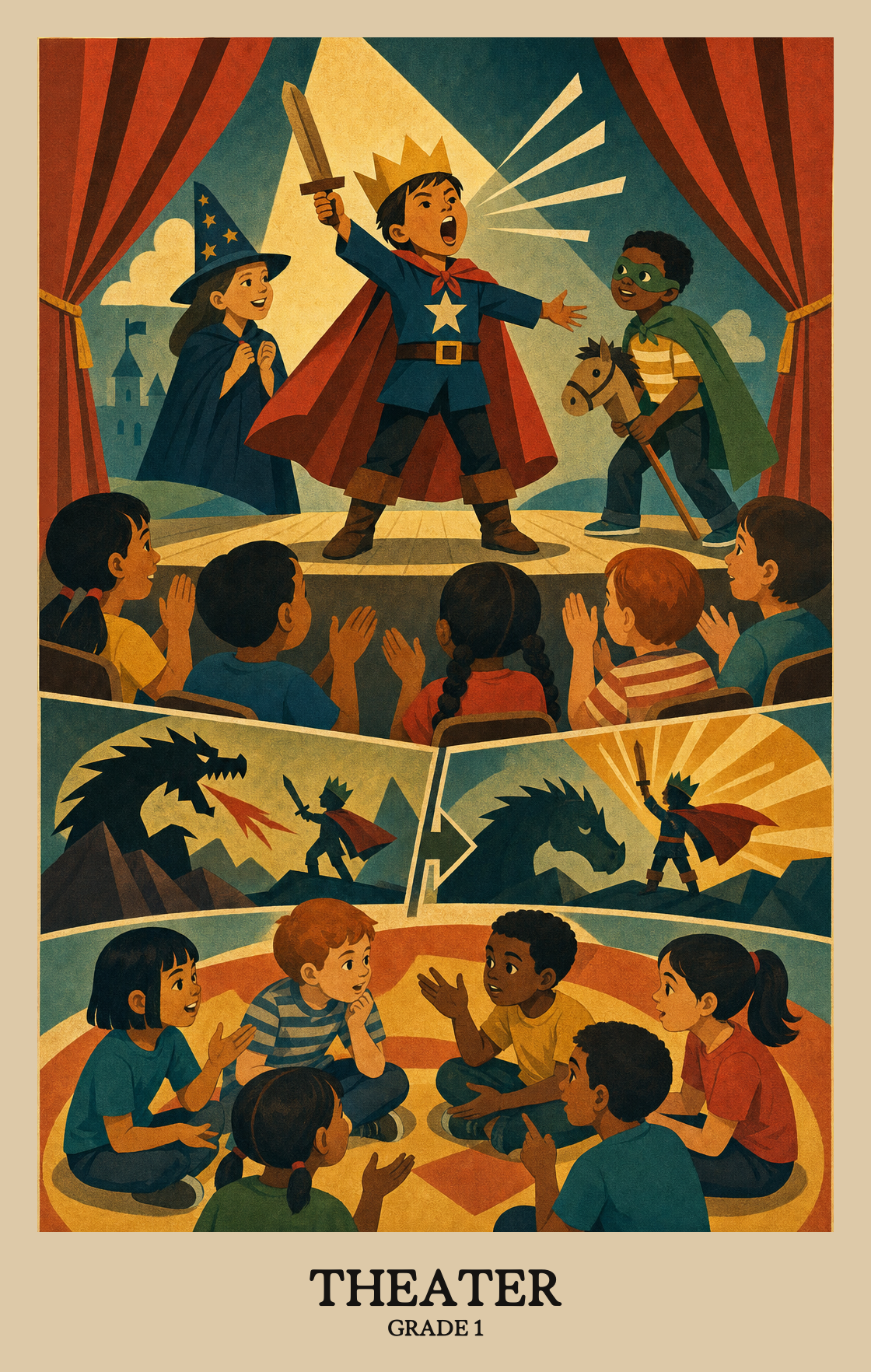
Students start the year by inventing characters, places, and short stories from their own ideas. At home, expect lots of make-believe and questions like what if a dog could talk.
Students try out their ideas with their bodies and voices, working in pairs and small groups. They learn to take turns, listen to a partner, and add their own twist to a scene.
Students pick a favorite idea and shape it into something to share. They practice the same scene more than once, try changes, and decide what looks and sounds best.
Students perform short scenes for classmates and watch others perform too. They talk about what they noticed, what the story meant to them, and what made a scene work.
Students link stories on stage to their own lives, families, and the wider world. They notice how a play can come from a book, a holiday, or something that really happened.
Students connect something from their own life to a character or story in a play. That personal connection shapes the choices they make when acting or creating a scene.
Students connect a play or story to real life by talking about where, when, or how people lived. That link helps them understand why characters act the way they do.
| Standard | Definition | Code |
|---|---|---|
| Making art from what you know | Students connect something from their own life to a character or story in a play. That personal connection shapes the choices they make when acting or creating a scene. | TH:Cn10.1 |
| Stories and art from different times and places | Students connect a play or story to real life by talking about where, when, or how people lived. That link helps them understand why characters act the way they do. | TH:Cn11.1 |
Students come up with characters, stories, and moments to act out, then shape those ideas into something they can perform or share with the class.
Students take a story idea and turn it into a short scene by deciding who the characters are, what they want, and what happens next.
Students revisit a short scene or character choice, make one or two changes to improve it, and practice until the piece feels finished.
| Standard | Definition | Code |
|---|---|---|
| Imagine and sketch ideas for a play | Students come up with characters, stories, and moments to act out, then shape those ideas into something they can perform or share with the class. | TH:Cr1.1 |
| Turning ideas into a short play | Students take a story idea and turn it into a short scene by deciding who the characters are, what they want, and what happens next. | TH:Cr2.1 |
| Finish and polish a short play | Students revisit a short scene or character choice, make one or two changes to improve it, and practice until the piece feels finished. | TH:Cr3.1 |
Students choose which character to play or which scene to act out, then figure out how to show it through voice and movement.
Students practice a scene or short play, then work on making it better before showing it to an audience. Rehearsing and improving the performance is the whole point.
Students act out a character or scene and make choices, like how to move or speak, so the audience understands what the story is about.
| Standard | Definition | Code |
|---|---|---|
| Picking a scene to perform | Students choose which character to play or which scene to act out, then figure out how to show it through voice and movement. | TH:Pr4.1 |
| Practice and polish a performance | Students practice a scene or short play, then work on making it better before showing it to an audience. Rehearsing and improving the performance is the whole point. | TH:Pr5.1 |
| Share a story through performance | Students act out a character or scene and make choices, like how to move or speak, so the audience understands what the story is about. | TH:Pr6.1 |
Students watch a short play or puppet show and talk about what they noticed, what happened, and how it made them feel.
Students look at a short play or performance and explain what they think the characters want or feel. They put the story's meaning into their own words.
Students look at a scene or performance and explain what worked and what did not, using a simple reason like "the actor spoke too quietly" or "the costumes matched the story."
| Standard | Definition | Code |
|---|---|---|
| Watching and thinking about a performance | Students watch a short play or puppet show and talk about what they noticed, what happened, and how it made them feel. | TH:Re7.1 |
| What a story means to you | Students look at a short play or performance and explain what they think the characters want or feel. They put the story's meaning into their own words. | TH:Re8.1 |
| Decide what makes a performance good | Students look at a scene or performance and explain what worked and what did not, using a simple reason like "the actor spoke too quietly" or "the costumes matched the story." | TH:Re9.1 |
Students play pretend with a purpose. They act out short stories, take on simple characters, use their voices and bodies to show feelings, and watch each other perform. Most of the work happens through games, story drama, and acting out books they already know.
Read a favorite picture book together and act it out. Take turns being different characters and try changing your voice or face to match how the character feels. Five minutes of this a few times a week builds real skill.
No. At this age, students mostly improvise short scenes or retell stories in their own words. A polished stage performance is not the goal. The goal is comfort with pretending in front of others and listening to a partner in a scene.
Start with drama games and solo pretend work so students get comfortable using their voice and body. Move into partner and small-group scenes built from familiar stories. Save sharing work with an audience for later in the year, once students can stay in a character for a minute or two.
Two things tend to slip: staying in character when classmates laugh, and being a good audience member without calling out. Both get better with short, repeated practice and a clear signal for when a scene starts and ends.
Start with puppets or stuffed animals doing the talking instead of the child. Read stories with funny voices and invite the child to join in on one line. Confidence grows when the pressure is on the puppet, not the performer.
Students learn to name what they saw and how it made them feel. A simple prompt like what did you notice or what part stuck with you gets honest answers. Over the year they start to give a reason for their opinion instead of just liking or not liking a scene.
By the end of the year, students can take on a character in a short scene, use voice and body to show a feeling, and watch a classmate perform without interrupting. They can also share one thing they noticed about a scene and one idea for making it stronger.