Skip to content

What does a student learn in ?

This is the year theater shifts from playing pretend to making deliberate choices a character would make. Students build scenes from their own ideas, then revise the work after watching it land with an audience. They also start asking why a play was written and what it meant to the people who first saw it. By spring, they can rehearse a short scene, take notes from a classmate, and explain what they changed and why.

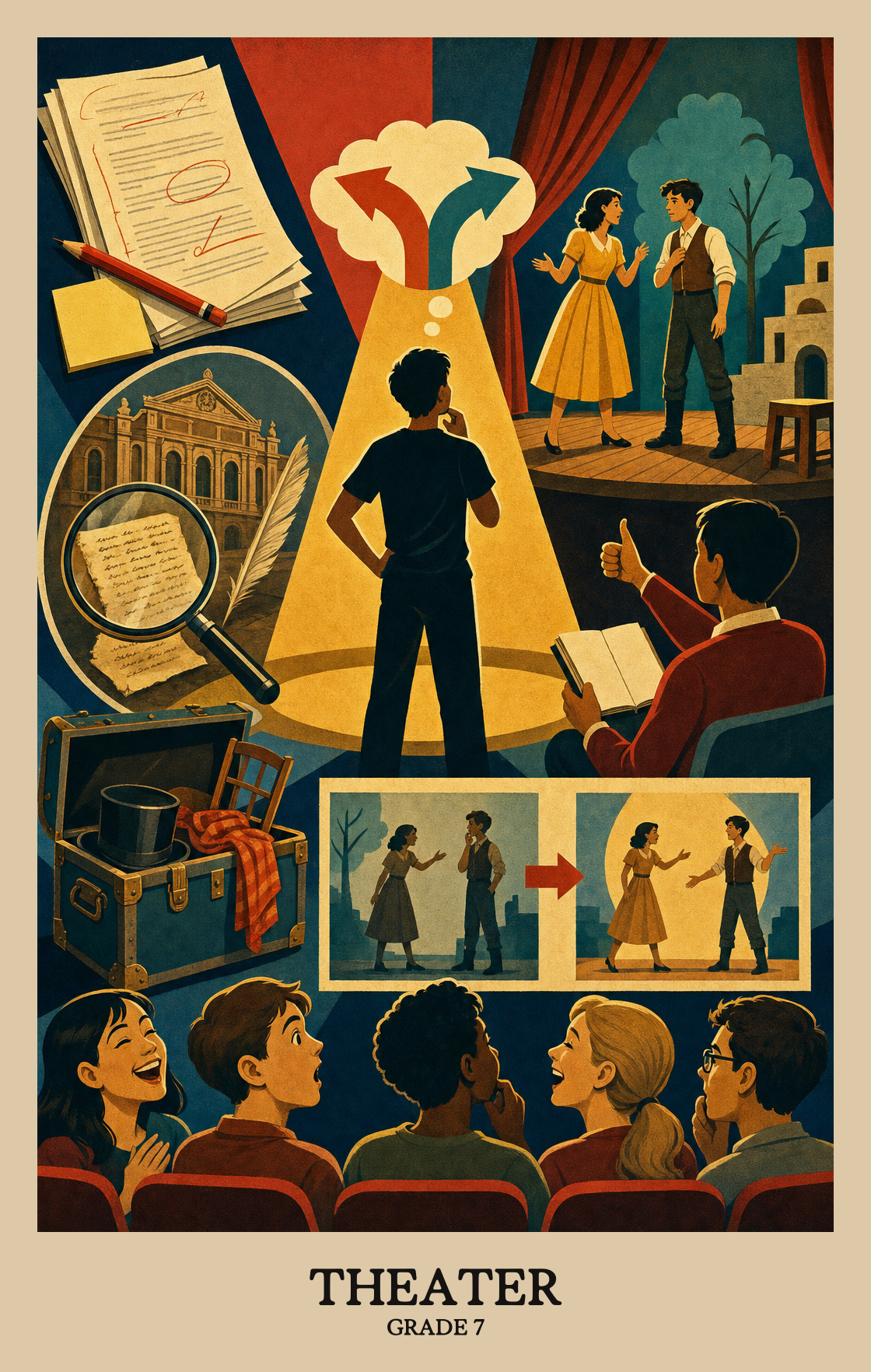
Illustration of what students learn in Grade 7 Arts: Theater
  • Scene work
  • Character choices
  • Rehearsal and revision
  • Audience feedback
  • Historical context
Source: New York P-12 Learning Standards
Year at a glance
How the year usually goes. Every school and district set their own curriculum, so treat this as a guide, not official pacing.
  1. 1

    Building characters and ideas

    Students start the year by pulling from their own experiences to invent characters, settings, and short scenes. Expect them to come home talking about ideas they sketched out in class and stories they want to tell on stage.

  2. 2

    Shaping scenes and scripts

    Students take rough ideas and turn them into scenes with clear choices about who the characters are and what they want. They work in small groups, try things out, and revise based on what lands and what falls flat.

  3. 3

    Theater in context

    Students look at plays and performances from different times and places and connect them to what is happening in the world around them. The goal is to see theater as a way people have always made sense of their lives.

  4. 4

    Rehearsing for an audience

    Students sharpen acting choices, voice, and movement so a scene reads clearly to people watching. They learn that rehearsal is about making small adjustments until the meaning comes through.

  5. 5

    Performing and responding

    Students perform their work and watch each other with a critical eye. They give and receive feedback using shared criteria, then talk about what a piece meant and how well it got there.

Mastery Learning Standards
The required skills a student should display by the end of Grade 7.
Connecting
Standard Definition Code

Using life experience to make theater

Students connect something from their own life to a scene, character, or story they're working on in class, then use that personal link to shape their performance or creative choices.

TH:Cn10.7

Theater in its time and place

Students look at a play or scene and connect it to the time period, culture, or real-world events behind it. That context helps them understand why the story was told and what it meant to the people who first saw it.

TH:Cn11.7
Creating
Standard Definition Code

Coming up with ideas for a scene

Students brainstorm and develop original ideas for a scene or performance, exploring characters, settings, and stories before any rehearsal begins.

TH:Cr1.7

Develop and shape a theater idea

Students take a rough idea for a scene or character and shape it into something stageable, making choices about dialogue, movement, and setting until the piece holds together.

TH:Cr2.7

Finishing a scene until it works

Students revise a scene or script based on feedback, making specific changes until the work is ready to perform or share.

TH:Cr3.7
Performing/Presenting/Producing
Standard Definition Code

Choosing and interpreting work to perform

Students choose a scene or monologue to perform and explain why it suits their skills and the story they want to tell.

TH:Pr4.7

Rehearse and polish a performance

Students rehearse and revise a performance until it's ready to show an audience. That means sharpening movement, voice, and timing based on feedback from practice runs.

TH:Pr5.7

Perform to make the audience feel something

Students perform a scene or monologue with a clear intention, making deliberate choices about movement, voice, and character so the audience understands what the moment is about.

TH:Pr6.7
Responding
Standard Definition Code

Reading a performance with fresh eyes

Students watch a scene or performance and break down what they notice: how the actors move, speak, and make choices that shape the story. The focus is on reading a performance the way a reader reads a page.

TH:Re7.7

Reading what a performance means

Students explain what a scene, character, or design choice is meant to communicate and why the people who made it likely chose that approach.

TH:Re8.7

How to judge a performance

Students judge a scene or performance against a clear set of criteria, explaining what works, what falls short, and why.

TH:Re9.7
Common Questions
  • What does theater class actually look like this year?

    Students build characters, write short scenes, and rehearse and perform them. They also watch plays or clips and talk about what the playwright was trying to say. A lot of the work happens in small groups, so showing up and being a reliable partner matters as much as talent.

  • How can I support a student who feels shy about performing?

    Start small at home. Ask them to read a short scene out loud with different voices, or act out a memory from their day as if it were a story. The goal is comfort speaking and moving in front of someone safe, not polish.

  • How should I sequence the year so performances feel earned?

    Build from short solo work, to partner scenes, to group scenes with a real audience. Layer character work, voice, and movement skills across each cycle so students have something concrete to refine each time. Save scripted scene study for after students have generated their own material.

  • What does mastery look like by the end of the year?

    Students can take a script or idea, make specific choices about character and meaning, rehearse with a group, and perform with intention. They can also watch a piece of theater and explain what worked, what the artist seemed to mean, and why, using more than just liked it or did not like it.

  • Why is so much class time spent talking about plays instead of acting?

    Analyzing scenes teaches students to read like a director: noticing choices about character, setting, and meaning. That thinking is what makes their own acting and writing sharper. The discussion and the performing feed each other.

  • Which skills usually need the most reteaching?

    Giving useful feedback to peers and revising a scene after notes. Students can often generate ideas but stall when asked to cut, rework, or justify a choice. Build short revision routines into rehearsal so it becomes normal, not a correction.

  • How do I help with a memorization or scene assignment at home?

    Run lines as the other character, then ask one or two questions about the scene: what does this character want, and what changes by the end? Avoid directing the performance. Coaching the thinking helps more than coaching the delivery.

  • How do students connect theater to history and culture at this level?

    They look at where a play comes from, who it was written for, and what was happening in the world around it. Then they consider how those choices land with a today audience. It is a way to practice reading art in context, not a history lesson in costume.