Finding ideas to move
Students start the year turning their own experiences and observations into movement. They try out ideas, play with shapes and rhythms, and start building short dance phrases from scratch.
This is the year dance becomes about choices, not just steps. Students start with an idea or feeling and shape it into a short piece, deciding how movement, space, and timing carry the meaning. They also learn to watch dance carefully, talk about what a piece is trying to say, and connect it to the world it came from. By spring, students can perform a short dance they helped create and explain what it means.
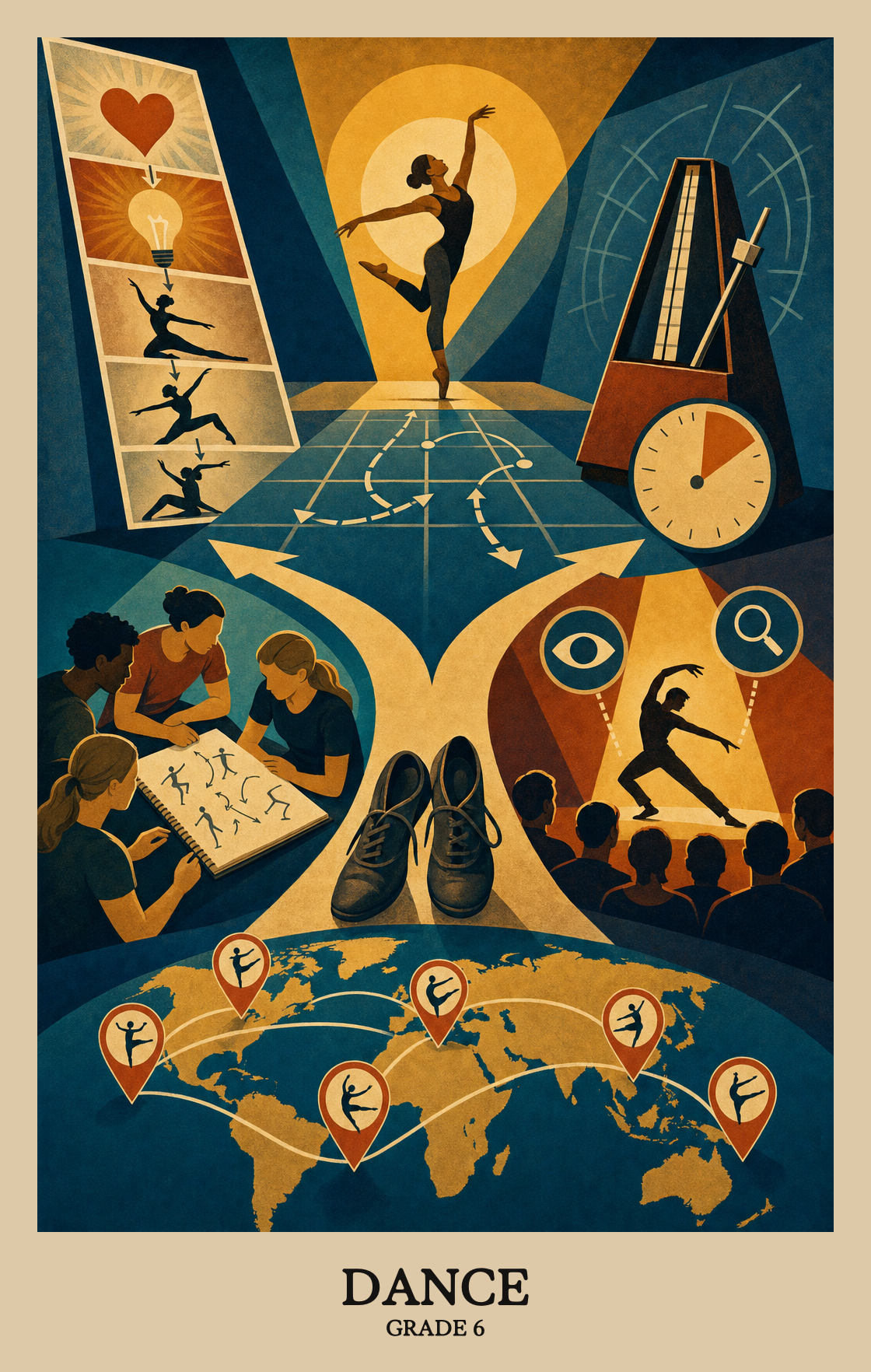
Students start the year turning their own experiences and observations into movement. They try out ideas, play with shapes and rhythms, and start building short dance phrases from scratch.
Students take rough ideas and organize them into something with a clear beginning, middle, and end. They revise their work, get feedback from classmates, and clean up the parts that feel unfinished.
Students look at dances from different cultures and time periods and notice what the dances say about the people who made them. They use what they learn to add depth to their own choreography.
Students sharpen technique and pick which pieces are ready for an audience. They work on control, expression, and the small details that make a performance land.
Students watch performances closely and talk about what they see. They figure out what a choreographer was trying to say and use clear reasons, not just opinions, to decide what works.
Students connect their own memories and life experiences to the movement choices they make in dance, explaining how those personal connections shape what the piece looks and feels like.
Students look at a dance and ask where it came from: what culture created it, when, and why. That context changes how the dance looks and what it means.
| Standard | Definition | Code |
|---|---|---|
| Using life experiences to make dances | Students connect their own memories and life experiences to the movement choices they make in dance, explaining how those personal connections shape what the piece looks and feels like. | DA:Cn10.6 |
| Dance and its place in history | Students look at a dance and ask where it came from: what culture created it, when, and why. That context changes how the dance looks and what it means. | DA:Cn11.6 |
Students brainstorm and develop original ideas for a dance, experimenting with movement choices before settling on a direction for their work.
Students take a rough dance idea and shape it into something that holds together, making choices about movement, order, and structure until the piece feels intentional.
Students revisit a dance they've been building, make specific changes to improve timing or movement quality, and bring it to a finished, presentable form.
| Standard | Definition | Code |
|---|---|---|
| Coming up with dance ideas | Students brainstorm and develop original ideas for a dance, experimenting with movement choices before settling on a direction for their work. | DA:Cr1.6 |
| Building a dance from your own ideas | Students take a rough dance idea and shape it into something that holds together, making choices about movement, order, and structure until the piece feels intentional. | DA:Cr2.6 |
| Finishing and polishing a dance | Students revisit a dance they've been building, make specific changes to improve timing or movement quality, and bring it to a finished, presentable form. | DA:Cr3.6 |
Students choose which dances to perform and explain why those pieces best show their skills and artistic choices.
Students practice and improve their dance skills to get ready to perform in front of others. They work on technique, rehearse their movement, and refine what they've made until it's ready to share.
Students perform a dance to share a specific idea or feeling with an audience. Every movement choice, from timing to spacing, works toward that meaning.
| Standard | Definition | Code |
|---|---|---|
| Choosing dances worth performing | Students choose which dances to perform and explain why those pieces best show their skills and artistic choices. | DA:Pr4.6 |
| Refine a dance before performing it | Students practice and improve their dance skills to get ready to perform in front of others. They work on technique, rehearse their movement, and refine what they've made until it's ready to share. | DA:Pr5.6 |
| Perform a dance that means something | Students perform a dance to share a specific idea or feeling with an audience. Every movement choice, from timing to spacing, works toward that meaning. | DA:Pr6.6 |
Students watch a dance and describe what they notice: how the dancer moves, how the piece is structured, and what choices the choreographer made. The goal is to look closely before forming an opinion.
Students analyze a dance performance and explain what the choreographer was trying to say. They look at movement choices, mood, and style to build a supported interpretation.
Students look at a dance performance and judge what works and what doesn't, using a clear set of criteria. They explain their thinking with specific reasons tied to the movement, not just a personal reaction.
| Standard | Definition | Code |
|---|---|---|
| Reading dance with a critical eye | Students watch a dance and describe what they notice: how the dancer moves, how the piece is structured, and what choices the choreographer made. The goal is to look closely before forming an opinion. | DA:Re7.6 |
| Reading meaning in a dance performance | Students analyze a dance performance and explain what the choreographer was trying to say. They look at movement choices, mood, and style to build a supported interpretation. | DA:Re8.6 |
| How to judge dance performances | Students look at a dance performance and judge what works and what doesn't, using a clear set of criteria. They explain their thinking with specific reasons tied to the movement, not just a personal reaction. | DA:Re9.6 |
Students move past simple steps and start shaping their own short dances. They build pieces from an idea or feeling, practice them, and perform for classmates. They also watch other dances and talk about what the choreographer was trying to say.
Ask students to show a short piece they have been working on and tell the story behind it. Push back gently with questions like what does this part mean or why did you choose that movement. Talking about the choices matters more than knowing any steps.
Start with short movement studies that link to a personal idea or memory, then layer in structure, revision, and rehearsal. Save the larger choreographed pieces for the second half of the year, once students are comfortable giving and using feedback on their work.
Memorising a routine is only part of it. Students are also expected to come up with their own movement ideas, shape them into a short dance, and explain what the dance is about. Ask what choices they made and why.
Students can take an idea, image, or experience and turn it into a short dance with a clear beginning, middle, and end. They can rehearse and refine it, perform it with intent, and talk about another dance using specific criteria instead of just liking or disliking it.
Look for students who can generate their own movement ideas, take feedback in rehearsal, and revise without starting over. They should also be able to interpret a dance they watch and back up their reading with what they actually saw on stage or screen.
Let students rehearse short pieces in the living room or kitchen before any classroom showing. Be a quiet audience and ask one specific question afterward, such as what part felt strongest. Comfort grows from low-stakes practice in front of someone safe.
Revision is the hardest part. Students often want to perform the first version of a dance and move on. Plan extra time for refining choreography and for using feedback, since these skills carry over into every later unit.
Students look at how dances come from specific times, places, and communities, and how a piece can carry meaning beyond the steps. At home, watching a dance from a family tradition or a different culture together and talking about it counts as real practice.