Building ideas for the stage
Students start the year by inventing characters and scenes from their own lives and imagination. They try out ideas through quick improvisations and short written sketches.
This is the year theater shifts from playing pretend to making deliberate choices as an actor and storyteller. Students build characters by drawing on their own experiences and the world around them, then shape scenes through rehearsal, feedback, and revision. They also learn to watch a performance with a careful eye, explaining what worked and why. By spring, they can rehearse a scene, perform it for an audience, and give a thoughtful response to someone else's work.
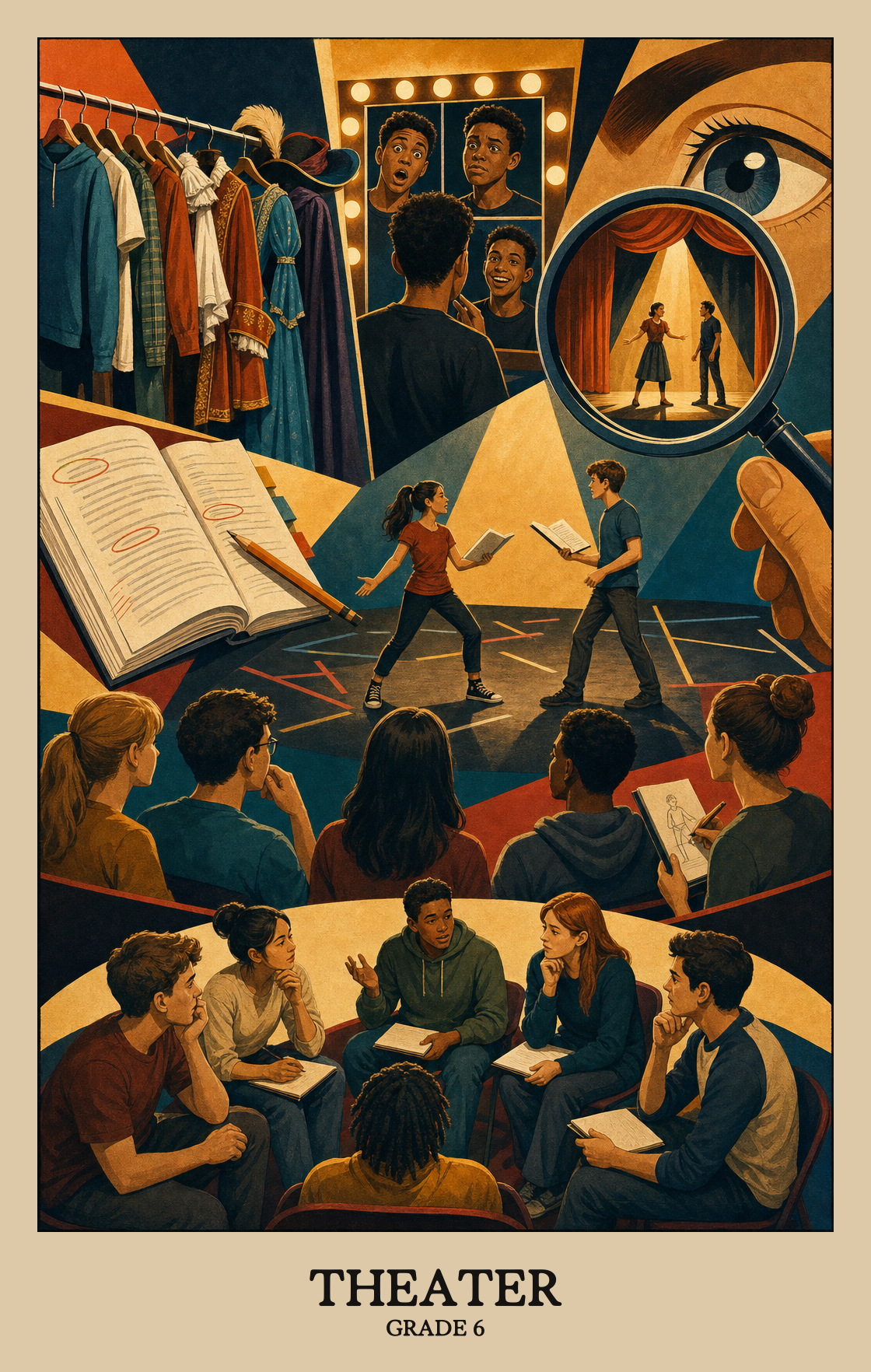
Students start the year by inventing characters and scenes from their own lives and imagination. They try out ideas through quick improvisations and short written sketches.
Students take their early ideas and turn them into scenes with a beginning, middle, and end. They make choices about who a character is, what they want, and how they speak.
Students look at plays and stories from different times and places. They notice how a play reflects the world it came from and connect it to things happening in their own lives.
Students pick a scene to perform and start polishing it. They work on voice, movement, and timing, and use feedback from classmates to make the next run-through stronger.
Students share finished scenes with classmates or family. They focus on telling the story clearly so the audience understands what the characters feel and why it matters.
Students watch performances and talk about what worked. They learn to back up their opinions with specific details from the acting, the script, or the staging.
Students connect something they have lived or read to a scene or character they are creating, using that real experience to make the work feel honest and specific.
Students look at a play or performance and connect it to the time, place, or culture it came from. That context helps explain why the story was told and what it meant to the people who first saw it.
| Standard | Definition | Code |
|---|---|---|
| Using life experience to make theater | Students connect something they have lived or read to a scene or character they are creating, using that real experience to make the work feel honest and specific. | TH:Cn10.6 |
| Theater and the world around it | Students look at a play or performance and connect it to the time, place, or culture it came from. That context helps explain why the story was told and what it meant to the people who first saw it. | TH:Cn11.6 |
Students brainstorm original ideas for a scene or character, then develop those ideas into a plan for a performance.
Students take early ideas for a scene or character and shape them into something that holds together, making choices about what to keep, cut, or change until the work is ready to share.
Students revise a scene or script based on feedback, making specific changes until the work is ready to perform or share.
| Standard | Definition | Code |
|---|---|---|
| Brainstorm ideas for a scene | Students brainstorm original ideas for a scene or character, then develop those ideas into a plan for a performance. | TH:Cr1.6 |
| Develop ideas into a scene | Students take early ideas for a scene or character and shape them into something that holds together, making choices about what to keep, cut, or change until the work is ready to share. | TH:Cr2.6 |
| Finishing and polishing a theater piece | Students revise a scene or script based on feedback, making specific changes until the work is ready to perform or share. | TH:Cr3.6 |
Students choose a scene or monologue and explain why it fits the performance they are building. The choice is deliberate, not random.
Students rehearse and refine a scene or performance before presenting it, making deliberate choices about voice, movement, and timing to strengthen the work.
Students perform a scene or monologue and make deliberate choices, like timing, movement, and tone, so the audience understands what the character feels or wants.
| Standard | Definition | Code |
|---|---|---|
| Choosing scenes worth performing | Students choose a scene or monologue and explain why it fits the performance they are building. The choice is deliberate, not random. | TH:Pr4.6 |
| Rehearse and refine a scene for performance | Students rehearse and refine a scene or performance before presenting it, making deliberate choices about voice, movement, and timing to strengthen the work. | TH:Pr5.6 |
| Perform to share a clear meaning | Students perform a scene or monologue and make deliberate choices, like timing, movement, and tone, so the audience understands what the character feels or wants. | TH:Pr6.6 |
Students watch a scene or performance and explain what choices the actors or designers made, pointing to specific moments that shaped the overall effect.
Students explain what a scene or performance is trying to say and why the playwright or actor made specific choices. They look past what happens on stage to describe what the work actually means.
Students compare a scene or performance against clear standards and explain what works, what doesn't, and why. The judgment has to be backed by reasons, not just personal taste.
| Standard | Definition | Code |
|---|---|---|
| Reading and analyzing a performance | Students watch a scene or performance and explain what choices the actors or designers made, pointing to specific moments that shaped the overall effect. | TH:Re7.6 |
| Reading what a play is really saying | Students explain what a scene or performance is trying to say and why the playwright or actor made specific choices. They look past what happens on stage to describe what the work actually means. | TH:Re8.6 |
| How to judge a performance | Students compare a scene or performance against clear standards and explain what works, what doesn't, and why. The judgment has to be backed by reasons, not just personal taste. | TH:Re9.6 |
Students learn to build characters, shape short scenes, and perform them for an audience. They also watch plays and other performances and talk about what worked and why. A lot of the year is about making choices on purpose, not just acting things out.
Start small. Read a picture book together and ask students to read one character in a different voice, or act out a short moment from a movie scene. Five minutes of low-stakes play at home builds the same muscles used in class.
Some short scenes and monologues, yes. Practicing a few lines a night out loud, with a parent reading the other part, makes a big difference. Memorizing is less about pressure and more about freeing students to focus on how they say the lines.
Start with ensemble games and improv to build trust, then move into character work and short written scenes. Save longer performance pieces and peer feedback for the second half of the year, once students can give honest, kind notes. Reflection should run through every unit.
Students can take an idea, develop it into a short scene, rehearse it with a partner, and perform it with clear choices about voice and movement. They can also watch a peer's work and explain what the actor was trying to do and how well it landed.
Giving useful feedback and revising a scene based on that feedback. Students often want to perform once and be done. Building in a clear rehearsal-feedback-rewrite cycle from the first unit pays off all year.
Pick scenes or short plays tied to a time period or culture students are studying elsewhere. Ask them to research one detail, a job, a meal, a piece of clothing, and use it in their performance. The research becomes a choice the audience can see.
Ask three questions: Who are these people? What does each one want? What is getting in the way? Most scene problems at this age come from skipping those questions. Talking it out at the kitchen table for ten minutes usually unsticks it.
By spring, students should be able to take a prompt, plan a short scene with a partner, rehearse it, and perform it with clear character choices. They should also be able to watch another group and say one specific thing that worked and one thing to try next.