Adding and subtracting within 10
Students get fast and steady with small addition and subtraction problems. They count on from a number, break numbers apart, and use what they know about adding to figure out subtraction.
This is the year students start thinking in tens, not just counting one by one. Students add and subtract within 20 using tricks like making a ten, and they learn that the number 47 means 4 tens and 7 ones. They also tell time on a clock, name coins, and split shapes into halves and fourths. By spring, students can add a two-digit number and a one-digit number and explain how they got the answer.
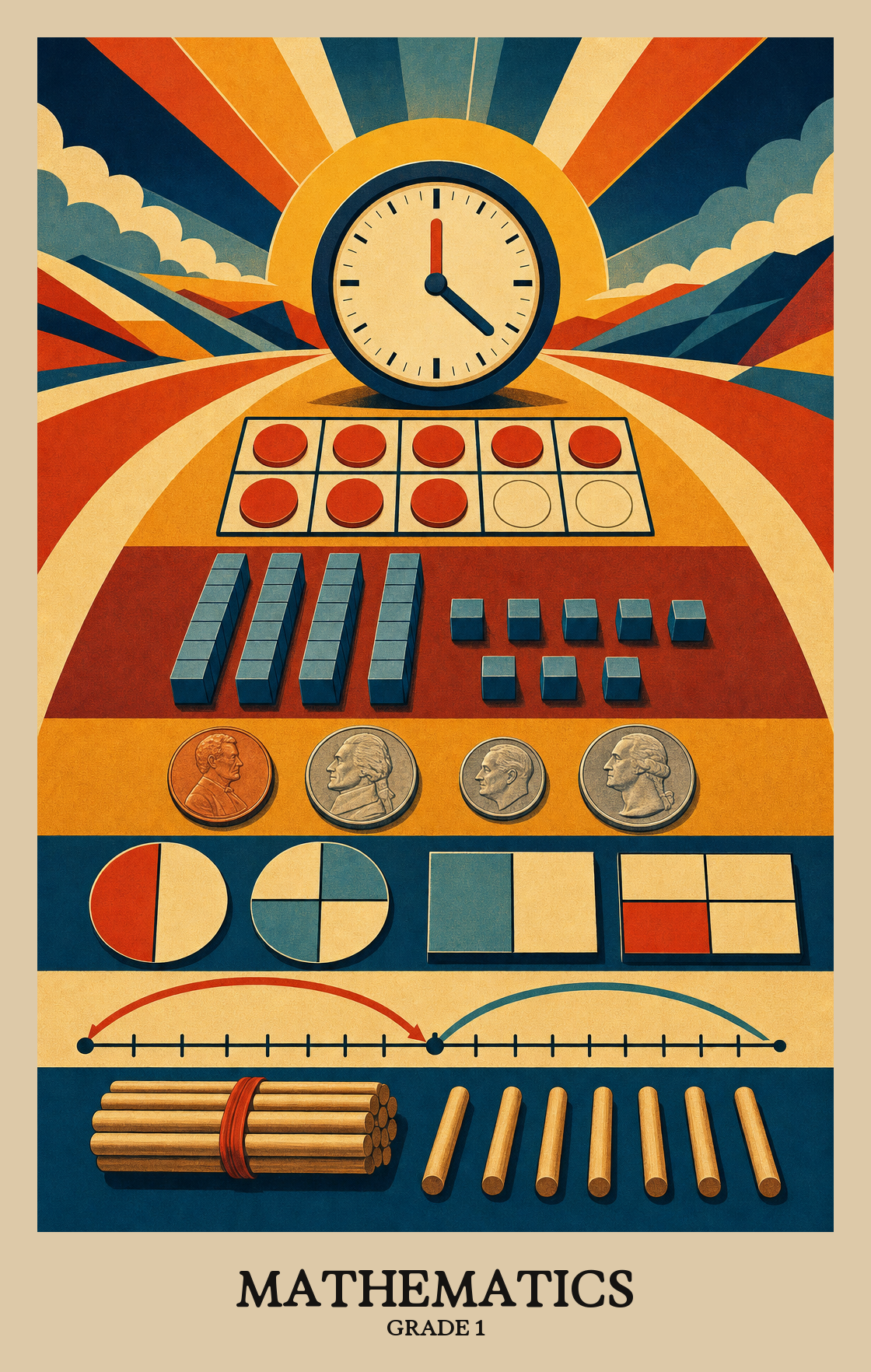
Students get fast and steady with small addition and subtraction problems. They count on from a number, break numbers apart, and use what they know about adding to figure out subtraction.
Students solve story problems by drawing pictures, using objects, and writing simple equations. They learn that the equal sign means both sides match, and they find the missing number in a problem.
Students see that a number like 47 is really 4 tens and 7 ones. They count past 100, write numbers up to 100, and compare two numbers using the signs for greater than and less than.
Students add a small number to a bigger one and add groups of ten. They can quickly say what 10 more or 10 less is, and they subtract tens like 60 minus 30.
Students line up objects to measure length, tell time to the hour and half hour, and start to recognize coins. They also sort information into groups and answer questions about it.
Students build and draw flat shapes and solid shapes, and put smaller shapes together to make new ones. They split circles and rectangles into halves and fourths.
Students solve addition and subtraction story problems where a number is missing. They use blocks, drawings, or number sentences with a box or symbol to find what's unknown, working with numbers up to 20.
Students add three small numbers together to solve a simple story problem, like finding out how many apples are in three baskets. They show their work with drawings, objects, or a number sentence that includes a missing number.
Adding numbers in any order gives the same sum (3 + 5 = 5 + 3). Students also learn to regroup numbers to make adding easier, like solving 2 + 9 by thinking of it as 9 + 2.
When a number is missing from an addition problem, students figure it out by counting up or by turning the problem into subtraction. This works with any numbers up to 20.
Students add and subtract any two numbers up to 10 quickly and accurately, without counting on fingers. By the end of first grade, these facts should come to mind the way a familiar word does.
Students add and subtract with numbers up to 20 using strategies like counting forward, breaking numbers apart to make a ten, or using a number line. The goal is to solve these problems without always counting from one.
The equal sign means "both sides are the same amount." Students look at an addition or subtraction equation and decide whether it is true or false by checking that both sides balance out.
Students find the missing number in an equation like 5 + ? = 12 or 14 - ? = 6. They figure out what value makes both sides of the equation balance.
| Standard | Definition | Code |
|---|---|---|
| Represent and solve addition and subtraction word problems, within 20, with… | Students solve addition and subtraction story problems where a number is missing. They use blocks, drawings, or number sentences with a box or symbol to find what's unknown, working with numbers up to 20. | NC.1.OA.1 |
| Represent and solve word problems that call for addition of three whole numbers… | Students add three small numbers together to solve a simple story problem, like finding out how many apples are in three baskets. They show their work with drawings, objects, or a number sentence that includes a missing number. | NC.1.OA.2 |
| Apply the commutative and associative properties as strategies for solving… | Adding numbers in any order gives the same sum (3 + 5 = 5 + 3). Students also learn to regroup numbers to make adding easier, like solving 2 + 9 by thinking of it as 9 + 2. | NC.1.OA.3 |
| Solve an unknown-addend problem, within 20, by using addition strategies and/or… | When a number is missing from an addition problem, students figure it out by counting up or by turning the problem into subtraction. This works with any numbers up to 20. | NC.1.OA.4 |
| Demonstrate fluency with addition and subtraction within 10 | Students add and subtract any two numbers up to 10 quickly and accurately, without counting on fingers. By the end of first grade, these facts should come to mind the way a familiar word does. | NC.1.OA.9 |
| Add and subtract, within 20, using strategies such as:<ul><li>Counting… | Students add and subtract with numbers up to 20 using strategies like counting forward, breaking numbers apart to make a ten, or using a number line. The goal is to solve these problems without always counting from one. | NC.1.OA.6 |
| Apply understanding of the equal sign to determine if equations involving… | The equal sign means "both sides are the same amount." Students look at an addition or subtraction equation and decide whether it is true or false by checking that both sides balance out. | NC.1.OA.7 |
| Determine the unknown whole number in an addition or subtraction equation… | Students find the missing number in an equation like 5 + ? = 12 or 14 - ? = 6. They figure out what value makes both sides of the equation balance. | NC.1.OA.8 |
Students count forward to 150, starting from any number, not just 1. This builds the mental number line students need before they start adding and subtracting larger numbers.
Students read and write numbers up to 100, and can look at a group of objects and write down how many there are.
A two-digit number like 47 means 4 groups of ten and 7 leftovers. Students practice breaking numbers into tens and ones, so 30 means three tens and nothing left over.
Students look at two numbers and decide which is bigger, smaller, or equal, then write the answer using the symbols >, =, or <. The tens place gets checked first, then the ones.
Students add numbers up to 100 by breaking them into tens and ones, like combining 34 and 5, or 34 and 20. They use blocks or drawings and explain how they got the answer.
Students pick a number like 43 and figure out in their head what 10 more or 10 less would be, without counting up or back. Then they explain how they knew.
Students subtract numbers like 70 minus 40 using blocks, drawings, or a number line, then explain how they got the answer.
| Standard | Definition | Code |
|---|---|---|
| Count to 150, starting at any number less than 150 | Students count forward to 150, starting from any number, not just 1. This builds the mental number line students need before they start adding and subtracting larger numbers. | NC.1.NBT.1 |
| Read and write numerals | Students read and write numbers up to 100, and can look at a group of objects and write down how many there are. | NC.1.NBT.7 |
| Understand that the two digits of a two-digit number represent amounts of tens… | A two-digit number like 47 means 4 groups of ten and 7 leftovers. Students practice breaking numbers into tens and ones, so 30 means three tens and nothing left over. | NC.1.NBT.2 |
| Compare two two-digit numbers based on the value of the tens and ones digits… | Students look at two numbers and decide which is bigger, smaller, or equal, then write the answer using the symbols >, =, or <. The tens place gets checked first, then the ones. | NC.1.NBT.3 |
| Using concrete models or drawings, strategies based on place value, properties… | Students add numbers up to 100 by breaking them into tens and ones, like combining 34 and 5, or 34 and 20. They use blocks or drawings and explain how they got the answer. | NC.1.NBT.4 |
| Given a two-digit number, mentally find 10 more or 10 less than the number… | Students pick a number like 43 and figure out in their head what 10 more or 10 less would be, without counting up or back. Then they explain how they knew. | NC.1.NBT.5 |
| Subtract multiples of 10 in the range 10-90 from multiples of 10 in the range… | Students subtract numbers like 70 minus 40 using blocks, drawings, or a number line, then explain how they got the answer. | NC.1.NBT.6 |
Students line up three objects from shortest to longest, then figure out which of two things is longer by comparing each one to a third object, like a piece of string or a pencil.
Students line up small objects, like paper clips or cubes, from one end of something to the other to find out how long it is. The total count of those objects is the measurement.
Reading a clock is the focus here. Students practice telling time to the hour and half-hour on both the round analog clock with hands and the digital clock with numbers.
Students learn to recognize quarters, dimes, and nickels by sight and connect each coin's value to pennies. A dime equals 10 pennies, a nickel equals 5, and a quarter equals 25.
Students sort information into groups, count what's in each group, and compare the groups to answer questions like "which has more?" or "how many fewer?"
| Standard | Definition | Code |
|---|---|---|
| Order three objects by length | Students line up three objects from shortest to longest, then figure out which of two things is longer by comparing each one to a third object, like a piece of string or a pencil. | NC.1.MD.1 |
| Measure lengths with non-standard units.<ul><li>Express the length of an object… | Students line up small objects, like paper clips or cubes, from one end of something to the other to find out how long it is. The total count of those objects is the measurement. | NC.1.MD.2 |
| Tell and write time in hours and half-hours using analog and digital clocks | Reading a clock is the focus here. Students practice telling time to the hour and half-hour on both the round analog clock with hands and the digital clock with numbers. | NC.1.MD.3 |
| Identify quarters, dimes | Students learn to recognize quarters, dimes, and nickels by sight and connect each coin's value to pennies. A dime equals 10 pennies, a nickel equals 5, and a quarter equals 25. | NC.1.MD.5 |
| Organize, represent, and interpret data with up to three categories.<ul><li>Ask… | Students sort information into groups, count what's in each group, and compare the groups to answer questions like "which has more?" or "how many fewer?" | NC.1.MD.4 |
Students sort shapes by the features that actually make them what they are, like the number of sides, not by color or size. They draw and build flat shapes like triangles and rectangles, and solid shapes like cubes and cones.
Students build new shapes by combining smaller ones, like putting a triangle on top of a square to make a house. They name each piece they used, whether the shapes are flat or solid.
Students cut circles and rectangles into two or four equal pieces, then name those pieces as halves or fourths. They also figure out that slicing a shape into more pieces makes each piece smaller.
| Standard | Definition | Code |
|---|---|---|
| Distinguish between defining and non-defining attributes and create shapes with… | Students sort shapes by the features that actually make them what they are, like the number of sides, not by color or size. They draw and build flat shapes like triangles and rectangles, and solid shapes like cubes and cones. | NC.1.G.1 |
| Create composite shapes by:<ul><li>Making a two-dimensional composite shape… | Students build new shapes by combining smaller ones, like putting a triangle on top of a square to make a house. They name each piece they used, whether the shapes are flat or solid. | NC.1.G.2 |
| Partition circles and rectangles into two and four equal… | Students cut circles and rectangles into two or four equal pieces, then name those pieces as halves or fourths. They also figure out that slicing a shape into more pieces makes each piece smaller. | NC.1.G.3 |
End-of-grade mathematics assessment for grades 3 through 8, aligned to the North Carolina Standard Course of Study.
Alternate assessment for eligible students with significant cognitive disabilities, covering state-tested grades and subjects.
Students add and subtract within 20, know their facts within 10 by heart, and count to 150 from any starting number. They also tell time to the hour and half-hour, identify coins, and break circles and rectangles into halves and fourths.
Count out loud while walking up stairs or putting away groceries. Ask quick questions like how many more apples are in one bowl than the other, or what time the clock shows. Five minutes a day adds up.
Fluency within 10 means students answer facts like 4 plus 3 quickly and accurately, without counting on fingers every time. They still use strategies like making ten or counting on for harder problems within 20.
Start with counting and writing numbers to 100, then build the idea that a ten is a bundle of ten ones. Once students see numbers as tens and ones, move into comparing two-digit numbers, finding 10 more or 10 less, and adding within 100.
That is normal early in the year. Practice making ten with small objects like buttons or cereal pieces, so students see that 8 plus 5 is the same as 10 plus 3. The goal is to move from counting every object to using known facts.
The equal sign as a balance, not a signal to write the answer, trips up many students. Word problems with an unknown in the middle, such as 8 plus what equals 13, also need repeated practice across the year.
Point to the clock during daily routines and ask what time it is to the hour or half-hour. Let students sort coins from a jar and count out small amounts using pennies, nickels, dimes, and quarters.
Students should add and subtract within 20 using flexible strategies, understand two-digit numbers as tens and ones, and compare them using greater than and less than. They should also measure with non-standard units and name basic shapes by their attributes.
Lining up paper clips end to end teaches students what a length unit actually is, with no gaps or overlaps. Once that idea is solid, the ruler in second grade makes much more sense.