Building dance ideas
Students start the year coming up with their own movement ideas. They draw from things they have seen, felt, or done, then turn those ideas into short dances they can show a partner.
This is the year dance moves from following steps to shaping a dance with a point of view. Students build short pieces from their own ideas, then revise them with feedback before performing. They start to read other dances too, naming what they see and connecting it to history or culture. By spring, students can perform a polished routine and explain what it means and why they made the choices they did.
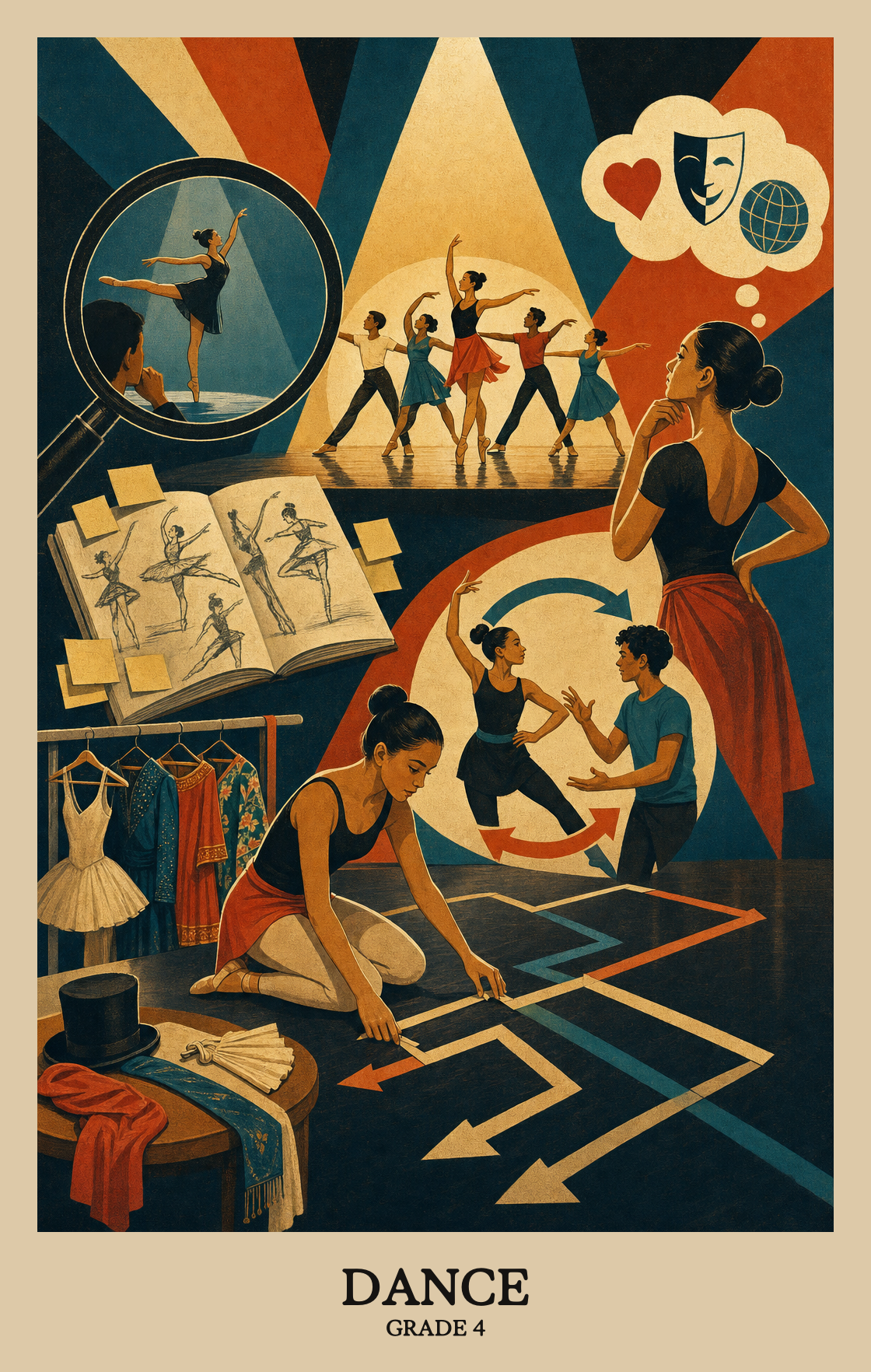
Students start the year coming up with their own movement ideas. They draw from things they have seen, felt, or done, then turn those ideas into short dances they can show a partner.
Students organize steps and shapes into longer patterns with a clear beginning, middle, and end. They try different orders and pick what works best before sharing.
Students sharpen their balance, timing, and control so a dance reads clearly from across the room. They practice with the goal of showing it to classmates or family.
Students watch dances, including their own on video, and talk about what they notice. They describe what the dance might mean and use simple checkpoints to say what worked.
Students connect dances to the places, people, and stories they come from. They look at how dance shows up in different communities and how that shapes the way it looks and feels.
Students connect something from their own life to a dance they create or perform. A memory, a feeling, or an everyday moment becomes the starting point for the movement.
Students look at a dance and figure out where, when, and why it came from. That context changes what the dance means and how it feels to watch or perform.
| Standard | Definition | Code |
|---|---|---|
| Using life experience to make dances | Students connect something from their own life to a dance they create or perform. A memory, a feeling, or an everyday moment becomes the starting point for the movement. | CA-DA:Cn10.4.4 |
| Dance and its cultural roots | Students look at a dance and figure out where, when, and why it came from. That context changes what the dance means and how it feels to watch or perform. | CA-DA:Cn11.4.4 |
Students brainstorm movement ideas and start shaping them into a short dance. They experiment with how the body can move, then pick the ideas worth developing further.
Students take a movement idea and shape it into a short dance phrase, making choices about order, timing, and repetition until the piece feels intentional.
Students revisit a dance they made, fix sections that feel off, and practice until the piece is ready to share.
| Standard | Definition | Code |
|---|---|---|
| Coming up with dance ideas | Students brainstorm movement ideas and start shaping them into a short dance. They experiment with how the body can move, then pick the ideas worth developing further. | CA-DA:Cr1.4.4 |
| Turning movement ideas into a dance | Students take a movement idea and shape it into a short dance phrase, making choices about order, timing, and repetition until the piece feels intentional. | CA-DA:Cr2.4.4 |
| Finish and polish a dance piece | Students revisit a dance they made, fix sections that feel off, and practice until the piece is ready to share. | CA-DA:Cr3.4.4 |
Students choose which dances to perform and explain why those pieces are worth sharing with an audience.
Students practice a dance phrase, spot what needs fixing, and refine their movements before performing for an audience.
Students perform a dance they have practiced and make deliberate choices, like speed or spacing, so the audience understands what the dance is about.
| Standard | Definition | Code |
|---|---|---|
| Choosing dances worth performing | Students choose which dances to perform and explain why those pieces are worth sharing with an audience. | CA-DA:Pr4.4.4 |
| Refining a dance for performance | Students practice a dance phrase, spot what needs fixing, and refine their movements before performing for an audience. | CA-DA:Pr5.4.4 |
| Perform a dance to share an idea | Students perform a dance they have practiced and make deliberate choices, like speed or spacing, so the audience understands what the dance is about. | CA-DA:Pr6.4.4 |
Students watch a dance and explain what they notice about how the movements are put together. They look for patterns, repetition, and contrast to describe how the piece is designed.
Students watch a dance and explain what the choreographer was trying to say. They describe how the movements, shape, and timing work together to tell a story or express a feeling.
Students look at a dance using specific criteria, like use of space or timing, and explain in words why those choices work or fall short.
| Standard | Definition | Code |
|---|---|---|
| Reading a dance with fresh eyes | Students watch a dance and explain what they notice about how the movements are put together. They look for patterns, repetition, and contrast to describe how the piece is designed. | CA-DA:Re7.4.4 |
| Reading meaning in a dance | Students watch a dance and explain what the choreographer was trying to say. They describe how the movements, shape, and timing work together to tell a story or express a feeling. | CA-DA:Re8.4.4 |
| Judging dance using clear criteria | Students look at a dance using specific criteria, like use of space or timing, and explain in words why those choices work or fall short. | CA-DA:Re9.4.4 |
Students make up short dances, practice them, perform for classmates, and talk about what they see in other dances. They learn that dance is a way to share an idea, a feeling, or a story, not just a set of steps to copy.
Give them space to move and a song or two. Ask them to make up a short dance about something specific, like a rainy morning or a busy kitchen, then watch it and tell them one part you noticed. Five minutes is plenty.
Start small. Let them show a short dance to one person at home before any bigger audience. Praise specific choices, like a strong ending or a clear shape, instead of saying the whole thing was good.
Most teachers loop through all three each unit rather than teaching them in big blocks. Students make something small, show it, then watch and talk about classmates' work. The pieces get longer and the feedback gets sharper as the year goes on.
Students can plan a short dance with a clear beginning, middle, and end, rehearse it on purpose, and perform it for an audience. They can also watch a classmate's dance and say what they think it means using something they actually saw.
No. The class is about making and sharing movement, not formal technique. Curiosity and a willingness to try ideas matter more than lessons outside of school.
Refining and revising. Students often want to call a first draft finished. Building in a quick rehearsal step, with one specific thing to change each time, is usually where the biggest growth happens.
Students draw on history, stories, and their own lives to come up with dance ideas. A dance about a local landmark or a folktale gives them a real reason to think about the subject more deeply.