Plants, animals, and survival
Students look at how plants and animals are built to stay alive. They study parts like roots, eyes, and ears, and explain how each part helps a living thing find food, stay safe, or grow.
This is the year science becomes about energy and evidence. Students study how energy moves through motion, sound, light, heat, and electricity, and they build small devices that turn one kind of energy into another. They also look at how wind, water, and ice shape the land, and how plants and animals use their parts to survive. By spring, students can explain why a faster ball hits harder and point to clues in rocks that show how a landscape changed.
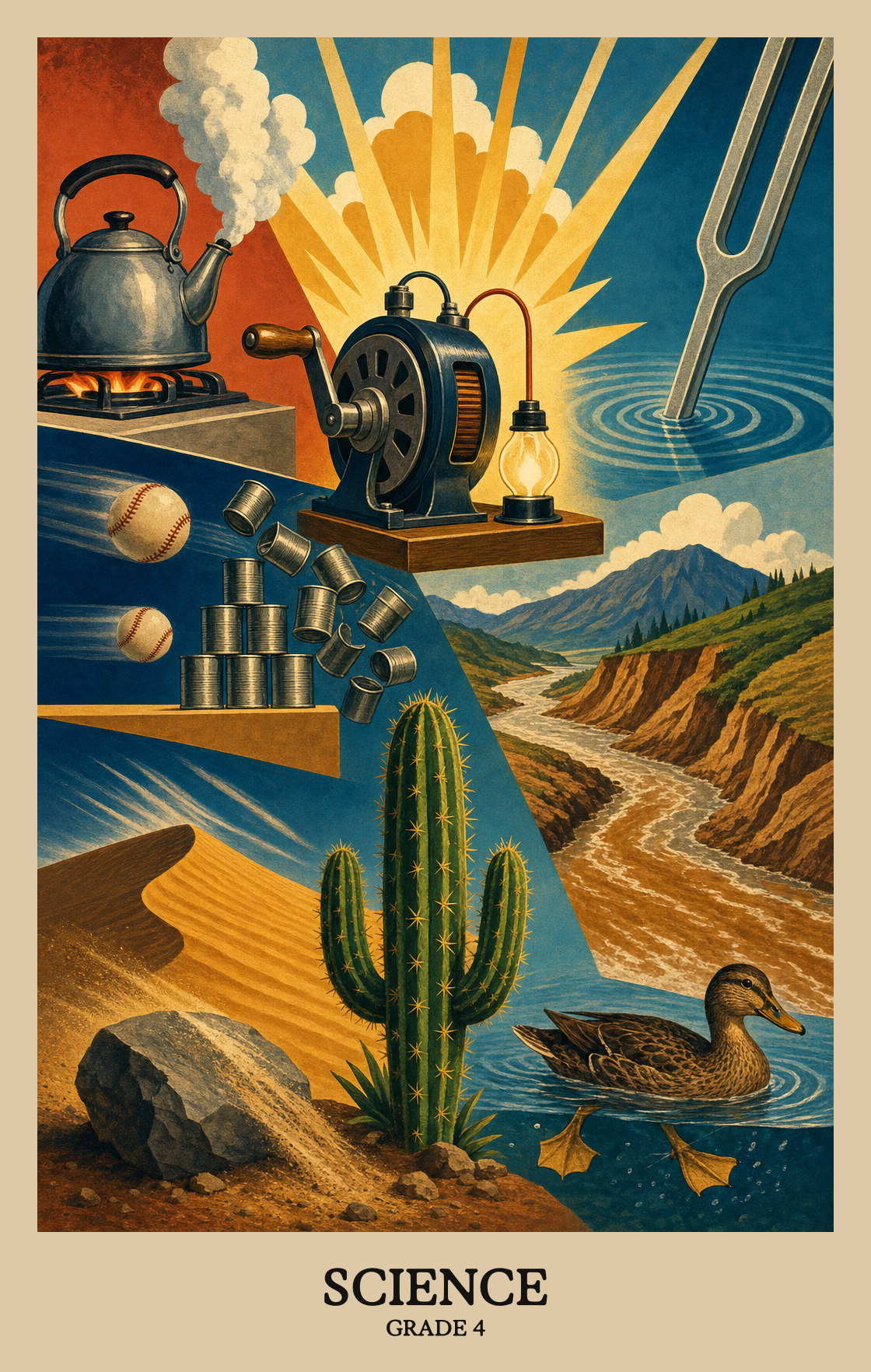
Students look at how plants and animals are built to stay alive. They study parts like roots, eyes, and ears, and explain how each part helps a living thing find food, stay safe, or grow.
Students explore how moving things carry energy. They notice that a faster ball hits harder, and they watch what happens when objects bump, roll, or crash into each other.
Students study how energy travels through sound, light, heat, and electricity. They build models of waves, see how light bouncing off objects lets the eye see them, and compare ways people send messages with patterns.
Students act like engineers. They design and test a small device that turns one kind of energy into another, then change the design to make it work better.
Students read the story of the land. They study rock layers and fossils for clues about the past, watch how water, wind, and ice wear down the ground, and use maps to spot patterns in mountains, rivers, and coastlines.
Students learn where energy and fuels come from and how using them changes the world around us. They think about choices people make with water, land, and power.
Rock layers act like a timeline. Students read clues in stacked stone and fossils to explain how a landscape changed over millions of years.
Rocks and soil don't stay the same forever. Students observe how water, wind, ice, or plant roots slowly break down and move rock and soil, then use measurements or notes from those observations as evidence to explain what caused the change.
Students read maps to spot patterns in where mountains, valleys, volcanoes, and ocean trenches show up. They use those patterns to explain how Earth's surface is arranged.
Students learn where energy comes from, such as wood, coal, sunlight, and wind, and look at how using those resources changes the land, air, and water around us.
| Standard | Definition | Code |
|---|---|---|
| Identify evidence from patterns in rock formations and fossils in rock layers… | Rock layers act like a timeline. Students read clues in stacked stone and fossils to explain how a landscape changed over millions of years. | CA-4-ESS1-1.4 |
| Make observations and/or measurements to provide evidence of the effects of… | Rocks and soil don't stay the same forever. Students observe how water, wind, ice, or plant roots slowly break down and move rock and soil, then use measurements or notes from those observations as evidence to explain what caused the change. | CA-4-ESS2-1.4 |
| Analyze and interpret data from maps to describe patterns of Earth’s features | Students read maps to spot patterns in where mountains, valleys, volcanoes, and ocean trenches show up. They use those patterns to explain how Earth's surface is arranged. | CA-4-ESS2-2.4 |
| Obtain and combine information to describe that energy and fuels are derived… | Students learn where energy comes from, such as wood, coal, sunlight, and wind, and look at how using those resources changes the land, air, and water around us. | CA-4-ESS3-1.4 |
Plants and animals have body parts inside and out that help them survive, grow, and reproduce. Students study those structures and build an argument explaining what each one does and why it matters.
Students show how an animal uses its senses to take in information, how the brain processes that signal, and how the body reacts. Think: a dog hears a noise, recognizes it, then runs toward the door.
| Standard | Definition | Code |
|---|---|---|
| Construct an argument that plants and animals have internal and external… | Plants and animals have body parts inside and out that help them survive, grow, and reproduce. Students study those structures and build an argument explaining what each one does and why it matters. | CA-4-LS1-1.4 |
| Use a model to describe that animals receive different types of information… | Students show how an animal uses its senses to take in information, how the brain processes that signal, and how the body reacts. Think: a dog hears a noise, recognizes it, then runs toward the door. | CA-4-LS1-2.4 |
Students explain why a faster-moving object has more energy than a slower one. They use observations or data as evidence to back up that explanation.
Students watch and record how energy moves from one place to another, through sound, light, heat, and electricity. A ringing bell, a lit bulb, a warm stove, and a running fan all show energy traveling from a source to somewhere new.
Students watch two objects collide and predict what will happen to their speed, sound, or movement. The focus is on noticing how energy changes hands when things bump into each other.
Students design and test a simple device that changes one kind of energy into another, like turning motion into electricity or heat into movement. Then they use what they learn from testing to improve it.
Waves carry energy and can push or pull objects. Students learn to draw and describe waves, including how tall a wave is (its amplitude) and how long each wave is from peak to peak (its wavelength).
Students learn why they can see things: light bounces off objects and travels into the eye. They draw or diagram that process to show how seeing actually works.
Students design and compare different ways to send information using patterns, like how a flashing light or a repeating sound signal can carry a message from one place to another.
| Standard | Definition | Code |
|---|---|---|
| Use evidence to construct an explanation relating the speed of an object to the… | Students explain why a faster-moving object has more energy than a slower one. They use observations or data as evidence to back up that explanation. | CA-4-PS3-1.4 |
| Make observations to provide evidence that energy can be transferred from place… | Students watch and record how energy moves from one place to another, through sound, light, heat, and electricity. A ringing bell, a lit bulb, a warm stove, and a running fan all show energy traveling from a source to somewhere new. | CA-4-PS3-2.4 |
| Ask questions and predict outcomes about the changes in energy that occur when… | Students watch two objects collide and predict what will happen to their speed, sound, or movement. The focus is on noticing how energy changes hands when things bump into each other. | CA-4-PS3-3.4 |
| Apply scientific ideas to design, test | Students design and test a simple device that changes one kind of energy into another, like turning motion into electricity or heat into movement. Then they use what they learn from testing to improve it. | CA-4-PS3-4.4 |
| Develop a model of waves to describe patterns in terms of amplitude and… | Waves carry energy and can push or pull objects. Students learn to draw and describe waves, including how tall a wave is (its amplitude) and how long each wave is from peak to peak (its wavelength). | CA-4-PS4-1.4 |
| Develop a model to describe that light reflecting from objects and entering the… | Students learn why they can see things: light bounces off objects and travels into the eye. They draw or diagram that process to show how seeing actually works. | CA-4-PS4-2.4 |
| Generate and compare multiple solutions that use patterns to transfer… | Students design and compare different ways to send information using patterns, like how a flashing light or a repeating sound signal can carry a message from one place to another. | CA-4-PS4-3.4 |
The grade 5 science test in the CAASPP suite, based on the California Next Generation Science Standards. Online test covering Physical, Life, Earth and Space, and Engineering science.
The state science test for students with the most significant cognitive disabilities. Replaces the CAST in grades 5, 8, and once during high school for the small group of students whose IEP teams qualify them.
Students study three big areas: how the Earth changes through things like erosion and fossils, how plants and animals use their body parts and senses to survive, and how energy moves through motion, light, sound, heat, and electricity.
Notice science in daily life. Watch how rain wears down a dirt patch, talk about why a bike speeds up going downhill, or point out how a pet uses its ears and nose. A short conversation about what students see counts as real practice.
Students should be able to explain how the land changes over time, describe how body parts and senses help living things survive, and connect the speed of an object to how much energy it has. They should also be able to design a small device that moves energy from one form to another.
Many teachers start with energy and motion because students can see and test it right away with ramps, balls, and circuits. Life science fits well in winter with structures and senses, and Earth science lands well in spring when weather and erosion are easy to observe outside.
Energy transfer trips students up, especially the idea that sound and light carry energy from one place to another. Waves and amplitude also need more time than the pacing guide suggests. Plan extra hands-on rounds for both.
No. Most of the work this year is building explanations from evidence, like using fossils to explain how a place once looked or using a ramp test to explain why a faster ball hits harder. Asking students what they observed and why they think it happened matters more than quizzing vocabulary.
Build a simple ramp from a book and a cookie sheet, then race toy cars from different heights. Ask which car had more energy and how you can tell. It covers speed, energy, and collisions in about fifteen minutes.
Aim for roughly half the science time on investigations, models, and building. Students remember energy, waves, and erosion far better when they have tested them. Reading and writing then give students a way to explain what they found.
Students are ready when they can look at a simple observation, like a fossil photo or a ramp test, and write or say an explanation backed by what they noticed. Comfort with drawing labeled models of waves, senses, or energy flow is another strong signal.