Forces and motion
Students push, pull, and roll objects to see how forces change motion. They look for patterns in how things move so they can predict what happens next, like a swing or a ball on a ramp.
This is the year science becomes about evidence. Students push and pull objects to see how forces change motion, then look for patterns they can use to predict what happens next. They study how living things grow up, pass traits to their young, and survive in a habitat. By spring, students can read a weather chart, explain why a trait helps an animal live where it does, and back up an answer with what they observed.
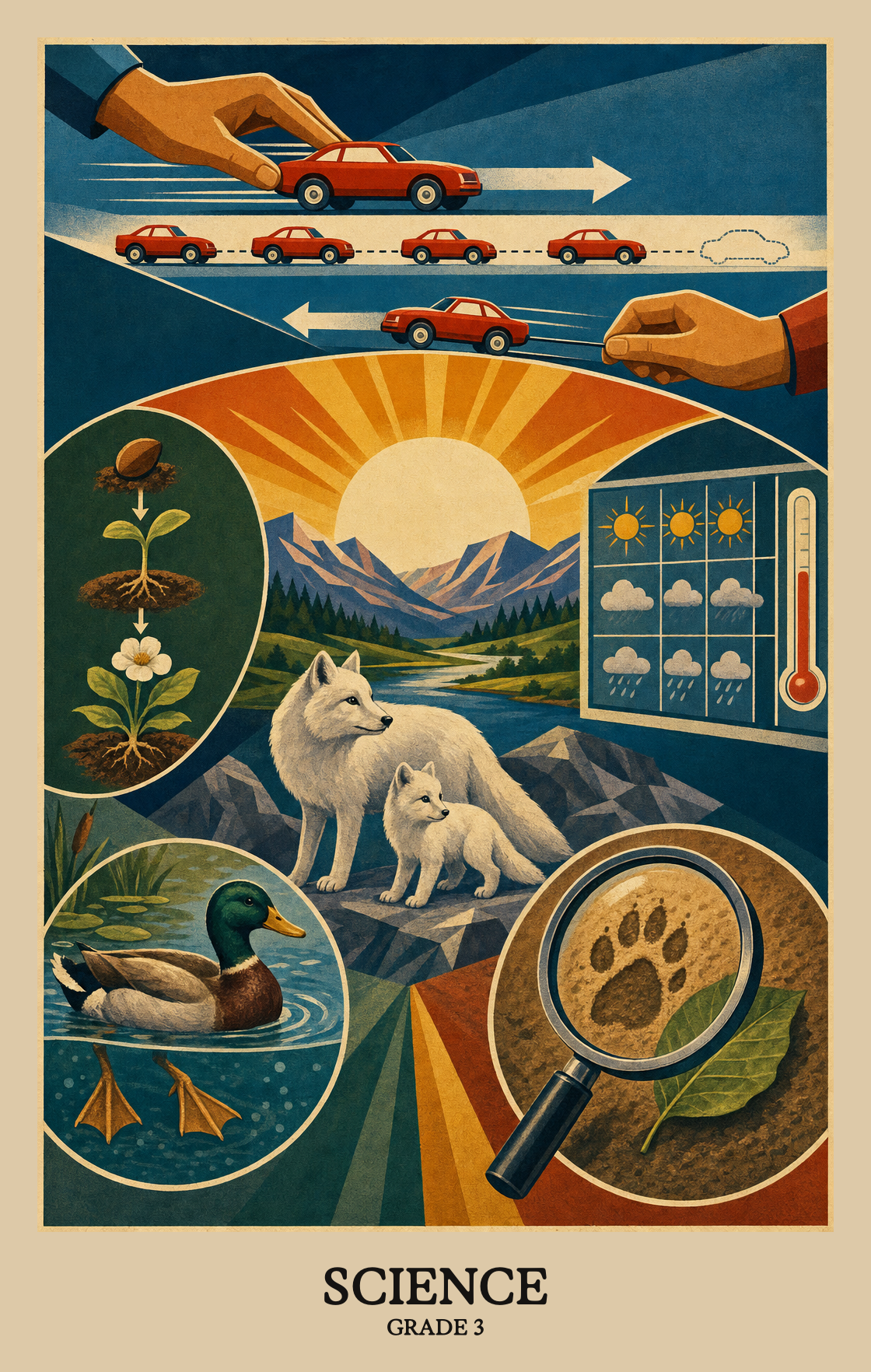
Students push, pull, and roll objects to see how forces change motion. They look for patterns in how things move so they can predict what happens next, like a swing or a ball on a ramp.
Students explore how magnets and static electricity can push or pull without touching. They ask questions about why a magnet sticks to one thing but not another, then use that idea to solve a small design problem.
Students compare how plants, insects, and animals grow up. They notice which traits come from parents, like eye color or petal shape, and which ones get shaped by where a plant or animal lives.
Students study fossils and living animals to see why some survive in a habitat and others do not. They build an argument, with evidence, about how a trait like sharp claws or thick fur helps an animal get by.
Students chart temperature and rainfall to describe what a season usually looks like where they live. They then judge design ideas, like a storm shutter or a levee, that protect people from weather hazards.
Students record weather data in charts and graphs to show what weather a season typically brings, like how much it rains in spring or how cold winters get.
Students look at a real design (a seawall, a storm drain, a wind barrier) and argue whether it actually helps protect people from weather like floods or heavy wind. They back up their opinion with evidence.
| Standard | Definition | Code |
|---|---|---|
| Represent data in tables and graphical displays to describe typical weather… | Students record weather data in charts and graphs to show what weather a season typically brings, like how much it rains in spring or how cold winters get. | CA-3-ESS2-1.3 |
| Make a claim about the merit of a design solution that reduces the impacts of a… | Students look at a real design (a seawall, a storm drain, a wind barrier) and argue whether it actually helps protect people from weather like floods or heavy wind. They back up their opinion with evidence. | CA-3-ESS3-1.3 |
Every living thing is born, grows, reproduces, and dies. Students build models showing how that pattern plays out differently across animals and plants, a frog's cycle looks nothing like a pine tree's, but the same four stages show up in both.
Plants and animals inherit traits from their parents, like color, size, or shape. Students look at real examples to see how those traits vary from one individual to the next, even within the same species.
Students learn that a plant grown in shade or a pet raised differently can look or act unlike its relatives. Traits come from parents, but surroundings shape them too.
Fossils are clues about animals and plants that lived long ago. Students study fossil data to figure out what those creatures looked like and what kind of place they called home.
Some animals are born slightly different from others of their kind. Students learn how those differences, like better camouflage or sharper senses, can help certain individuals survive longer and raise more offspring.
Some animals and plants thrive in a habitat, others just get by, and some cannot live there at all. Students use evidence to explain why a habitat suits certain organisms better than others.
Students look at a real environmental change (a drought, a flood, a habitat cleared for roads) and argue whether a proposed fix would actually help the plants and animals that live there.
| Standard | Definition | Code |
|---|---|---|
| Develop models to describe that organisms have unique and diverse life cycles… | Every living thing is born, grows, reproduces, and dies. Students build models showing how that pattern plays out differently across animals and plants, a frog's cycle looks nothing like a pine tree's, but the same four stages show up in both. | CA-3-LS1-1.3 |
| Analyze and interpret data to provide evidence that plants and animals have… | Plants and animals inherit traits from their parents, like color, size, or shape. Students look at real examples to see how those traits vary from one individual to the next, even within the same species. | CA-3-LS3-1.3 |
| Use evidence to support the explanation that traits can be influenced by the… | Students learn that a plant grown in shade or a pet raised differently can look or act unlike its relatives. Traits come from parents, but surroundings shape them too. | CA-3-LS3-2.3 |
| Analyze and interpret data from fossils to provide evidence of the organisms… | Fossils are clues about animals and plants that lived long ago. Students study fossil data to figure out what those creatures looked like and what kind of place they called home. | CA-3-LS4-1.3 |
| Use evidence to construct an explanation for how the variations in… | Some animals are born slightly different from others of their kind. Students learn how those differences, like better camouflage or sharper senses, can help certain individuals survive longer and raise more offspring. | CA-3-LS4-2.3 |
| Construct an argument with evidence that in a particular habitat some organisms… | Some animals and plants thrive in a habitat, others just get by, and some cannot live there at all. Students use evidence to explain why a habitat suits certain organisms better than others. | CA-3-LS4-3.3 |
| Make a claim about the merit of a solution to a problem caused when the… | Students look at a real environmental change (a drought, a flood, a habitat cleared for roads) and argue whether a proposed fix would actually help the plants and animals that live there. | CA-3-LS4-4.3 |
Students push, pull, and observe objects to learn how balanced forces keep things still and unbalanced forces make them move or change direction.
Students watch how an object moves, such as a ball rolling down a ramp, and look for a pattern. Then they use that pattern to predict what the object will do next.
Students ask questions about what causes two magnets or two charged objects to push or pull each other without touching. They look for patterns in what changes when the objects move closer, farther apart, or switch positions.
Students identify a real problem (like keeping a cabinet shut or sorting metal from plastic) and explain how magnets could solve it. They connect what they know about magnetic attraction to a specific, practical fix.
| Standard | Definition | Code |
|---|---|---|
| Plan and conduct an investigation to provide evidence of the effects of… | Students push, pull, and observe objects to learn how balanced forces keep things still and unbalanced forces make them move or change direction. | CA-3-PS2-1.3 |
| Make observations and/or measurements of an object’s motion to provide evidence… | Students watch how an object moves, such as a ball rolling down a ramp, and look for a pattern. Then they use that pattern to predict what the object will do next. | CA-3-PS2-2.3 |
| Ask questions to determine cause and effect relationships of electric or… | Students ask questions about what causes two magnets or two charged objects to push or pull each other without touching. They look for patterns in what changes when the objects move closer, farther apart, or switch positions. | CA-3-PS2-3.3 |
| Define a simple design problem that can be solved by applying scientific ideas… | Students identify a real problem (like keeping a cabinet shut or sorting metal from plastic) and explain how magnets could solve it. They connect what they know about magnetic attraction to a specific, practical fix. | CA-3-PS2-4.3 |
The grade 5 science test in the CAASPP suite, based on the California Next Generation Science Standards. Online test covering Physical, Life, Earth and Space, and Engineering science.
The state science test for students with the most significant cognitive disabilities. Replaces the CAST in grades 5, 8, and once during high school for the small group of students whose IEP teams qualify them.
Students study three big areas: weather and how to prepare for storms, living things and how they grow and change, and forces like pushes, pulls, and magnets. Most of the work is hands-on. Students ask questions, run small experiments, and explain what they notice using evidence.
Talk about what students see outside. Track the weather for a week on a simple chart, watch a plant grow on the windowsill, or test which magnets stick to the fridge and which do not. Ask one question: why do you think that happened?
Look at family photos and talk about traits that pass from parents to children, like eye color or curly hair. Then compare it to pets or backyard animals. This connects directly to the year's work on life cycles, inherited traits, and how some animals survive better in certain habitats.
A common path is forces and motion in the fall, life cycles and traits in the winter, and weather, climate, and habitats in the spring. Fossils and habitat change fit well near the end because they pull together traits, environment, and survival.
Inherited traits versus environmental influence trips students up, since both shape how a plant or animal looks. Cause and effect with magnets and static electricity also needs extra rounds, because students want to touch the objects instead of observing action at a distance.
Stick with short investigations students can run in one class period. Rolling cars down ramps, testing magnets through paper and water, graphing daily temperatures, and observing mealworms or bean seeds all hit the standards without heavy setup.
Students move from describing what they see to using evidence to explain why. They start making claims, supporting them with data from a chart or an experiment, and arguing for one design over another. The science is still concrete, but the thinking gets sharper.
By spring, students should be able to read a simple data table, describe a pattern, and back up an idea with something they observed. They should also be comfortable working in small groups to plan a short test and share what they found.