Imagining characters and stories
Students invent characters, settings, and short story ideas of their own. At home, you might hear them act out a made-up scene or dream up a new world for a familiar toy.
This is the year theater shifts from playing pretend to building scenes on purpose. Students invent characters, plan what happens on stage, and rehearse with simple choices about voice and movement. They also start talking about plays they watch, sharing what worked and what a scene was really about. By spring, students can help create a short scene, perform a role they practiced, and explain why a character did what they did.
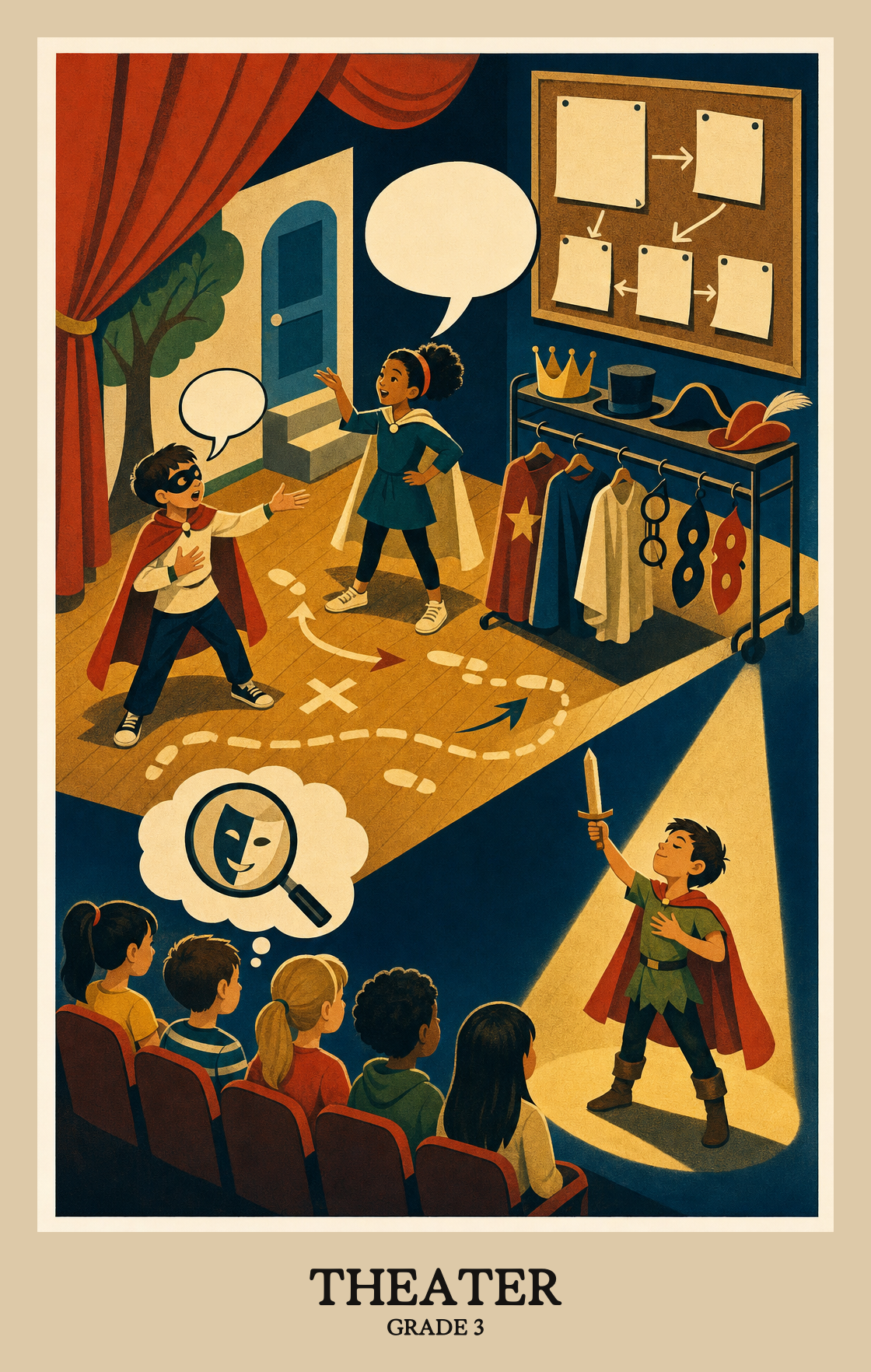
Students invent characters, settings, and short story ideas of their own. At home, you might hear them act out a made-up scene or dream up a new world for a familiar toy.
Students work in small groups to turn an idea into a short scene. They try out different choices, listen to classmates, and rework parts that did not land the first time.
Students practice using their voice, face, and body to play a character on purpose. They rehearse a piece they will share, paying attention to what the audience needs to hear and see.
Students watch plays and classmates' scenes and talk about what they noticed. They give kind, specific feedback and explain what a scene might mean and why.
Students connect scenes to their own experiences and to stories from different places and times. They start to see how plays reflect the people who make them and the people watching.
Students connect something from their own life to a story or scene they perform. A memory, a feeling, or something they've seen helps make the character or moment feel real.
Students look at a play or performance and ask where it came from: what culture, time period, or community shaped it. That context helps students understand why the story matters and what it meant to the people who first told it.
| Standard | Definition | Code |
|---|---|---|
| Using life experiences to make theater | Students connect something from their own life to a story or scene they perform. A memory, a feeling, or something they've seen helps make the character or moment feel real. | CA-TH:Cn10.3.3 |
| Theater stories across time and culture | Students look at a play or performance and ask where it came from: what culture, time period, or community shaped it. That context helps students understand why the story matters and what it meant to the people who first told it. | CA-TH:Cn11.3.3 |
Students brainstorm characters, settings, and story ideas to build a short scene or play. They turn those ideas into something a group can actually perform.
Students take their story idea and shape it into a short scene, deciding what characters say and do and what order events happen in.
Students revisit a scene or character choice, make changes based on feedback, and practice until the work feels finished and ready to share.
| Standard | Definition | Code |
|---|---|---|
| Brainstorm ideas for a scene | Students brainstorm characters, settings, and story ideas to build a short scene or play. They turn those ideas into something a group can actually perform. | CA-TH:Cr1.3.3 |
| Turning ideas into a short play | Students take their story idea and shape it into a short scene, deciding what characters say and do and what order events happen in. | CA-TH:Cr2.3.3 |
| Finish and polish a theater piece | Students revisit a scene or character choice, make changes based on feedback, and practice until the work feels finished and ready to share. | CA-TH:Cr3.3.3 |
Students choose a scene or story to perform and explain why it fits what they want to show an audience.
Students practice a scene or monologue more than once, working on voice, movement, and timing until the performance is ready to share with an audience.
Students perform a scene or monologue and make deliberate choices, like tone of voice or movement, so the audience understands what the character thinks or feels.
| Standard | Definition | Code |
|---|---|---|
| Choosing a scene to perform | Students choose a scene or story to perform and explain why it fits what they want to show an audience. | CA-TH:Pr4.3.3 |
| Rehearse and improve a performance | Students practice a scene or monologue more than once, working on voice, movement, and timing until the performance is ready to share with an audience. | CA-TH:Pr5.3.3 |
| Perform to share a story or feeling | Students perform a scene or monologue and make deliberate choices, like tone of voice or movement, so the audience understands what the character thinks or feels. | CA-TH:Pr6.3.3 |
Students watch a scene or performance and explain what they notice: what the actors do, how the story feels, and why specific choices stand out to them.
Students explain what they think a scene or character means and why the playwright or performer made specific choices. There is no single right answer, but students back up their thinking with details from what they saw or heard.
Students look at a piece of theater and decide what makes it work well or fall short. They use a short list of agreed-on rules, like whether the actors spoke clearly or the story made sense, to back up their opinion.
| Standard | Definition | Code |
|---|---|---|
| Noticing what makes a performance work | Students watch a scene or performance and explain what they notice: what the actors do, how the story feels, and why specific choices stand out to them. | CA-TH:Re7.3.3 |
| What a play is trying to say | Students explain what they think a scene or character means and why the playwright or performer made specific choices. There is no single right answer, but students back up their thinking with details from what they saw or heard. | CA-TH:Re8.3.3 |
| Judging what makes a performance work | Students look at a piece of theater and decide what makes it work well or fall short. They use a short list of agreed-on rules, like whether the actors spoke clearly or the story made sense, to back up their opinion. | CA-TH:Re9.3.3 |
Students make up short scenes, act out stories, and try on characters using voice and body. They also watch each other perform and talk about what worked. The focus is on building ideas together, not memorizing big scripts or staging full productions.
Ask students to act out a favorite scene from a book or movie and play one of the characters yourself. Talk about how a character feels and how their voice or face might show it. Five minutes of pretend play counts as real practice.
Not at this age. Most of the work happens in the classroom, in small groups, with short improvised scenes. Some teachers share a short performance with families, but the goal is confidence and creative thinking, not a polished show.
Shy students still grow a lot in theater. Start at home with puppets, stuffed animals, or voices behind a couch so performing feels like play. Praise the idea or the choice, not the bravery, so it stays low pressure.
Start with imagination and ensemble games so students learn to trust each other and offer ideas. Move into building characters and short scenes by midyear. End the year with small group pieces where students plan, rehearse, give feedback, and revise.
Staying in character past the first laugh, listening to a scene partner instead of waiting to talk, and giving feedback that points to a specific moment. Short, repeated practice with clear examples helps more than long lessons.
Pull a scene from a class read-aloud or a moment from a social studies unit and let students act it out. This covers the connection standards and gives reluctant readers another way into the text. It also makes planning lighter since the content is already familiar.
Students can build a character with a clear voice and body, work in a small group to shape a short scene, and talk about a performance using specific details. They can also revise a scene after getting feedback instead of starting over.