Generating ideas from experience
Students start the year by turning their own memories, interests, and observations into art. They sketch, brainstorm, and try out different ways to picture an idea before picking one to develop.
This is the year art moves from making to thinking about making. Students plan a piece before they start, try different materials, and go back to fix what isn't working. They look at art from other times and places and talk about what the artist might have meant. By spring, they can choose a finished piece to display and explain why they made the choices they did.
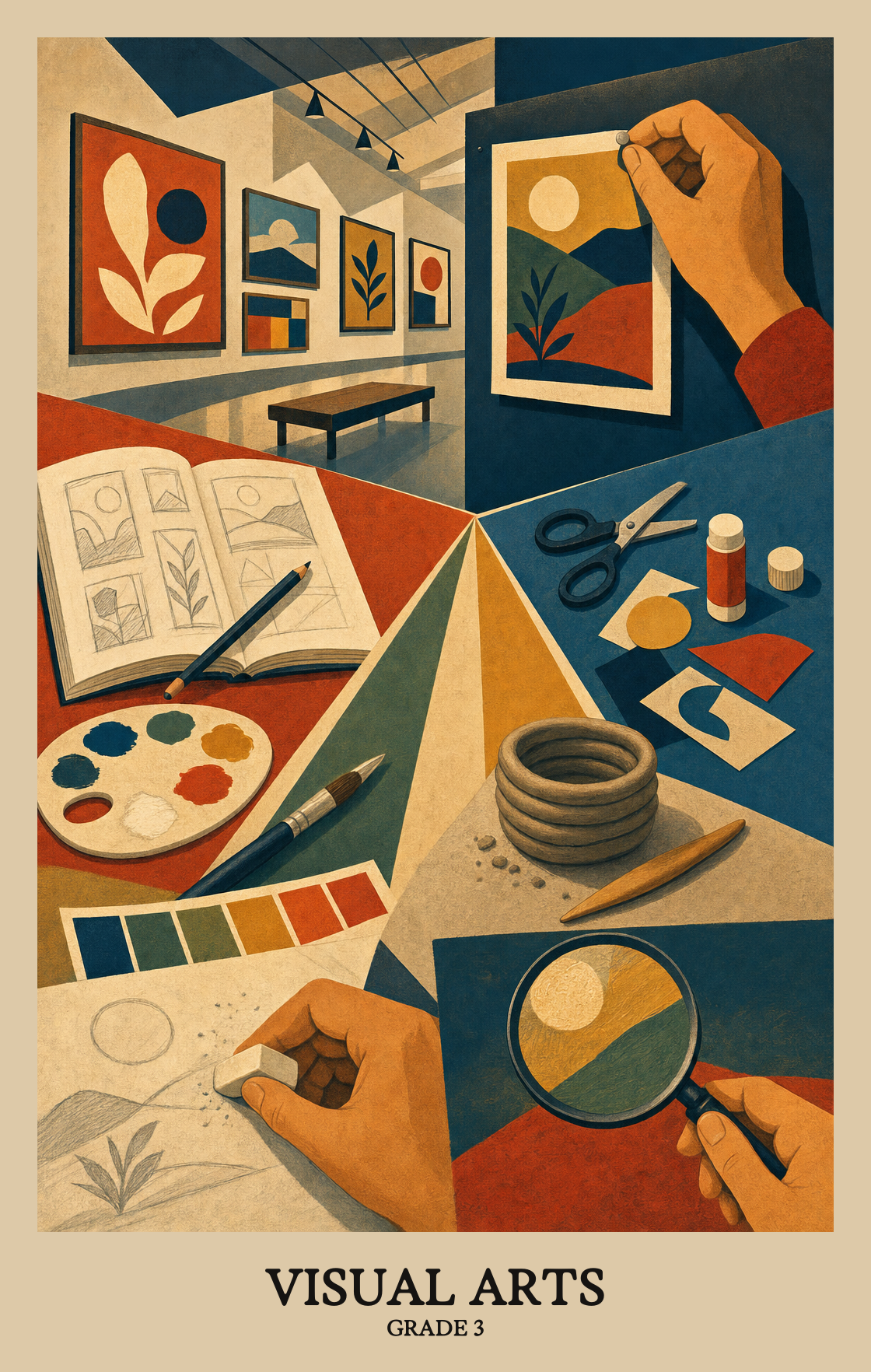
Students start the year by turning their own memories, interests, and observations into art. They sketch, brainstorm, and try out different ways to picture an idea before picking one to develop.
Students practice with pencils, paint, paper, and clay to learn what each material can do. They focus on craft, like mixing colors or shaping forms, and start making choices about which tools fit their idea.
Students look at art from different places and time periods and talk about what they notice. They connect what artists made long ago or far away to ideas in their own work.
Students learn to slow down and describe what they see in a piece of art, including their own. They use simple criteria to talk about what is working and what could be stronger.
Students revise a piece, decide how to display it, and explain what it means. By year end, they can present a finished artwork and talk about the choices behind it.
Students draw on things they already know and moments from their own life to make creative choices in their artwork.
Students look at a piece of artwork and think about where, when, and why it was made. Knowing that context helps them understand what the artist was trying to say.
| Standard | Definition | Code |
|---|---|---|
| Using personal experiences to make art | Students draw on things they already know and moments from their own life to make creative choices in their artwork. | CA-VA:Cn10.3.3 |
| Art from different times and places | Students look at a piece of artwork and think about where, when, and why it was made. Knowing that context helps them understand what the artist was trying to say. | CA-VA:Cn11.3.3 |
Students brainstorm ideas for their own artwork, then decide what they want to make and how to make it.
Students pick a subject, decide how to arrange colors and shapes, and turn a rough idea into a finished piece of art.
Students look back at a drawing or artwork they started, fix what isn't working, and decide when it's finished.
| Standard | Definition | Code |
|---|---|---|
| Coming up with ideas for art | Students brainstorm ideas for their own artwork, then decide what they want to make and how to make it. | CA-VA:Cr1.3.3 |
| Develop an original artwork from start to finish | Students pick a subject, decide how to arrange colors and shapes, and turn a rough idea into a finished piece of art. | CA-VA:Cr2.3.3 |
| Finish and refine your artwork | Students look back at a drawing or artwork they started, fix what isn't working, and decide when it's finished. | CA-VA:Cr3.3.3 |
Students choose which of their artworks to display and explain why that piece best shows what they were trying to make.
Students practice and improve a piece of artwork until it is ready to share with an audience. That might mean adding detail, fixing a line, or choosing how to display the finished work.
Students choose how to display their artwork and explain what they want viewers to notice or feel. The presentation itself becomes part of the message.
| Standard | Definition | Code |
|---|---|---|
| Choosing art to share with others | Students choose which of their artworks to display and explain why that piece best shows what they were trying to make. | CA-VA:Pr4.3.3 |
| Improve artwork before showing it | Students practice and improve a piece of artwork until it is ready to share with an audience. That might mean adding detail, fixing a line, or choosing how to display the finished work. | CA-VA:Pr5.3.3 |
| Sharing art to say something meaningful | Students choose how to display their artwork and explain what they want viewers to notice or feel. The presentation itself becomes part of the message. | CA-VA:Pr6.3.3 |
Students look closely at a piece of art and describe what they notice, from the colors and shapes used to how the whole thing feels. Then they start to explain why the artist may have made those choices.
Students look at a piece of art and explain what they think the artist was trying to say or show. They use details in the work to back up what they think it means.
Students look at their own or a classmate's artwork and decide what's working and what could improve, using a clear set of questions or rules to guide their thinking.
| Standard | Definition | Code |
|---|---|---|
| Looking closely at a piece of art | Students look closely at a piece of art and describe what they notice, from the colors and shapes used to how the whole thing feels. Then they start to explain why the artist may have made those choices. | CA-VA:Re7.3.3 |
| Reading meaning in artwork | Students look at a piece of art and explain what they think the artist was trying to say or show. They use details in the work to back up what they think it means. | CA-VA:Re8.3.3 |
| Judging whether art is working | Students look at their own or a classmate's artwork and decide what's working and what could improve, using a clear set of questions or rules to guide their thinking. | CA-VA:Re9.3.3 |
Students make art with a clear idea in mind, then talk about why they made the choices they did. They also look at art from other times and places and share what they notice. Sketching, painting, cutting, and building are all fair game.
Keep paper, pencils, scissors, and tape somewhere students can reach without asking. When students finish a drawing, ask what part they like best and what they might change next time. That short conversation builds the same thinking they practice in class.
No. Students are learning to plan, revise, and explain their choices, not to copy things perfectly. A drawing with a clear idea behind it counts more than a polished picture made without much thought.
A common arc is to start with idea generation and sketching, move into a few longer projects that practice revision, and end with a small showcase where students explain their choices. Weave in looking at other artists throughout so students have a bank of ideas to pull from.
Revising and finishing tend to be the hardest. Students often want to call a piece done as soon as the main shape is on the paper. Short, repeated practice with one specific change, like adding background or fixing proportion, helps more than a long critique.
Students can start with an idea, plan it out in a sketch, work through a draft and a revision, and talk about what the finished piece means. They can also look at someone else's art and point to specific parts when they share an opinion.
Students are asked to pull from their own lives and from things they have studied, like a story, a place, or a moment in history. A project tied to a class read-aloud or a science unit gives students more to draw from and makes the art feel less random.
Ask questions instead of giving grades. Try what do you want people to notice first, or what was the trickiest part to figure out. Students learn more from explaining their thinking than from hearing that a picture is nice.