Exploring how the body moves
Students start the year noticing what their bodies can do. They try big and small movements, fast and slow, and learn the words for the shapes their arms, legs, and backs can make.
This is the year dance starts to feel like its own language. Students invent short movement ideas from a picture, a story, or a feeling, then practice them until the steps stay the same each time. They also watch other dancers and put words to what they see and how it makes them feel. By spring, students can perform a simple dance for the class and explain what it was about.
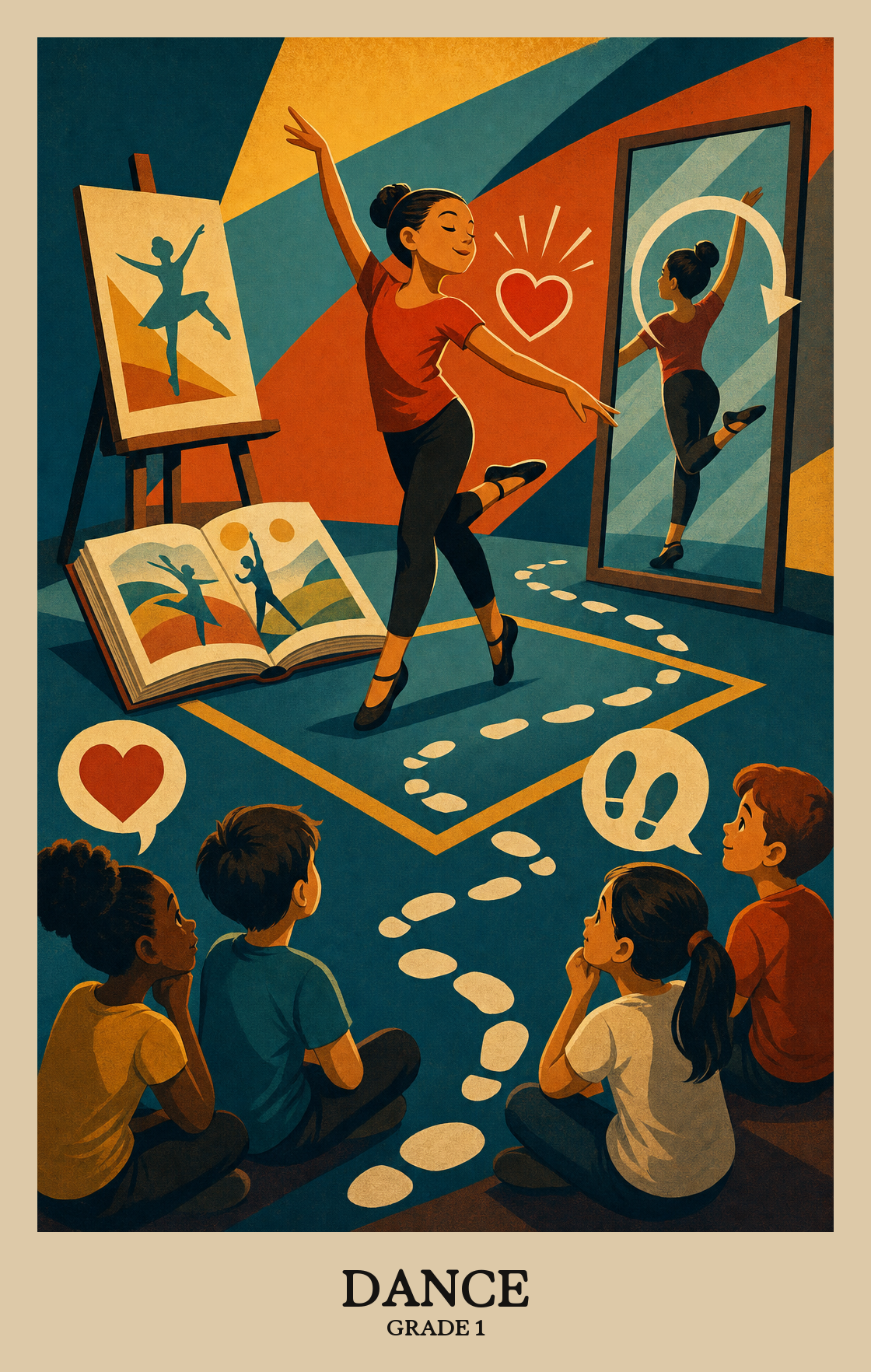
Students start the year noticing what their bodies can do. They try big and small movements, fast and slow, and learn the words for the shapes their arms, legs, and backs can make.
Students take an idea, a feeling, or a story and turn it into movement. A rainstorm, a seed growing, a favorite animal. They start to see that a dance can mean something.
Students put movements together in an order that makes sense. They practice a beginning, a middle, and an ending, and learn to clean up a dance so it looks the way they want it to.
Students share short dances with classmates and watch others perform. They talk about what they noticed, what the dance might mean, and what made it work.
Students learn that people everywhere dance, and that dances carry stories from families, communities, and history. They connect what they are learning to dances they see at home and in the world around them.
Students connect what they know from everyday life to the dances they make and watch. A memory, a feeling, or something from home can become the starting point for a dance idea.
Students connect dances they see or perform to where and when those dances come from. A dance from another country or time tells a story about how people lived.
| Standard | Definition | Code |
|---|---|---|
| Synthesize and relate knowledge and personal experiences to make art | Students connect what they know from everyday life to the dances they make and watch. A memory, a feeling, or something from home can become the starting point for a dance idea. | DA:Cn10.1 |
| Relate artistic ideas and works with societal, cultural | Students connect dances they see or perform to where and when those dances come from. A dance from another country or time tells a story about how people lived. | DA:Cn11.1 |
Students come up with their own ideas for dance movements and start turning those ideas into something they can actually perform.
Students take a movement idea and shape it into a short dance by deciding what comes first, what comes next, and how to end it.
Students revisit a short dance they made and adjust movements until the piece feels finished and ready to share.
| Standard | Definition | Code |
|---|---|---|
| Generate and conceptualize artistic ideas and work | Students come up with their own ideas for dance movements and start turning those ideas into something they can actually perform. | DA:Cr1.1 |
| Organize and develop artistic ideas and work | Students take a movement idea and shape it into a short dance by deciding what comes first, what comes next, and how to end it. | DA:Cr2.1 |
| Refine and complete artistic work | Students revisit a short dance they made and adjust movements until the piece feels finished and ready to share. | DA:Cr3.1 |
Students choose a dance or movement to perform and think about why it fits the moment. They practice making simple decisions about how and what to share with an audience.
Students practice a dance movement again and again to make it cleaner and more precise before performing it for an audience.
Students perform a dance for others and make choices, like how to move and where to look, to share a feeling or tell a story.
| Standard | Definition | Code |
|---|---|---|
| Analyze, interpret, and select artistic work for presentation | Students choose a dance or movement to perform and think about why it fits the moment. They practice making simple decisions about how and what to share with an audience. | DA:Pr4.1 |
| Develop and refine artistic techniques and work for presentation | Students practice a dance movement again and again to make it cleaner and more precise before performing it for an audience. | DA:Pr5.1 |
| Convey meaning through the presentation of artistic work | Students perform a dance for others and make choices, like how to move and where to look, to share a feeling or tell a story. | DA:Pr6.1 |
Students watch a dance and talk about what they notice, like how the dancer moves fast or slow, big or small. They start to see that dances are made of choices.
Students look at a dance and explain what they think it means or how it makes them feel. They connect what they see in the movement to ideas or emotions the dancer might be expressing.
Students look at a dance and say what works and what could be better, using simple rules like "Did the dancer move with the music?" Giving a reason matters as much as the opinion.
| Standard | Definition | Code |
|---|---|---|
| Perceive and analyze artistic work | Students watch a dance and talk about what they notice, like how the dancer moves fast or slow, big or small. They start to see that dances are made of choices. | DA:Re7.1 |
| Interpret intent and meaning in artistic work | Students look at a dance and explain what they think it means or how it makes them feel. They connect what they see in the movement to ideas or emotions the dancer might be expressing. | DA:Re8.1 |
| Apply criteria to evaluate artistic work | Students look at a dance and say what works and what could be better, using simple rules like "Did the dancer move with the music?" Giving a reason matters as much as the opinion. | DA:Re9.1 |
Students explore how their bodies move through space, copy and create simple movement patterns, and perform short dances for classmates. They also watch dances and talk about what they noticed and how it made them feel.
Put on a song and ask students to show three different ways to move, like high, low, and fast. Five minutes of free dancing in the living room builds the same body awareness as class. Asking what their favorite part was helps them reflect.
No. Most students this age are still warming up to performing. Start small at home by asking for a short movement to share, then clap and ask one question about it. Confidence grows over the year as students get used to being watched by a friendly audience.
Start with body awareness and basic movements like bend, stretch, twist, and jump. Then layer in space and tempo, then short pattern-making. Save group choreography and audience performance for later in the year once students can hold a short sequence on their own.
Students can make up a short movement idea, repeat it the same way twice, perform it for classmates, and say one thing they liked about a peer's dance. They can also connect a dance to a feeling or a story.
Holding a movement pattern in order is the hardest part. Many students can invent moves but lose track of the sequence by the third try. Short repeated practice with a count or a song helps the order stick.
Yes. Students often dance about stories from reading, count beats from math, and explore patterns from science like weather or animal movement. Asking about these connections at home reinforces both subjects.
They can follow a short movement sequence, make up their own short dance, and talk about what a dance was about. They should also be comfortable watching a classmate perform and saying something kind and specific about it.