Getting started with art ideas
Students learn that art starts with their own ideas. They draw from things they know, like family, pets, or favorite places, and try out different tools without worrying about getting it perfect.
This is the year art shifts from making marks for fun to making art on purpose. Students start with their own ideas and memories, then choose materials and try different ways to draw, paint, or build. They learn to talk about what they see in their own work and in art made by other people. By spring, they can finish a piece, explain what it means, and pick one to share with the class.
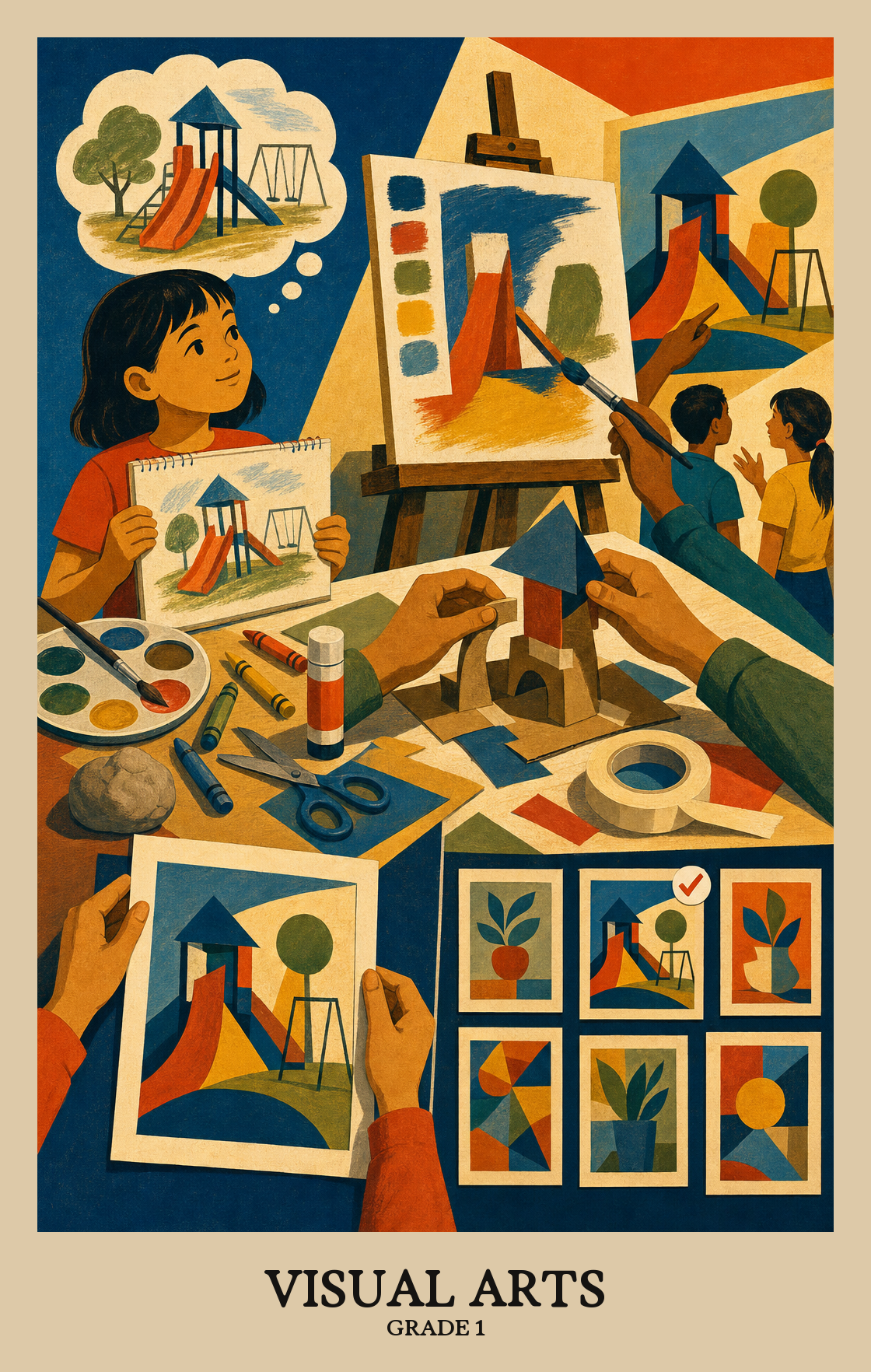
Students learn that art starts with their own ideas. They draw from things they know, like family, pets, or favorite places, and try out different tools without worrying about getting it perfect.
Students slow down and notice what they see in a picture or sculpture. They talk about colors, shapes, and what the artist might be showing, using simple words to describe what stands out.
Students plan a piece of art and stick with it from start to finish. They practice cutting, gluing, painting, and shaping clay, and learn that going back to fix something is part of making art.
Students look at art made by people from different cultures and time periods. They start to see that art tells stories about where it came from, and they connect those stories to their own lives.
Students pick a piece they are proud of and get it ready to show. They think about how their art will be displayed and what they want a viewer to notice or feel when looking at it.
Students connect something from their own life, a memory, a feeling, or a place they know, to what they make in art class.
Students look at a painting or sculpture and talk about when it was made, who made it, and what was happening in the world at the time. That context helps them understand why the artwork looks the way it does.
| Standard | Definition | Code |
|---|---|---|
| Synthesize and relate knowledge and personal experiences to make art | Students connect something from their own life, a memory, a feeling, or a place they know, to what they make in art class. | VA:Cn10.1 |
| Relate artistic ideas and works with societal, cultural | Students look at a painting or sculpture and talk about when it was made, who made it, and what was happening in the world at the time. That context helps them understand why the artwork looks the way it does. | VA:Cn11.1 |
Students come up with their own ideas for art before they start making anything. That might mean sketching a quick plan, talking through an idea, or just deciding what a drawing will be about.
Students choose colors, shapes, and materials to build out a drawing or artwork they have in mind. Planning and making are part of the same process.
Students look at their own drawings or projects, decide what to fix or improve, and finish the work to the best of their ability.
| Standard | Definition | Code |
|---|---|---|
| Generate and conceptualize artistic ideas and work | Students come up with their own ideas for art before they start making anything. That might mean sketching a quick plan, talking through an idea, or just deciding what a drawing will be about. | VA:Cr1.1 |
| Organize and develop artistic ideas and work | Students choose colors, shapes, and materials to build out a drawing or artwork they have in mind. Planning and making are part of the same process. | VA:Cr2.1 |
| Refine and complete artistic work | Students look at their own drawings or projects, decide what to fix or improve, and finish the work to the best of their ability. | VA:Cr3.1 |
Students look at their own artwork, talk about what they made and why, and choose a piece to share with others.
Students practice and improve a piece of artwork until it's ready to show others. That might mean adjusting colors, cleaning up lines, or reworking a detail that isn't quite right yet.
Students choose how to share a drawing or artwork so a viewer can tell what the work is about or how it makes them feel.
| Standard | Definition | Code |
|---|---|---|
| Analyze, interpret, and select artistic work for presentation | Students look at their own artwork, talk about what they made and why, and choose a piece to share with others. | VA:Pr4.1 |
| Develop and refine artistic techniques and work for presentation | Students practice and improve a piece of artwork until it's ready to show others. That might mean adjusting colors, cleaning up lines, or reworking a detail that isn't quite right yet. | VA:Pr5.1 |
| Convey meaning through the presentation of artistic work | Students choose how to share a drawing or artwork so a viewer can tell what the work is about or how it makes them feel. | VA:Pr6.1 |
Students look closely at a piece of art and describe what they notice, like colors, shapes, and how the parts fit together.
Students look at a piece of art and explain what they think the artist was trying to say or show. They use what they see in the image to back up their thinking.
Students look at a piece of art and decide what makes it work well. They use simple questions, like whether the colors or shapes match what the artist was trying to do, to explain what they think.
| Standard | Definition | Code |
|---|---|---|
| Perceive and analyze artistic work | Students look closely at a piece of art and describe what they notice, like colors, shapes, and how the parts fit together. | VA:Re7.1 |
| Interpret intent and meaning in artistic work | Students look at a piece of art and explain what they think the artist was trying to say or show. They use what they see in the image to back up their thinking. | VA:Re8.1 |
| Apply criteria to evaluate artistic work | Students look at a piece of art and decide what makes it work well. They use simple questions, like whether the colors or shapes match what the artist was trying to do, to explain what they think. | VA:Re9.1 |
Students make art from their own ideas and life. They try drawing, painting, cutting, and building, then talk about what they made and what other artists made. The focus is on trying things, finishing a piece, and sharing it with others.
Keep paper, crayons, glue, and scissors in one easy spot. Ask students to draw something that happened today or a place they like, then ask them to tell the story of the picture. Fifteen minutes a few times a week is plenty.
Praise the choices, not the likeness. Point out the colors, the shapes, or the part that looks like it took the most work. At this age, finishing a picture matters more than how realistic it looks.
Start with mark-making and shape, then move into color mixing, simple collage, and basic sculpture with paper or clay. Build in one or two looking-and-talking lessons each unit so students learn the words for what they see.
Students should come up with their own idea for a piece, work on it across more than one class, and finish it. They should also be able to say what their art is about and notice something specific in a classmate's work or a famous artwork.
A little, yes. Looking at a few artists and artworks from different times and places gives students ideas and a shared vocabulary. Keep it short, two or three minutes of looking and talking, then back to making.
Ask three quick questions: what is it, how did it get made, and what was the hardest part. This shows the work was worth noticing and gives students practice talking about choices, which is half of what art class asks them to do.