Finding ideas for movement
Students start the year turning everyday experiences, memories, and stories into movement. They try out ideas on their own and with classmates, and begin keeping track of what works.
This is the year dance becomes a way to say something on purpose. Students pull from their own lives and from stories they've learned to shape short dances with a clear beginning, middle, and end. They practice the moves until the meaning comes through, then watch other dancers and talk about what the choices add up to. By spring, students can perform a short dance they helped build and explain the idea behind it.
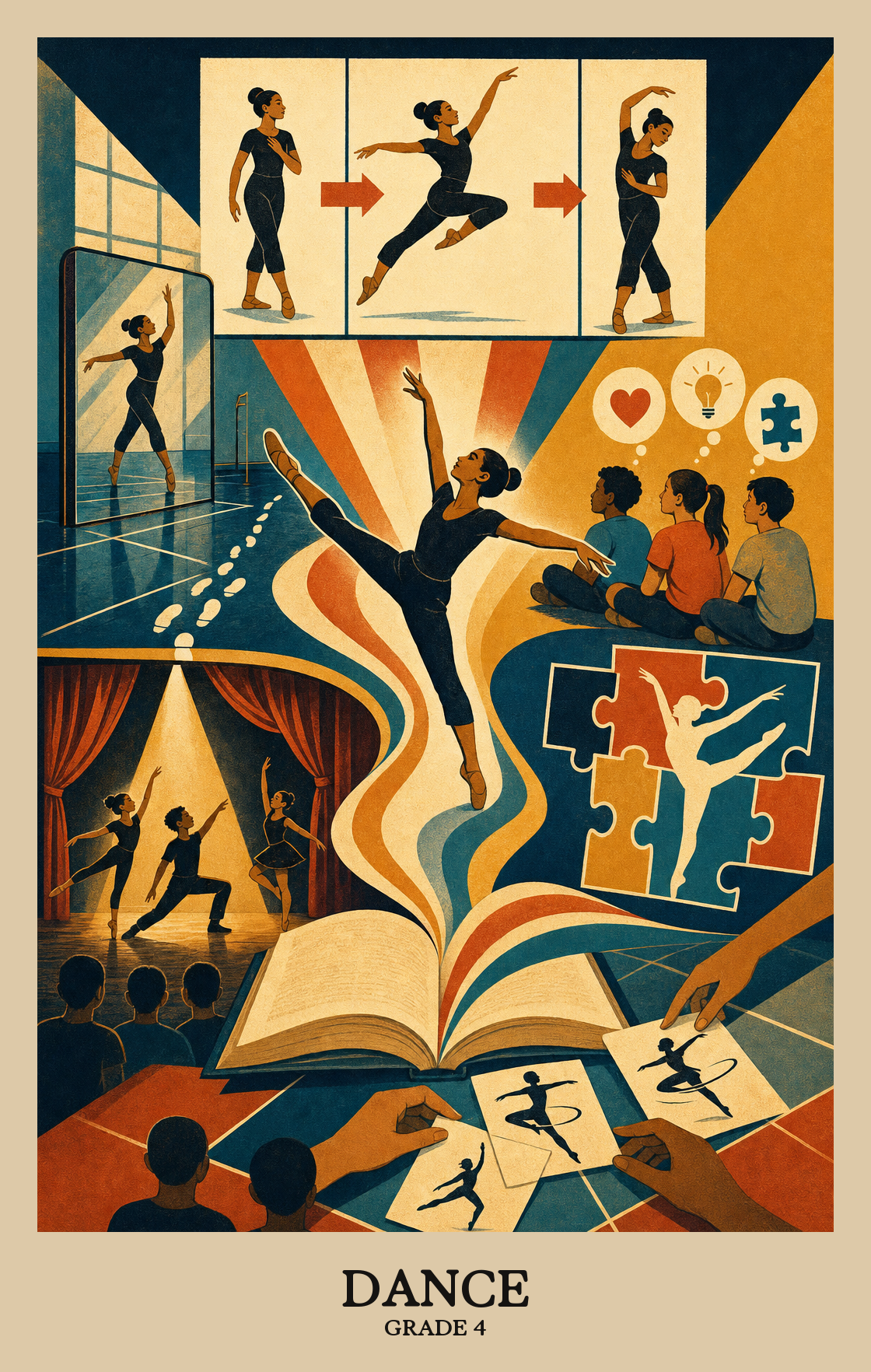
Students start the year turning everyday experiences, memories, and stories into movement. They try out ideas on their own and with classmates, and begin keeping track of what works.
Students take a rough idea and build it into a real dance with a clear beginning, middle, and end. They practice choices about speed, space, and energy, then revise based on feedback.
Students work on the skills that make a dance readable to someone watching. They focus on balance, timing, and control, and pick which pieces are ready to share.
Students look at dances from different cultures and time periods and talk about what the movement might mean. They use what they notice to inform their own choices as dancers and choreographers.
Students watch performances and use clear criteria to describe what they see. They explain what the dance might be about and give specific reasons for their opinions.
Students connect something from their own life to what they're learning in dance, then use that personal experience to shape the movements they create.
Students look at a dance and ask where it came from: what culture created it, when, and why. That context helps them understand what the movement means beyond the steps.
| Standard | Definition | Code |
|---|---|---|
| Synthesize and relate knowledge and personal experiences to make art | Students connect something from their own life to what they're learning in dance, then use that personal experience to shape the movements they create. | DA:Cn10.4 |
| Relate artistic ideas and works with societal, cultural | Students look at a dance and ask where it came from: what culture created it, when, and why. That context helps them understand what the movement means beyond the steps. | DA:Cn11.4 |
Students brainstorm and sketch out ideas for a new dance, deciding on a theme, a feeling, or a story before movement begins.
Students take their movement ideas and shape them into a short dance by choosing which moves to keep, which to cut, and how to arrange them in order.
Students revisit a dance they have been building, make specific changes to improve it, and practice until it feels finished and ready to share.
| Standard | Definition | Code |
|---|---|---|
| Generate and conceptualize artistic ideas and work | Students brainstorm and sketch out ideas for a new dance, deciding on a theme, a feeling, or a story before movement begins. | DA:Cr1.4 |
| Organize and develop artistic ideas and work | Students take their movement ideas and shape them into a short dance by choosing which moves to keep, which to cut, and how to arrange them in order. | DA:Cr2.4 |
| Refine and complete artistic work | Students revisit a dance they have been building, make specific changes to improve it, and practice until it feels finished and ready to share. | DA:Cr3.4 |
Students choose which dances or movements to perform and explain why those choices fit the piece they want to share with an audience.
Students practice a dance piece repeatedly, refining their movements and technique until the performance is ready to share with an audience.
Students perform a dance with clear intention, using movement choices to express a specific idea or feeling for an audience.
| Standard | Definition | Code |
|---|---|---|
| Analyze, interpret, and select artistic work for presentation | Students choose which dances or movements to perform and explain why those choices fit the piece they want to share with an audience. | DA:Pr4.4 |
| Develop and refine artistic techniques and work for presentation | Students practice a dance piece repeatedly, refining their movements and technique until the performance is ready to share with an audience. | DA:Pr5.4 |
| Convey meaning through the presentation of artistic work | Students perform a dance with clear intention, using movement choices to express a specific idea or feeling for an audience. | DA:Pr6.4 |
Students watch a dance and describe what they notice: how the dancer moves, where they move on the stage, and how the movement changes from one moment to the next.
Students watch a dance and explain what they think the choreographer was trying to express. They support their interpretation with specific movements or moments they observed.
Students use a short checklist or set of questions to judge a dance performance, explaining what worked and what could be stronger.
| Standard | Definition | Code |
|---|---|---|
| Perceive and analyze artistic work | Students watch a dance and describe what they notice: how the dancer moves, where they move on the stage, and how the movement changes from one moment to the next. | DA:Re7.4 |
| Interpret intent and meaning in artistic work | Students watch a dance and explain what they think the choreographer was trying to express. They support their interpretation with specific movements or moments they observed. | DA:Re8.4 |
| Apply criteria to evaluate artistic work | Students use a short checklist or set of questions to judge a dance performance, explaining what worked and what could be stronger. | DA:Re9.4 |
Students make up short dances, practice them, perform for classmates, and talk about what they saw. They learn to move with control, work with a partner or small group, and connect dances to stories, feelings, or things they are studying in other subjects.
Clear a small space and put on a song. Ask students to make up a short movement that shows an idea, like a storm or a busy city, then perform it and explain the choices. Five minutes is plenty, and it builds the same thinking they use in class.
No. This year is about making and shaping movement, not being a trained dancer. Students who like sports, acting, drawing, or building usually find something they enjoy once they see dance as another way to plan and present an idea.
Start with movement basics like shape, speed, and direction so students share a common vocabulary. Move into short solo and group studies, then into pieces tied to themes from social studies, science, or reading. Save more polished performances and peer feedback for the second half of the year.
By spring, students can take an idea, build a short dance from it, refine it after feedback, and perform it with intention. They can also watch a classmate's dance and say what it might mean and what made it work, using specific movement words.
Refining and revising. Students often want to perform a first draft and move on. Plan time to watch video, give specific feedback against a short list of criteria, and rework one section. Connecting dance to cultural and historical context also needs repeated modeling.
None is needed. Watch short dance clips together from different cultures and time periods and ask what the dancers might be saying. Ask about the music, the shapes, and the mood. That kind of noticing is exactly what students practice in class.
Students should be able to plan a short dance with a clear idea, rehearse and improve it, and perform it for a small group. They should also be able to give a classmate one specific, kind piece of feedback tied to what the dance was trying to show.