Listening with sharper ears
Students start the year listening closely to songs and noticing what the music is doing. They describe what they hear and begin sharing why a piece feels happy, calm, or full of energy.
This is the year music shifts from following along to making real musical choices. Students come up with their own short musical ideas, shape them with a clear beginning and end, and practice the pieces they perform. They also learn to listen with a critical ear, explaining why a song works and how it connects to a time or place. By spring, they can perform a prepared piece and talk about what the music is trying to say.
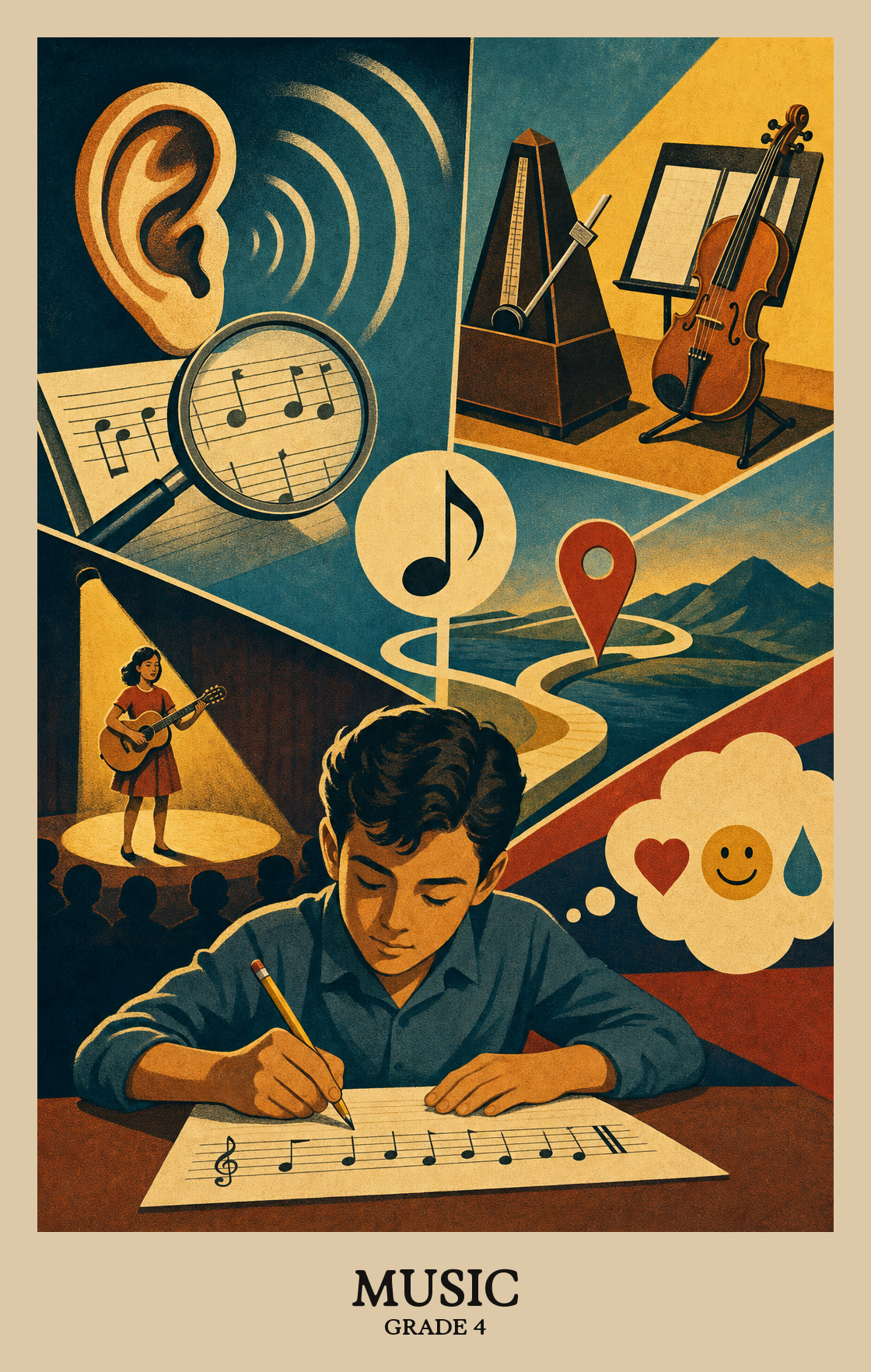
Students start the year listening closely to songs and noticing what the music is doing. They describe what they hear and begin sharing why a piece feels happy, calm, or full of energy.
Students try out their own short musical ideas using voice, classroom instruments, or simple rhythms. They play with patterns and pick the ones they like best.
Students take a rough idea and clean it up so someone else can hear it. They practice the tricky parts, fix mistakes, and decide how the piece should sound from start to finish.
Students prepare songs or pieces to perform for classmates and families. They think about what the music is trying to say and how to play or sing it so listeners get the message.
Students connect what they play and hear to their own lives and to music from other times and places. They notice why people make music and what it meant to the people who first played it.
Students connect what they know and have lived through to the music they create or perform. Personal memories, observations, and classroom learning all shape the choices they make.
Music is shaped by the world around it. Students connect songs and compositions to the time period, culture, or community where they came from, and explain what that context reveals about the music itself.
| Standard | Definition | Code |
|---|---|---|
| Synthesize and relate knowledge and personal experiences to make art | Students connect what they know and have lived through to the music they create or perform. Personal memories, observations, and classroom learning all shape the choices they make. | MU:Cn10.4 |
| Relate artistic ideas and works with societal, cultural | Music is shaped by the world around it. Students connect songs and compositions to the time period, culture, or community where they came from, and explain what that context reveals about the music itself. | MU:Cn11.4 |
Students brainstorm musical ideas, such as a short melody or rhythm pattern, and begin shaping them into something they could perform or record.
Students take their musical ideas and shape them into a short piece or pattern, making choices about which sounds to keep, change, or leave out.
Students revisit a piece of music they composed, make changes to improve it, and decide when it's ready to share. The focus is on revising, not just finishing.
| Standard | Definition | Code |
|---|---|---|
| Generate and conceptualize artistic ideas and work | Students brainstorm musical ideas, such as a short melody or rhythm pattern, and begin shaping them into something they could perform or record. | MU:Cr1.4 |
| Organize and develop artistic ideas and work | Students take their musical ideas and shape them into a short piece or pattern, making choices about which sounds to keep, change, or leave out. | MU:Cr2.4 |
| Refine and complete artistic work | Students revisit a piece of music they composed, make changes to improve it, and decide when it's ready to share. The focus is on revising, not just finishing. | MU:Cr3.4 |
Students listen to or read music, then decide which pieces are worth performing and explain why one choice fits better than another.
Students practice a song or piece until it sounds the way they want it to, then refine specific parts before performing it for an audience.
Students perform a song or piece and make deliberate choices about how to express its meaning to an audience. Every decision, from tempo to dynamics, is in service of the idea behind the music.
| Standard | Definition | Code |
|---|---|---|
| Analyze, interpret, and select artistic work for presentation | Students listen to or read music, then decide which pieces are worth performing and explain why one choice fits better than another. | MU:Pr4.4 |
| Develop and refine artistic techniques and work for presentation | Students practice a song or piece until it sounds the way they want it to, then refine specific parts before performing it for an audience. | MU:Pr5.4 |
| Convey meaning through the presentation of artistic work | Students perform a song or piece and make deliberate choices about how to express its meaning to an audience. Every decision, from tempo to dynamics, is in service of the idea behind the music. | MU:Pr6.4 |
Students listen to a piece of music and describe what they notice, like how the tempo changes or when instruments drop out. Then they explain what those choices do to the sound.
Students listen to a piece of music and explain what they think the composer or performer was trying to express. They use what they hear in the melody, rhythm, or dynamics to back up their thinking.
Students listen to a piece of music and use a clear set of reasons to explain why it works well or where it falls short. They back up their opinion with specific details from what they heard.
| Standard | Definition | Code |
|---|---|---|
| Perceive and analyze artistic work | Students listen to a piece of music and describe what they notice, like how the tempo changes or when instruments drop out. Then they explain what those choices do to the sound. | MU:Re7.4 |
| Interpret intent and meaning in artistic work | Students listen to a piece of music and explain what they think the composer or performer was trying to express. They use what they hear in the melody, rhythm, or dynamics to back up their thinking. | MU:Re8.4 |
| Apply criteria to evaluate artistic work | Students listen to a piece of music and use a clear set of reasons to explain why it works well or where it falls short. They back up their opinion with specific details from what they heard. | MU:Re9.4 |
Students sing and play simple instruments, read basic rhythms, and make up short pieces of their own. They also listen to music from different places and times and talk about what they hear. By spring, most can perform a short piece in front of others and explain choices they made.
Sing in the car, clap along to songs, and ask what a song reminds students of. If a student is learning recorder or another instrument, five to ten minutes of daily practice helps far more than one long session on the weekend.
Students start to read simple rhythms and a few notes, but they are not expected to sight-read like a older musician. Pointing at notes while singing a familiar song at home is plenty of support.
Fourth grade music is about trying things, not sounding perfect. Praise effort and curiosity, and ask what part of a song they liked or would change. Confidence at this age matters more than talent.
Build steady singing and rhythm routines in the fall, add notation and small group playing in the winter, and move toward creating and presenting short pieces in the spring. Looping back to listening and response work each unit keeps the four big areas balanced.
Steady beat under changing rhythms, reading rests, and matching pitch in head voice tend to slip. Short warm-ups at the start of each class, repeated across weeks, do more than a single focused lesson.
Students generate short rhythmic or melodic ideas, revise them with feedback, and share a finished version. Keep the form small, four to eight beats, so revision is the real work rather than starting over each time.
By June, students can keep a steady beat, sing in tune with a group, read simple rhythms, and talk about a piece of music using words like tempo, dynamics, and mood. They can also perform a short piece and offer one specific thing they would improve next time.