Sparking story ideas
Students start the year by making up characters and scenes from their own lives, books they like, and questions they wonder about. Expect kids to come home acting out little stories they invented.
This is the year acting moves from playing pretend to building a character on purpose. Students plan scenes, rehearse them, and shape how a character moves, speaks, and reacts. They also start watching plays like a thoughtful audience, talking about what worked and why. By spring, students can take a story or an idea from their own life, turn it into a short scene, and perform it for classmates.
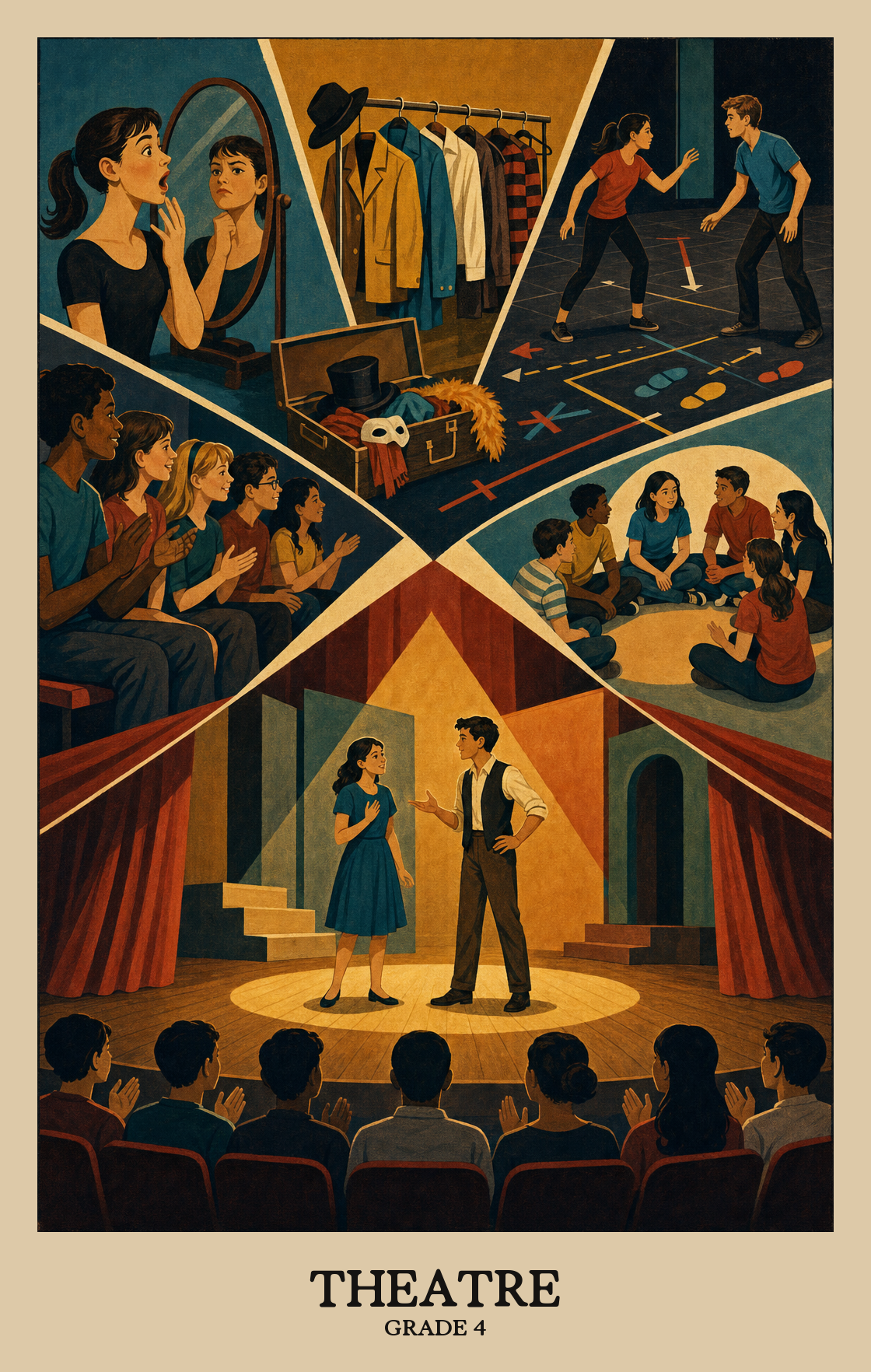
Students start the year by making up characters and scenes from their own lives, books they like, and questions they wonder about. Expect kids to come home acting out little stories they invented.
Students shape rough ideas into short scenes with a beginning, middle, and end. They work in small groups, try out lines, and change what is not working.
Students look at where stories come from, including different cultures, time periods, and communities. They notice how a play can show what people care about and how that connects to their own world.
Students practice voice, movement, and timing to make their scenes clearer for an audience. They take notes from the teacher and classmates and try the scene again with changes.
Students share finished scenes with classmates or families. The goal is to tell the story clearly so the audience understands what is happening and why it matters.
Students close the year by watching plays and classmates' work and talking about what worked. They use simple criteria to explain their opinions instead of just saying they liked it.
Students connect something from their own life to a character or scene they're creating. That personal detail shapes the story they tell onstage.
Students look at a play or performance and ask where it came from. They connect what they see on stage to the time period, community, or culture that shaped it.
| Standard | Definition | Code |
|---|---|---|
| Synthesize and relate knowledge and personal experiences to make art | Students connect something from their own life to a character or scene they're creating. That personal detail shapes the story they tell onstage. | TH:Cn10.4 |
| Relate artistic ideas and works with societal, cultural | Students look at a play or performance and ask where it came from. They connect what they see on stage to the time period, community, or culture that shaped it. | TH:Cn11.4 |
Students brainstorm characters, settings, or story ideas and start shaping them into a scene. The focus is on coming up with original ideas before any rehearsing begins.
Students take their story ideas and arrange them into a scene, deciding who the characters are, what they say, and how the action unfolds.
Students revisit a scene or character they've already created, making specific changes to dialogue, movement, or expression to make the work feel more finished and clear.
| Standard | Definition | Code |
|---|---|---|
| Generate and conceptualize artistic ideas and work | Students brainstorm characters, settings, or story ideas and start shaping them into a scene. The focus is on coming up with original ideas before any rehearsing begins. | TH:Cr1.4 |
| Organize and develop artistic ideas and work | Students take their story ideas and arrange them into a scene, deciding who the characters are, what they say, and how the action unfolds. | TH:Cr2.4 |
| Refine and complete artistic work | Students revisit a scene or character they've already created, making specific changes to dialogue, movement, or expression to make the work feel more finished and clear. | TH:Cr3.4 |
Students choose a scene or character to perform and explain why it fits the story and their skills as an actor.
Students practice and improve a scene or character until it's ready to share with an audience. They repeat, adjust, and polish their performance before the show.
Students rehearse a scene or monologue and perform it for an audience, making choices about voice and movement so the story lands clearly.
| Standard | Definition | Code |
|---|---|---|
| Analyze, interpret, and select artistic work for presentation | Students choose a scene or character to perform and explain why it fits the story and their skills as an actor. | TH:Pr4.4 |
| Develop and refine artistic techniques and work for presentation | Students practice and improve a scene or character until it's ready to share with an audience. They repeat, adjust, and polish their performance before the show. | TH:Pr5.4 |
| Convey meaning through the presentation of artistic work | Students rehearse a scene or monologue and perform it for an audience, making choices about voice and movement so the story lands clearly. | TH:Pr6.4 |
Students watch a short performance and describe what they notice: what the characters want, how the actors move, and why those choices make the story feel the way it does.
Students look at a scene or performance and explain what the actor or playwright was trying to say. They back up their thinking with details from what they saw or heard.
Students look at a scene or performance and decide what makes it work well or fall short, using a simple checklist or set of questions to back up their opinion.
| Standard | Definition | Code |
|---|---|---|
| Perceive and analyze artistic work | Students watch a short performance and describe what they notice: what the characters want, how the actors move, and why those choices make the story feel the way it does. | TH:Re7.4 |
| Interpret intent and meaning in artistic work | Students look at a scene or performance and explain what the actor or playwright was trying to say. They back up their thinking with details from what they saw or heard. | TH:Re8.4 |
| Apply criteria to evaluate artistic work | Students look at a scene or performance and decide what makes it work well or fall short, using a simple checklist or set of questions to back up their opinion. | TH:Re9.4 |
Students make up scenes, play characters, and work together to tell short stories on their feet. They also watch plays and talk about what worked and why. The focus is on building ideas with a group, not memorizing long scripts.
Ask students to act out a favorite story or invent a short scene with stuffed animals or family members. Play simple games like freeze, where everyone holds a pose and explains who they are and what they want. Ten minutes of pretend play counts.
No. Plenty of strong theatre work happens behind the scenes, like writing scenes, designing a set out of cardboard, or running sound. Encourage students to try small roles first, like one line or a silent character, and build up over the year.
Start with ensemble games and short improvisations so students get comfortable taking risks. Move into scene building and character work, then end with a small performance students helped shape. Responding and reflection should run through every unit, not sit at the end.
Students look at where a story comes from and what people in that time or place cared about. A scene from a folktale, for example, says something about the community that told it. Talking about this helps students make choices about how to play a character.
Giving useful feedback on a classmate's work is the hardest part. Students often default to either praise or teasing. Spend real time on what to look for in a scene, such as clear voice, a strong choice, or a moment that surprised the audience.
By spring, students should be able to invent a short scene with a partner, play a character with a clear voice and body, and say something specific about a play they watched. If those three things feel comfortable, they are in good shape.
Some, but not a full script. Most work at this level is improvised or read from a short scene. If students do perform a memorized piece, it is usually a few lines, not a long monologue.
A student can generate an idea for a scene, develop it with a group, and refine it based on feedback. They can also watch another group's work and point to specific choices the actors made. Both halves matter, making and responding.