Moving and exploring space
Students start by discovering how their bodies move. They try big and small movements, fast and slow, and learn to use the space around them without bumping into friends.
This is the year students discover that their bodies can tell a story. Students explore how to move in big and small ways, fast and slow, and start to notice what their movement means. They try out simple dances on their own and with classmates, then talk about what they saw and felt. By spring, students can make up a short dance about something familiar, like a rainstorm or a favorite animal, and share it with the class.
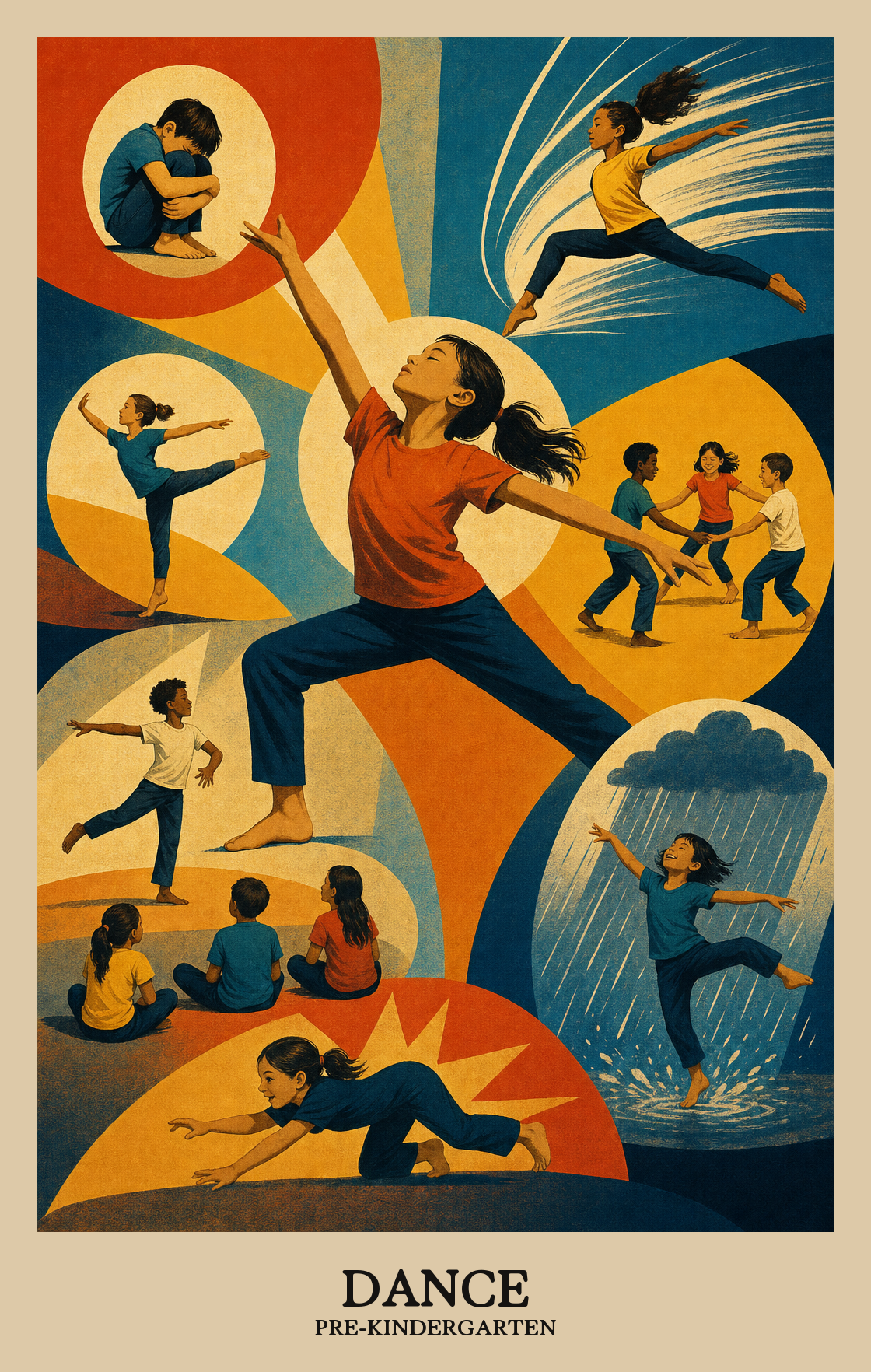
Students start by discovering how their bodies move. They try big and small movements, fast and slow, and learn to use the space around them without bumping into friends.
Students begin inventing their own movements based on ideas, stories, or feelings. A parent might see a child making up a dance about a rainstorm or a favorite animal at home.
Students put movements together in an order and practice them. They learn that a dance has a beginning, middle, and end, and they work on remembering the steps.
Students perform short dances for classmates and watch their friends dance too. They start talking about what they noticed and what a dance reminded them of.
Students connect something from their own life to a dance they create or watch, like moving like an animal they know or a feeling they had that day.
Dance connects to the world around it. Students begin to notice how the dances they see and do reflect where people come from, what they celebrate, and how communities share their stories through movement.
| Standard | Definition | Code |
|---|---|---|
| Synthesize and relate knowledge and personal experiences to make art | Students connect something from their own life to a dance they create or watch, like moving like an animal they know or a feeling they had that day. | DA:Cn10.pk |
| Relate artistic ideas and works with societal, cultural | Dance connects to the world around it. Students begin to notice how the dances they see and do reflect where people come from, what they celebrate, and how communities share their stories through movement. | DA:Cn11.pk |
Students come up with their own ideas for moving their bodies, choosing how to jump, spin, or sway before they dance.
Students choose movements and put them together to make a short dance. They try different ways to move, then pick what feels right and practice it.
Students pick a favorite way to move and practice it until it feels just right. They make small changes to improve their dance before showing it to others.
| Standard | Definition | Code |
|---|---|---|
| Generate and conceptualize artistic ideas and work | Students come up with their own ideas for moving their bodies, choosing how to jump, spin, or sway before they dance. | DA:Cr1.pk |
| Organize and develop artistic ideas and work | Students choose movements and put them together to make a short dance. They try different ways to move, then pick what feels right and practice it. | DA:Cr2.pk |
| Refine and complete artistic work | Students pick a favorite way to move and practice it until it feels just right. They make small changes to improve their dance before showing it to others. | DA:Cr3.pk |
Students choose which movements or short dances to show others. They pick what feels right and practice it so it's ready to share.
Students practice a dance move over and over until they can perform it for others. Repeating and refining is how the movement gets ready to share.
Students show what a dance means by performing it for others. Movement becomes a way to share a feeling or a story without using words.
| Standard | Definition | Code |
|---|---|---|
| Analyze, interpret, and select artistic work for presentation | Students choose which movements or short dances to show others. They pick what feels right and practice it so it's ready to share. | DA:Pr4.pk |
| Develop and refine artistic techniques and work for presentation | Students practice a dance move over and over until they can perform it for others. Repeating and refining is how the movement gets ready to share. | DA:Pr5.pk |
| Convey meaning through the presentation of artistic work | Students show what a dance means by performing it for others. Movement becomes a way to share a feeling or a story without using words. | DA:Pr6.pk |
Students watch a dance and talk about what they notice, like how the dancer moved fast or slow, used big or small movements, or changed direction.
Students look at a dance and say what they think it feels like or what story it tells. There are no wrong answers, just reasons.
Students look at a dance and say what they noticed and whether they liked it. They start learning to give a reason for their opinion.
| Standard | Definition | Code |
|---|---|---|
| Perceive and analyze artistic work | Students watch a dance and talk about what they notice, like how the dancer moved fast or slow, used big or small movements, or changed direction. | DA:Re7.pk |
| Interpret intent and meaning in artistic work | Students look at a dance and say what they think it feels like or what story it tells. There are no wrong answers, just reasons. | DA:Re8.pk |
| Apply criteria to evaluate artistic work | Students look at a dance and say what they noticed and whether they liked it. They start learning to give a reason for their opinion. | DA:Re9.pk |
Dance at this age is mostly moving to music in playful ways. Students hop, sway, spin, stretch, and freeze. They try out fast and slow, high and low, and start to notice how their bodies feel when they move.
Put on music and move together for five or ten minutes. Ask students to show how a cat moves, then a tree in the wind, then a rocket. Talking about how the movement felt is just as valuable as the dancing itself.
No. The goal is exploring movement, not learning routines. Students should feel comfortable moving their bodies in different ways and trying ideas without worrying about getting it right.
Start with movement that does not feel like performing. Marching to a drumbeat, copying animal walks, or dancing with a scarf gives students something to focus on besides being watched. Joining in alongside them helps too.
Start with basic body awareness and locomotor movement like walking, jumping, and galloping. Move into exploring space, speed, and energy. By spring, students can put short movement ideas together and show them to a small group.
Connecting movement to an idea or feeling takes the most repetition. Students can move freely, but linking a movement to a story, a season, or a piece of music takes prompting and modeling across many short sessions.
By spring, students should move in different ways on cue, copy a simple movement pattern, and share a short idea through movement. They should also be able to watch a classmate dance and say something they noticed.
Short and frequent works better than long sessions. Two or three movement breaks of ten to fifteen minutes give students enough practice without losing focus. Tie sessions to stories, songs, or themes already in the classroom.