Moving safely in shared space
Students learn to move around a room without bumping into classmates or equipment. They follow simple start and stop signals and practice taking turns during games.
This is the year bodies learn to move with purpose. Students practice the basics of running, jumping, hopping, balancing, and tossing or catching a ball, building the coordination that everything else in PE rests on. They also learn how to share space safely, take turns, and follow simple directions during games. By spring, students can move through an obstacle course, play a group game without crashing into classmates, and name an activity that makes their body feel good.
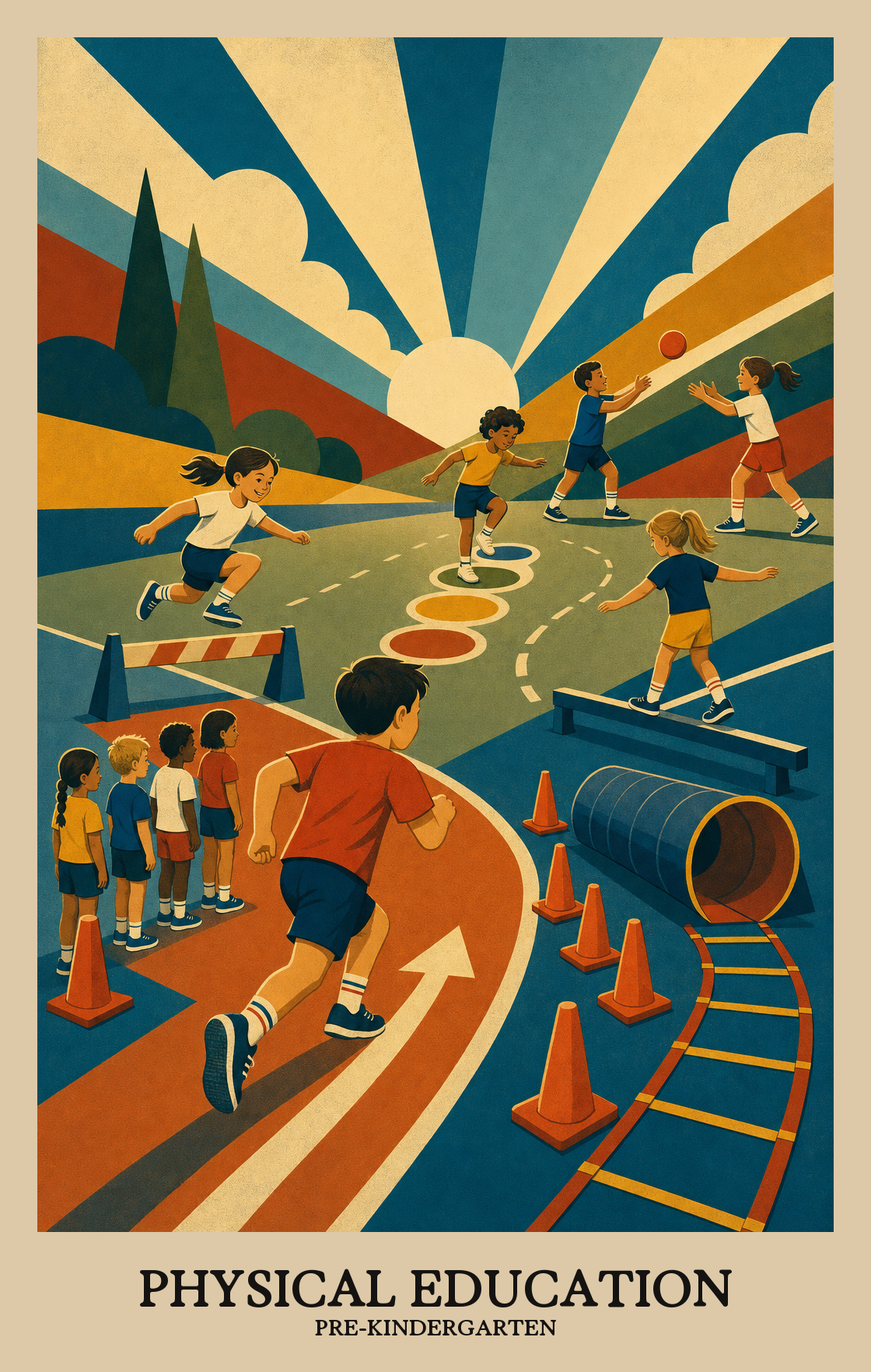
Students learn to move around a room without bumping into classmates or equipment. They follow simple start and stop signals and practice taking turns during games.
Students try out the basic ways bodies travel. They walk, run, hop, gallop, and jump, getting steadier on their feet and more confident chasing, fleeing, and changing direction.
Students start handling balls and beanbags. They roll, toss, catch, and kick at targets, building the hand-eye and foot-eye coordination behind playground games and sports.
Students hold balances on one foot, freeze in different shapes, and move through obstacle courses. They learn words for body parts and directions like over, under, and around.
Students play simple group games that mix the skills from earlier in the year. They practice taking turns, cheering on classmates, and noticing how good it feels to move every day.
Students practice moving their bodies in different ways: running, jumping, balancing, and throwing or catching. Building these basic skills early helps students stay active and healthy as they grow.
Students learn basic movement ideas, like how to balance, stop, or change direction, and practice them during active play. Understanding these concepts helps students move more safely and get more out of physical activity.
Students practice working with others during movement activities. They take turns, listen to classmates, and follow basic rules for how to treat people and act in a group.
Students practice basic movement skills like jumping and balancing, then start to notice how moving their body feels good. The goal is building a simple habit of staying active.
| Standard | Definition | Code |
|---|---|---|
| Develop a variety of motor skills, including locomotor, non-locomotor | Students practice moving their bodies in different ways: running, jumping, balancing, and throwing or catching. Building these basic skills early helps students stay active and healthy as they grow. | DE-PE.1.pk |
| Apply knowledge related to movement, performance | Students learn basic movement ideas, like how to balance, stop, or change direction, and practice them during active play. Understanding these concepts helps students move more safely and get more out of physical activity. | DE-PE.2.pk |
| Develop social skills through movement, including respect for self and others… | Students practice working with others during movement activities. They take turns, listen to classmates, and follow basic rules for how to treat people and act in a group. | DE-PE.3.pk |
| Develop personal skills, identify personal benefits of movement | Students practice basic movement skills like jumping and balancing, then start to notice how moving their body feels good. The goal is building a simple habit of staying active. | DE-PE.4.pk |
Most of the year is about moving in lots of different ways. Students practice running, jumping, hopping, and skipping. They also roll, throw, and catch balls, and learn to share space and take turns during games.
Give students time outside every day to run, climb, and chase. Roll a ball back and forth, play catch with a soft ball, or set up a simple obstacle course with pillows and chairs. Ten minutes of active play makes a real difference.
Students should be able to run, jump with both feet, hop on one foot, and gallop. They should also be able to throw a ball underhand, catch a large ball close to the body, and kick a ball that is sitting still.
Start with locomotor skills like walking, running, and jumping in open space. Move into balance and body control work in the middle of the year. Save throwing, catching, and kicking for later, once students can manage their bodies safely around others.
Probably not. Coordination at this age varies a lot from month to month. Keep offering chances to climb, balance on curbs, ride a tricycle, and play catch. Most students catch up with practice and time.
Catching and skipping take the longest to develop. Sharing space safely also needs repeated practice, since students often run without watching where others are going. Build in short reminders about personal space before every activity.
Keep groups small, two or three students, and use clear rules like taking turns with the ball. Name the behavior you want to see, such as waiting for a partner or passing instead of grabbing. Praise specific moments of cooperation as they happen.
Students are ready when they can follow simple directions in a group, move safely around other students, and try a new physical skill without giving up right away. Comfort with running, jumping, and catching a large ball is a good sign too.
Skip the word sports. Try dancing to music, jumping in puddles, balancing on a line of tape, or playing tag in the yard. The goal is daily movement that feels like play, not practice for a team.