Moving with purpose
Students explore how their bodies can move through space. They try fast and slow, high and low, and learn that a dance is more than running around the room.
This is the year dance moves from copying steps to making them up on purpose. Students turn an idea, a feeling, or a story into movement and shape it with a beginning, middle, and end. They practice cleaner footwork and shapes so a watcher can follow the meaning. By spring, students can perform a short dance they helped create and explain what it was about.
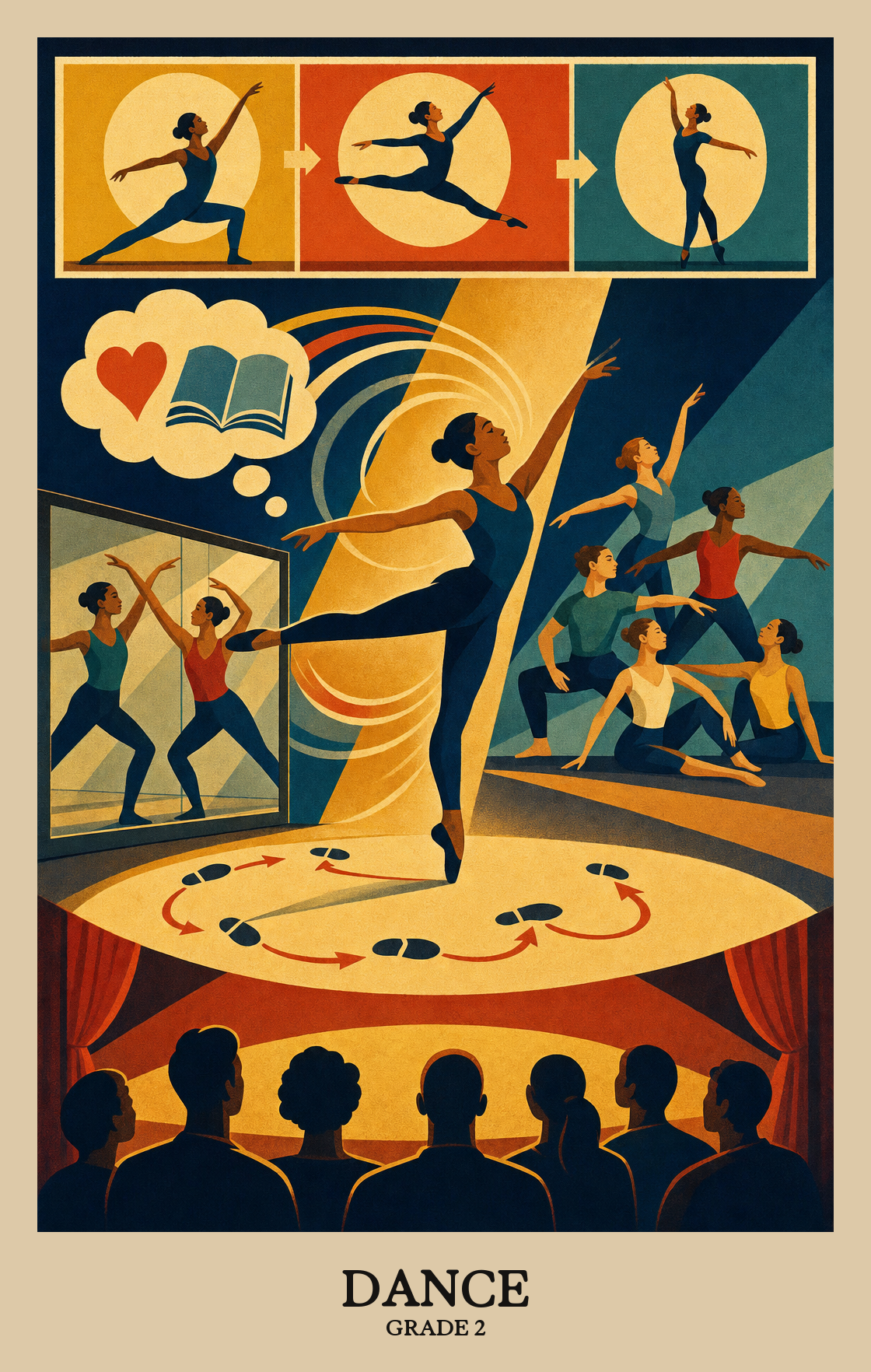
Students explore how their bodies can move through space. They try fast and slow, high and low, and learn that a dance is more than running around the room.
Students start inventing their own short dances from a feeling, a picture, or a story. They pick movements on purpose and put them in an order that makes sense.
Students practice their dances and clean them up before showing them to others. They work on staying with the music, remembering the steps, and facing the audience.
Students watch dances from different places and time periods and talk about what they notice. They share what a dance might mean and what makes one work well.
Students connect something from their own life to a dance they create or perform. A memory, a feeling, or something they've seen can shape the way they move.
Students connect dances they learn or create to the time, place, or culture they come from. Knowing that background helps them understand why a dance looks and feels the way it does.
| Standard | Definition | Code |
|---|---|---|
| Synthesize and relate knowledge and personal experiences to make art | Students connect something from their own life to a dance they create or perform. A memory, a feeling, or something they've seen can shape the way they move. | DA:Cn10.2 |
| Relate artistic ideas and works with societal, cultural | Students connect dances they learn or create to the time, place, or culture they come from. Knowing that background helps them understand why a dance looks and feels the way it does. | DA:Cn11.2 |
Students come up with their own movement ideas and start turning them into a short dance. They explore different ways their body can move before settling on what they want to create.
Students put dance moves in order to build a short piece, then try it out and make changes until it feels right.
Students revisit a dance they made, fix the parts that feel unclear or unfinished, and practice until the movement matches what they were trying to show.
| Standard | Definition | Code |
|---|---|---|
| Generate and conceptualize artistic ideas and work | Students come up with their own movement ideas and start turning them into a short dance. They explore different ways their body can move before settling on what they want to create. | DA:Cr1.2 |
| Organize and develop artistic ideas and work | Students put dance moves in order to build a short piece, then try it out and make changes until it feels right. | DA:Cr2.2 |
| Refine and complete artistic work | Students revisit a dance they made, fix the parts that feel unclear or unfinished, and practice until the movement matches what they were trying to show. | DA:Cr3.2 |
Students choose a dance to perform and explain why it fits the moment. They think about how the movement looks to an audience before they take the floor.
Students practice a dance sequence until the movements are clean and ready to share with an audience. They focus on things like timing, body control, and how the dance looks from the outside.
Students perform a dance for an audience and use movement to express a clear idea or feeling, not just steps.
| Standard | Definition | Code |
|---|---|---|
| Analyze, interpret, and select artistic work for presentation | Students choose a dance to perform and explain why it fits the moment. They think about how the movement looks to an audience before they take the floor. | DA:Pr4.2 |
| Develop and refine artistic techniques and work for presentation | Students practice a dance sequence until the movements are clean and ready to share with an audience. They focus on things like timing, body control, and how the dance looks from the outside. | DA:Pr5.2 |
| Convey meaning through the presentation of artistic work | Students perform a dance for an audience and use movement to express a clear idea or feeling, not just steps. | DA:Pr6.2 |
Students watch a dance and describe what they notice, such as how the dancer moves fast or slow, uses big or small shapes, or repeats a pattern. They put what they see into words.
Students watch a dance and explain what they think the dancer is trying to say or how the movement makes them feel.
Students look at a dance and decide what makes it work well, using a simple checklist or set of questions as a guide.
| Standard | Definition | Code |
|---|---|---|
| Perceive and analyze artistic work | Students watch a dance and describe what they notice, such as how the dancer moves fast or slow, uses big or small shapes, or repeats a pattern. They put what they see into words. | DA:Re7.2 |
| Interpret intent and meaning in artistic work | Students watch a dance and explain what they think the dancer is trying to say or how the movement makes them feel. | DA:Re8.2 |
| Apply criteria to evaluate artistic work | Students look at a dance and decide what makes it work well, using a simple checklist or set of questions as a guide. | DA:Re9.2 |
Students make up short dances, practice steps with control, and perform for classmates. They also watch dances and talk about what they noticed. The focus is on moving with purpose, not memorizing routines.
Put on music and ask students to show how the song makes them move. Try fast and slow, big and small, high and low. Five minutes of moving and talking about it counts as real practice.
No. Classroom dance is about exploring movement and expressing ideas, not technique from a studio. Time spent moving to music, acting out stories, or copying simple steps at home builds the same skills.
Start with body awareness and basic movement words like shape, level, and speed. Move into short improvisations, then into making and refining tiny dances with a beginning, middle, and end. Save sharing and audience feedback for the back half of each unit.
Students can make up a short dance with a clear idea behind it, repeat it the same way twice, and perform it for the class. They can also watch a peer's dance and say one specific thing they noticed about the movement.
Build up to performing in stages. Start with everyone moving at once, then small groups, then pairs sharing with one other pair. By the time anyone dances alone, the room already feels safe.
Join in. Students copy what adults do more than what adults say. Dance together in the kitchen, act out a story with movement at bedtime, or take turns making up a silly move the other has to copy.
They use movement to show ideas from stories, science, and social studies, like acting out a character or showing how a plant grows. Talking about where a dance comes from also ties into history and culture lessons.