Making believe together
Students step into pretend roles and build short scenes from their own ideas. They try out different voices, faces, and movements to bring a character to life.
This is the year pretend play starts to look like real theater. Students invent characters and short scenes from their own lives and from stories they know, then practice them with a partner before showing the class. They also learn to watch a scene and say what worked and why. By spring, they can plan a short scene, act it out for an audience, and give a kind, specific comment about a classmate's performance.
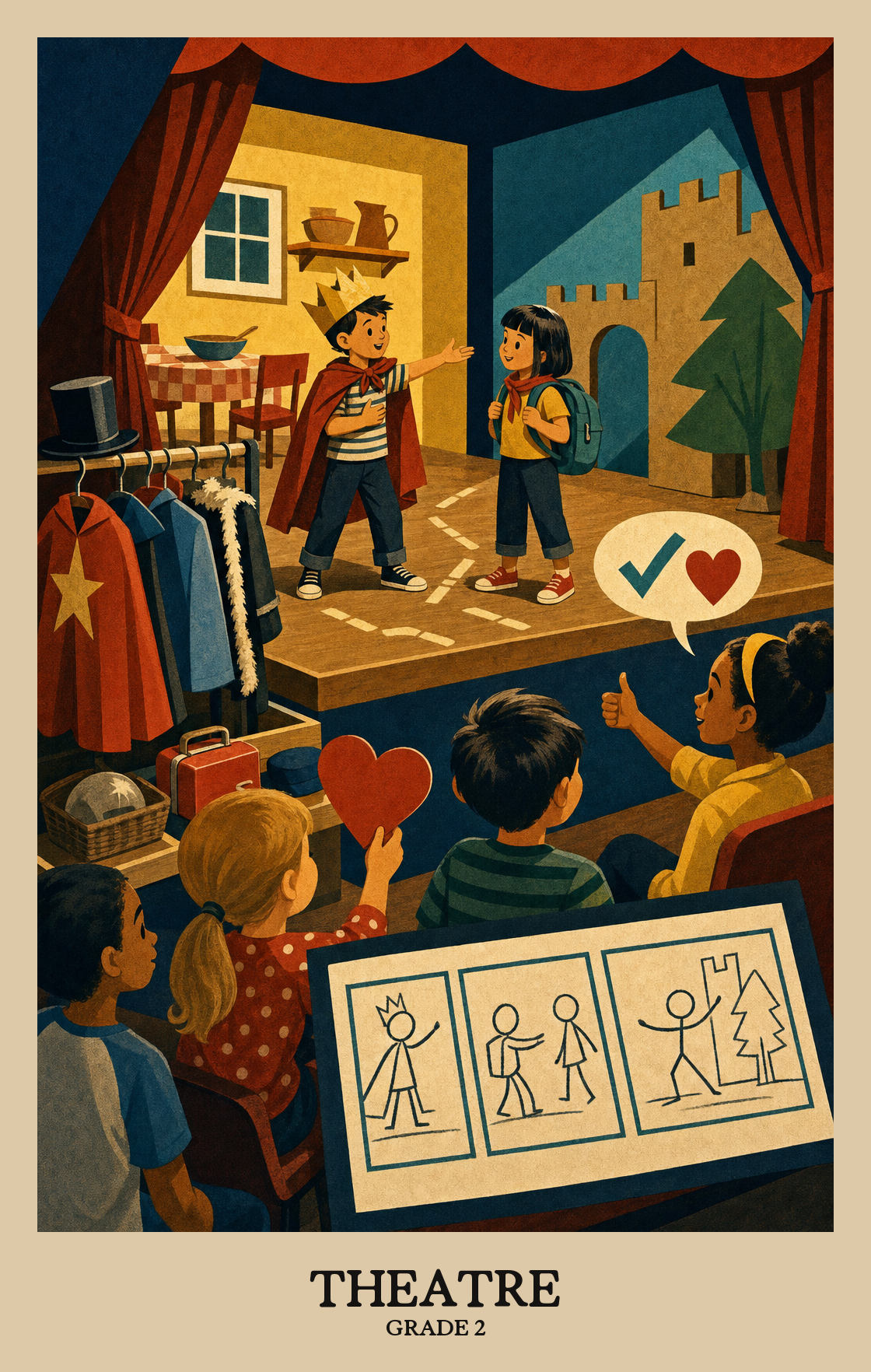
Students step into pretend roles and build short scenes from their own ideas. They try out different voices, faces, and movements to bring a character to life.
Students shape simple stories with a beginning, middle, and end. They decide what happens, who is in the scene, and where it takes place, then practice it with classmates.
Students rehearse their scenes and make small changes to make them clearer. They work on speaking so the audience can hear and moving so the audience can follow along.
Students perform for classmates and watch each other's work. They talk about what the scene meant, what they liked, and how a story on stage connects to their own lives.
Students connect something from their own life to a story or character they perform. A memory, a feeling, or a person they know helps make the performance feel real.
Students look at plays and performances and connect them to real places, times, and cultures. Seeing where a story comes from helps students understand both the art and the world it came from.
| Standard | Definition | Code |
|---|---|---|
| Synthesize and relate knowledge and personal experiences to make art | Students connect something from their own life to a story or character they perform. A memory, a feeling, or a person they know helps make the performance feel real. | TH:Cn10.2 |
| Relate artistic ideas and works with societal, cultural | Students look at plays and performances and connect them to real places, times, and cultures. Seeing where a story comes from helps students understand both the art and the world it came from. | TH:Cn11.2 |
Students brainstorm characters, settings, and story ideas to build the foundation of a short play or scene. The focus is on coming up with original ideas, not performing them yet.
Students take an idea for a short play or scene and figure out what happens first, next, and last. They arrange the story so it makes sense when acted out.
Students revisit a short scene or character choice and make it better before sharing it with an audience. They practice, adjust, and decide when the work is ready to perform.
| Standard | Definition | Code |
|---|---|---|
| Generate and conceptualize artistic ideas and work | Students brainstorm characters, settings, and story ideas to build the foundation of a short play or scene. The focus is on coming up with original ideas, not performing them yet. | TH:Cr1.2 |
| Organize and develop artistic ideas and work | Students take an idea for a short play or scene and figure out what happens first, next, and last. They arrange the story so it makes sense when acted out. | TH:Cr2.2 |
| Refine and complete artistic work | Students revisit a short scene or character choice and make it better before sharing it with an audience. They practice, adjust, and decide when the work is ready to perform. | TH:Cr3.2 |
Students choose a character or scene to perform and explain why it fits the story they want to tell.
Students practice a scene or performance multiple times, working out the rough spots so the final show looks and sounds ready for an audience.
Students perform a short scene or skit and make clear choices, like tone of voice or movement, so the audience understands the story or feeling being shared.
| Standard | Definition | Code |
|---|---|---|
| Analyze, interpret, and select artistic work for presentation | Students choose a character or scene to perform and explain why it fits the story they want to tell. | TH:Pr4.2 |
| Develop and refine artistic techniques and work for presentation | Students practice a scene or performance multiple times, working out the rough spots so the final show looks and sounds ready for an audience. | TH:Pr5.2 |
| Convey meaning through the presentation of artistic work | Students perform a short scene or skit and make clear choices, like tone of voice or movement, so the audience understands the story or feeling being shared. | TH:Pr6.2 |
Students look at a short performance or scene and describe what they noticed: who the characters are, what they did, and how the story felt to watch.
Students explain what a character in a play might be feeling and why, using what they saw or heard in the performance to back up their thinking.
Students look at a scene or performance and decide what worked well and what could be better, using simple rules like "Did the actors speak clearly?" or "Could the audience understand the story?"
| Standard | Definition | Code |
|---|---|---|
| Perceive and analyze artistic work | Students look at a short performance or scene and describe what they noticed: who the characters are, what they did, and how the story felt to watch. | TH:Re7.2 |
| Interpret intent and meaning in artistic work | Students explain what a character in a play might be feeling and why, using what they saw or heard in the performance to back up their thinking. | TH:Re8.2 |
| Apply criteria to evaluate artistic work | Students look at a scene or performance and decide what worked well and what could be better, using simple rules like "Did the actors speak clearly?" or "Could the audience understand the story?" | TH:Re9.2 |
Students make up short scenes, act out characters, and try on different voices and movements. They use stories from books, real life, and their imaginations as starting points. Most of the work happens through play, not scripts to memorize.
Ask students to act out a favorite scene from a story, or invent a new ending and perform it for the family. Pretend play with stuffed animals, puppets, or dress-up clothes counts too. Five minutes of acting out a story builds the same skills as classroom drama.
No. At this age, students improvise more than they recite. If there is a performance, it is usually short and built from work students helped create, not a long script handed to them.
Start with imagination and pretend play to build comfort, then move into character work and short improvised scenes. Bring in reflection and feedback in the second half of the year, once students trust the room. Save any small sharing or performance for late spring.
Students can take a story idea, turn it into a short scene with a beginning and end, and perform it for classmates. They can also watch a peer's scene and say what it was about and what they noticed.
Not at all. A lot of second graders warm up slowly. Working with a puppet, a partner, or a small group often helps more than pushing for a solo moment, and shy students usually open up by spring.
Staying in character past the first laugh, and giving feedback that is specific instead of just saying a scene was good or bad. Short routines for both, used often, work better than one big lesson.
Acting out a story helps students understand characters, feelings, and what happens in order. After reading at home, ask which character was most interesting and have students show how that character would walk or talk.