Listening with a musical ear
Students start the year by listening closely to songs and naming what they hear. They notice loud and soft, fast and slow, and begin to describe how a piece of music makes them feel.
This is the year music gets thoughtful. Students stop just singing and clapping along and start making real choices about how a song should sound. They try out their own short musical ideas, practice pieces until they feel ready to perform, and talk about why a song makes them feel happy, calm, or excited. By spring, they can perform a short piece for the class and explain what they were trying to express.
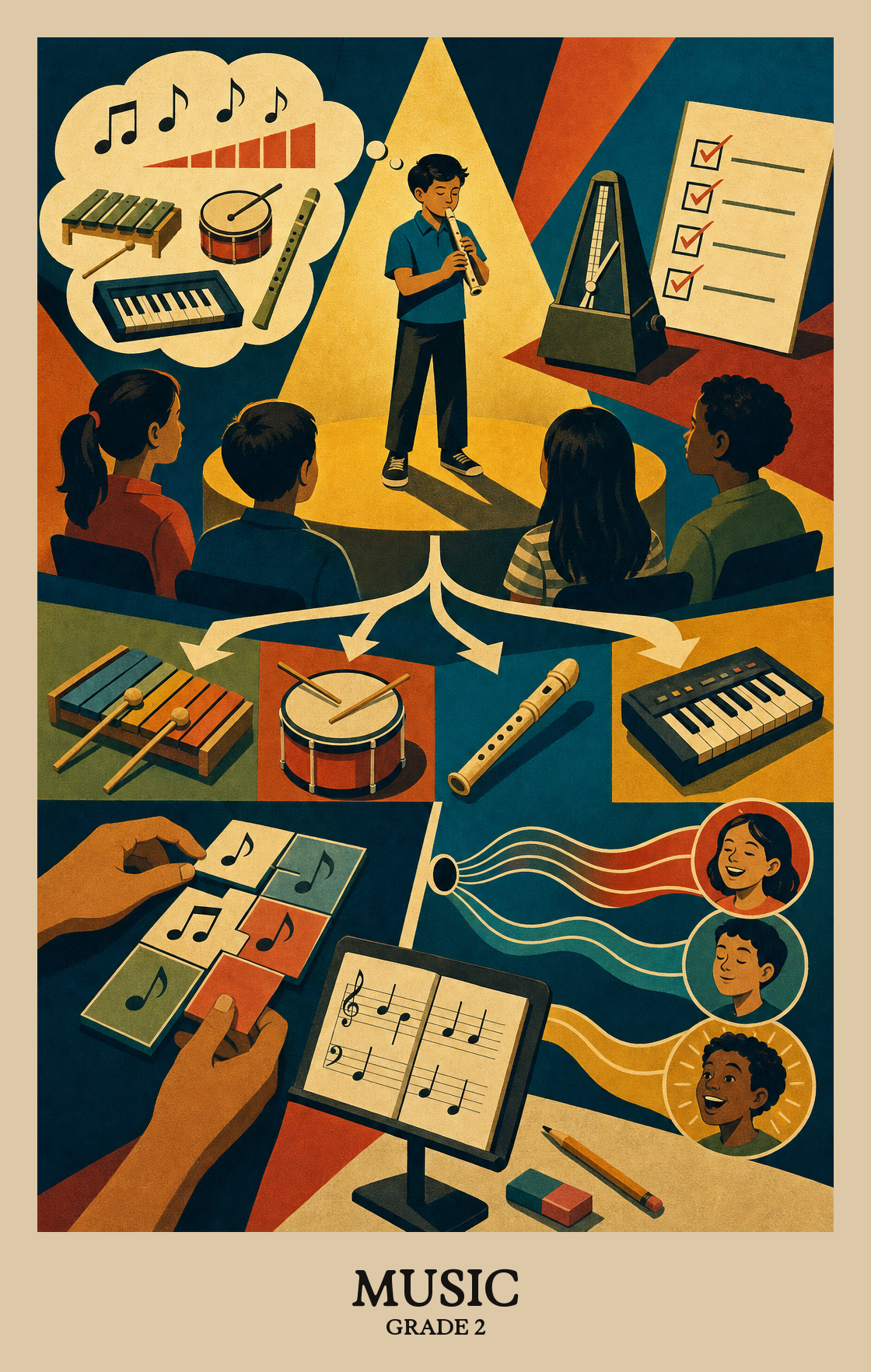
Students start the year by listening closely to songs and naming what they hear. They notice loud and soft, fast and slow, and begin to describe how a piece of music makes them feel.
Students try out their own rhythms and short melodies using voices, hands, and simple instruments. They play with patterns and pick the ones they like best.
Students take a rough musical idea and clean it up for an audience. They practice the tricky parts, decide how it should sound, and get it ready to perform.
Students sing and play together in front of classmates or family. They focus on staying with the group, keeping a steady beat, and showing the feeling of the song.
Students listen to songs from different places and times and connect them to their own lives. They talk about why people make music and what a song might be saying.
Students connect what they already know and what they've lived through to the music they make or perform. Personal experiences shape the choices they make as young musicians.
Songs and musical pieces come from real places, times, and communities. Students connect what they hear to where and why it was made.
| Standard | Definition | Code |
|---|---|---|
| Synthesize and relate knowledge and personal experiences to make art | Students connect what they already know and what they've lived through to the music they make or perform. Personal experiences shape the choices they make as young musicians. | MU:Cn10.2 |
| Relate artistic ideas and works with societal, cultural | Songs and musical pieces come from real places, times, and communities. Students connect what they hear to where and why it was made. | MU:Cn11.2 |
Students come up with their own musical ideas, like inventing a rhythm, choosing instruments, or deciding how a short piece should sound.
Students take a musical idea they have been exploring and shape it into a short piece, deciding which sounds to keep, which to change, and how to put them in order.
Students revisit a song or musical idea they started, make small changes to improve it, and finish it in a way they feel good about.
| Standard | Definition | Code |
|---|---|---|
| Generate and conceptualize artistic ideas and work | Students come up with their own musical ideas, like inventing a rhythm, choosing instruments, or deciding how a short piece should sound. | MU:Cr1.2 |
| Organize and develop artistic ideas and work | Students take a musical idea they have been exploring and shape it into a short piece, deciding which sounds to keep, which to change, and how to put them in order. | MU:Cr2.2 |
| Refine and complete artistic work | Students revisit a song or musical idea they started, make small changes to improve it, and finish it in a way they feel good about. | MU:Cr3.2 |
Students choose a song or piece to perform and think through why it fits the moment. They consider the mood, the words, and what the music asks them to do with their voice or instrument.
Students practice a song or piece of music until it sounds the way they want it to sound, then share it with an audience.
Students perform a song or piece and make deliberate choices, like tempo or dynamics, to express a specific feeling or idea to the audience.
| Standard | Definition | Code |
|---|---|---|
| Analyze, interpret, and select artistic work for presentation | Students choose a song or piece to perform and think through why it fits the moment. They consider the mood, the words, and what the music asks them to do with their voice or instrument. | MU:Pr4.2 |
| Develop and refine artistic techniques and work for presentation | Students practice a song or piece of music until it sounds the way they want it to sound, then share it with an audience. | MU:Pr5.2 |
| Convey meaning through the presentation of artistic work | Students perform a song or piece and make deliberate choices, like tempo or dynamics, to express a specific feeling or idea to the audience. | MU:Pr6.2 |
Students listen to a short piece of music and describe what they notice, like a repeated melody, a change in speed, or an instrument that stands out.
Students listen to a piece of music and explain what they think the composer or performer was feeling or trying to say. There is no single right answer, just reasons tied to what they actually heard.
Students listen to a piece of music and decide whether it is good, giving a reason why, such as a steady beat or clear melody.
| Standard | Definition | Code |
|---|---|---|
| Perceive and analyze artistic work | Students listen to a short piece of music and describe what they notice, like a repeated melody, a change in speed, or an instrument that stands out. | MU:Re7.2 |
| Interpret intent and meaning in artistic work | Students listen to a piece of music and explain what they think the composer or performer was feeling or trying to say. There is no single right answer, just reasons tied to what they actually heard. | MU:Re8.2 |
| Apply criteria to evaluate artistic work | Students listen to a piece of music and decide whether it is good, giving a reason why, such as a steady beat or clear melody. | MU:Re9.2 |
Students sing, clap rhythms, play simple classroom instruments, and listen to short pieces of music. They make up small musical ideas of their own, practice them, and share them with the class. They also start to talk about what they hear and why a song feels happy, sad, or exciting.
Sing in the car, clap rhythms while waiting in line, and let students tap a steady beat to songs on the radio. Ask what instruments they hear and whether the music feels fast or slow. Ten minutes of listening and singing together goes a long way.
No. Voices, hands, and pots and pans are enough at this age. If a small keyboard, ukulele, or shaker is around the house, students will enjoy exploring it, but nothing needs to be bought.
Students should keep a steady beat, sing simple songs in tune most of the time, and clap back short rhythm patterns. They should be able to make up a short musical idea, perform it for others, and say something about a piece of music they heard.
Start with steady beat, singing voice, and call-and-response so routines stick. Layer in simple rhythm reading and pitch matching through the fall, then move into short composition tasks in winter. Spring is the time to refine performance pieces and add reflection on listening examples.
Steady beat under a changing rhythm is the big one. Matching pitch in a group is another, especially for students who have not sung much before. Plan to revisit both across the year rather than treating them as one-and-done units.
Quite a bit. Short listening clips with one focused question build the vocabulary students need to describe and evaluate music. Two or three minutes of listening per class, with a quick discussion, is plenty.
Group singing, echo games, and playing a small instrument all count. Students can also share a rhythm by clapping or tapping instead of singing alone. Confidence builds over the year as the class becomes a familiar audience.
Students can keep a steady beat with a song, sing a familiar tune from memory, and clap back a short pattern. They can also point to something they like or notice in a piece of music. If those feel comfortable, they are in good shape.