Finding ideas to move
Students start the year exploring what sparks a dance. They draw from memories, music, pictures, and stories, then turn those starting points into short movement ideas they can build on later.
This is the year dance shifts from following steps to shaping ideas. Students pull from their own experiences and what they see in the world to build short pieces with a clear point. They practice the moves, refine the choreography, and learn to talk about why a dance works or falls flat. By spring, students can perform a short dance they helped create and explain what it means.
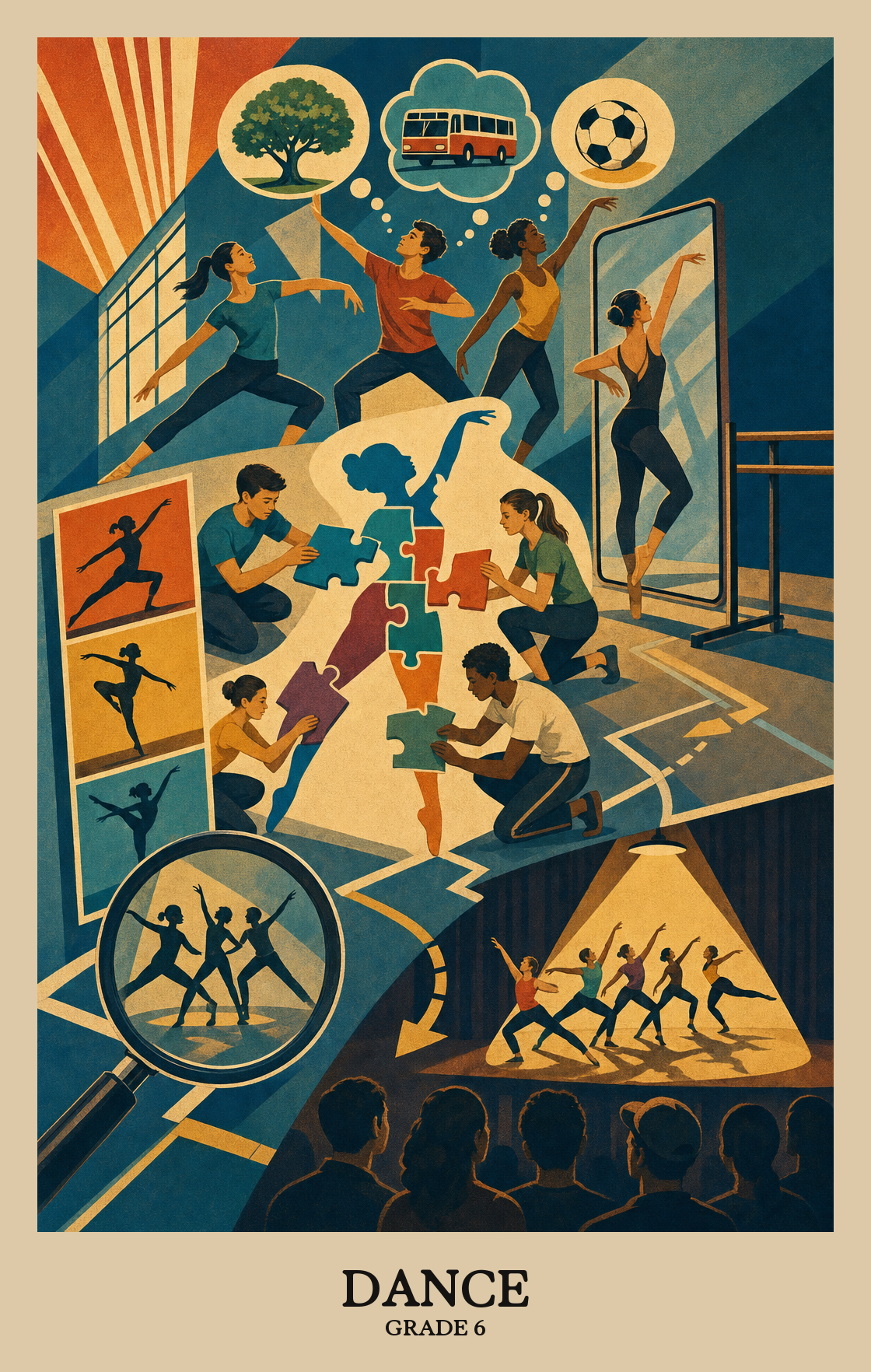
Students start the year exploring what sparks a dance. They draw from memories, music, pictures, and stories, then turn those starting points into short movement ideas they can build on later.
Students take rough ideas and give them order. They play with pathways, timing, and energy, then string movements together so a short piece has a clear beginning, middle, and feeling.
Students rehearse with intent. They sharpen their technique, fix what feels unclear, and make choices about what to keep so the dance reads cleanly to an audience.
Students prepare a piece to share. They think about what they want the audience to feel, then perform with focus so the meaning comes through in their movement.
Students become thoughtful viewers. They watch dances from different cultures and time periods, talk about what choices the dancers made, and use clear reasons to say what worked.
Students connect what they already know and have lived through to the dances they make. Personal experiences, other subjects, and outside interests all shape the choices they make as choreographers.
Students examine a dance piece and connect it to the time, place, or culture it came from. Understanding that context changes how the work looks and what it means.
| Standard | Definition | Code |
|---|---|---|
| Synthesize and relate knowledge and personal experiences to make art | Students connect what they already know and have lived through to the dances they make. Personal experiences, other subjects, and outside interests all shape the choices they make as choreographers. | DA:Cn10.6 |
| Relate artistic ideas and works with societal, cultural | Students examine a dance piece and connect it to the time, place, or culture it came from. Understanding that context changes how the work looks and what it means. | DA:Cn11.6 |
Students brainstorm and develop original ideas for a dance, experimenting with movement before settling on a direction for their piece.
Students take a rough movement idea and shape it into a structured dance sequence, making deliberate choices about how the piece flows from start to finish.
Students revisit a dance they've been building, make specific changes to improve how it looks or feels, and bring it to a finished, shareable form.
| Standard | Definition | Code |
|---|---|---|
| Generate and conceptualize artistic ideas and work | Students brainstorm and develop original ideas for a dance, experimenting with movement before settling on a direction for their piece. | DA:Cr1.6 |
| Organize and develop artistic ideas and work | Students take a rough movement idea and shape it into a structured dance sequence, making deliberate choices about how the piece flows from start to finish. | DA:Cr2.6 |
| Refine and complete artistic work | Students revisit a dance they've been building, make specific changes to improve how it looks or feels, and bring it to a finished, shareable form. | DA:Cr3.6 |
Students choose a dance or movement piece to perform and explain why it suits the moment, the audience, or their own strengths as a dancer.
Students practice and improve a dance piece until it's ready to share with an audience. That means cleaning up technique, fixing transitions, and making intentional choices about how the dance looks and feels in performance.
Students perform a dance for an audience with a clear purpose in mind, using movement choices to express an idea, emotion, or story rather than just going through the steps.
| Standard | Definition | Code |
|---|---|---|
| Analyze, interpret, and select artistic work for presentation | Students choose a dance or movement piece to perform and explain why it suits the moment, the audience, or their own strengths as a dancer. | DA:Pr4.6 |
| Develop and refine artistic techniques and work for presentation | Students practice and improve a dance piece until it's ready to share with an audience. That means cleaning up technique, fixing transitions, and making intentional choices about how the dance looks and feels in performance. | DA:Pr5.6 |
| Convey meaning through the presentation of artistic work | Students perform a dance for an audience with a clear purpose in mind, using movement choices to express an idea, emotion, or story rather than just going through the steps. | DA:Pr6.6 |
Students watch a dance performance and describe what they notice, from how the dancers move to how the whole piece is put together. The goal is to look closely and explain what they see, not just say whether they liked it.
Students explain what a dance is trying to say and why the choreographer made specific choices, like repeated movements or changes in speed and level.
Students watch a dance performance and judge it using a clear set of criteria, explaining what works, what doesn't, and why.
| Standard | Definition | Code |
|---|---|---|
| Perceive and analyze artistic work | Students watch a dance performance and describe what they notice, from how the dancers move to how the whole piece is put together. The goal is to look closely and explain what they see, not just say whether they liked it. | DA:Re7.6 |
| Interpret intent and meaning in artistic work | Students explain what a dance is trying to say and why the choreographer made specific choices, like repeated movements or changes in speed and level. | DA:Re8.6 |
| Apply criteria to evaluate artistic work | Students watch a dance performance and judge it using a clear set of criteria, explaining what works, what doesn't, and why. | DA:Re9.6 |
Sixth graders create short dances, perform them, and talk about what dances mean. They pull ideas from their own lives and from other cultures, then shape those ideas into movement they can share with an audience.
Clear a small space and let them show a short piece they are working on. Ask what feeling or idea the movement is about, then watch it again. Five minutes of focused rehearsal beats a long stretch of unfocused practice.
No. Sixth grade dance is about making and reading movement, not about being a trained dancer. Curiosity and a willingness to try a few moves in front of others matter more than talent or flexibility.
Start with short exploration tasks that build a movement vocabulary, then move into composing solos and small group pieces. Save the longer choreographed work and audience-ready performances for the second half of the year, once students can give and take feedback.
By spring, students can take an idea, shape it into a short dance with a clear beginning and end, and perform it with intent. They can also watch a peer's dance and say what worked and what they would change, using shared criteria.
Refining a piece is the hardest part. Students often want to call a dance finished after the first draft. Build in regular revision cycles where the same short piece gets reworked two or three times based on specific feedback.
Ask three plain questions. What did you notice? What do you think it was about? What would you change if you made it again? Short conversations like this build the same skills tested in class.
Students look at where dances come from and what they meant to the people who made them. A quick conversation at home about family celebrations, music, or movement traditions gives them real material to draw from in class.