Building the ensemble
Students get comfortable working as a group, trying out warm-ups, improv games, and short scenes. They start drawing on their own experiences to come up with ideas for characters and stories.
This is the year theatre shifts from playing pretend to building scenes on purpose. Students draw on their own lives to invent characters and stories, then shape those ideas into short pieces they rehearse and refine. They also start watching plays with a sharper eye, asking what the playwright meant and whether the choices on stage worked. By spring, students can perform a scene they helped develop and explain the decisions behind it.
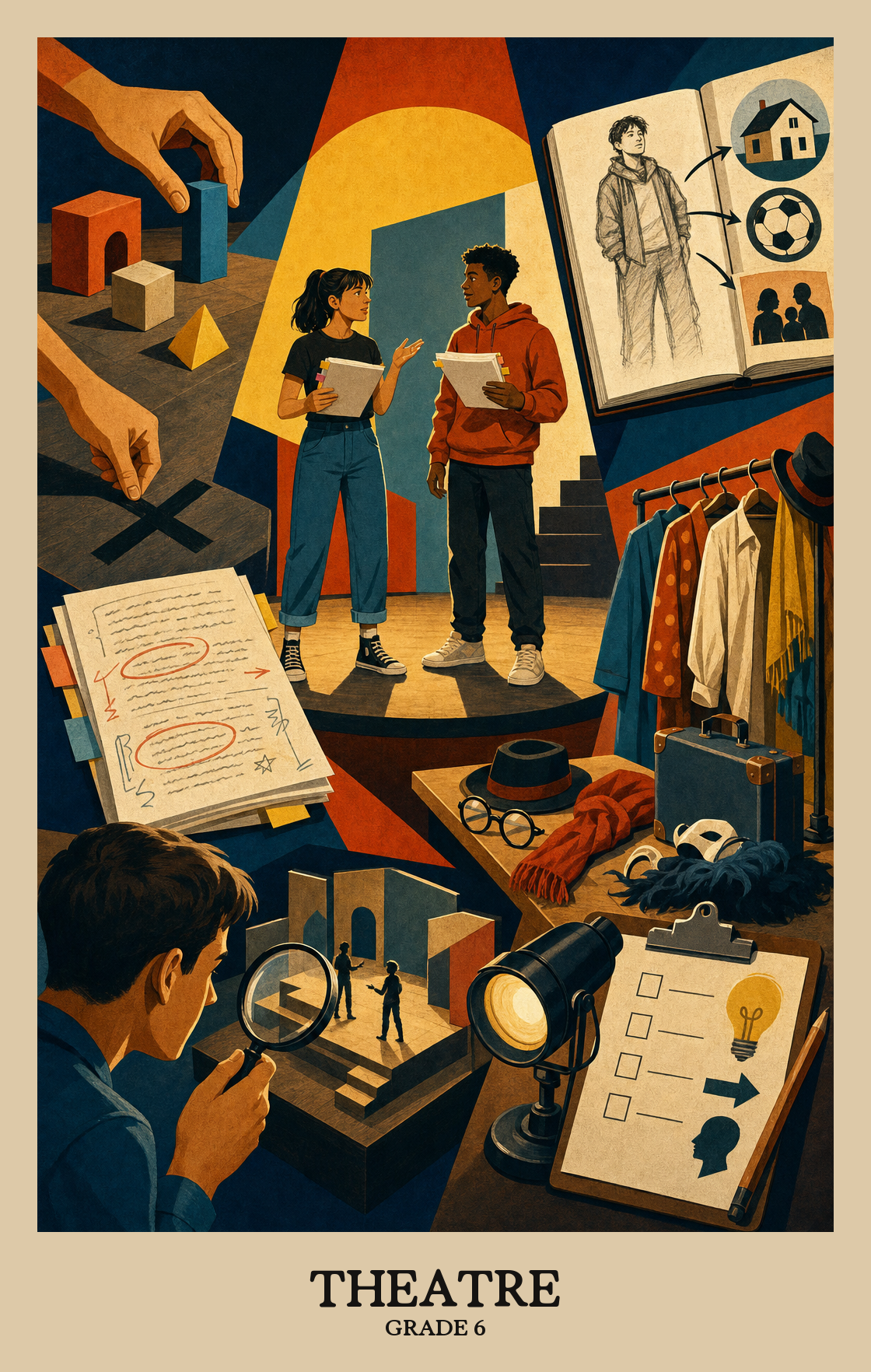
Students get comfortable working as a group, trying out warm-ups, improv games, and short scenes. They start drawing on their own experiences to come up with ideas for characters and stories.
Students take rough ideas and turn them into scenes with a clear beginning, middle, and end. They learn to revise their work after feedback from classmates and the teacher.
Students practice voice, body, and focus to bring characters to life. They rehearse scenes with intention, making choices about how a line sounds or how a character moves.
Students read and watch scenes from different times and places. They talk about how a play reflects the people who made it and the world around them.
Students present finished scenes to an audience and watch their classmates perform. They use clear criteria to talk about what worked, what the play meant, and what they would change next time.
Students connect something from their own life to a character, scene, or story they're creating in theatre class. Personal experience shapes the choices they make onstage.
Students look at a play or performance and ask where it came from: what was happening in the world, who made it, and why. That context changes what the work means.
| Standard | Definition | Code |
|---|---|---|
| Synthesize and relate knowledge and personal experiences to make art | Students connect something from their own life to a character, scene, or story they're creating in theatre class. Personal experience shapes the choices they make onstage. | TH:Cn10.6 |
| Relate artistic ideas and works with societal, cultural | Students look at a play or performance and ask where it came from: what was happening in the world, who made it, and why. That context changes what the work means. | TH:Cn11.6 |
Students brainstorm and develop original ideas for a theatre piece, exploring characters, stories, or situations before settling on a direction for their work.
Students take their early ideas for a scene or character and shape them into something ready to rehearse, making choices about story, dialogue, and how the performance will come together.
Students revisit a scene or script they drafted, then revise it based on feedback and their own judgment until the work is ready to share.
| Standard | Definition | Code |
|---|---|---|
| Generate and conceptualize artistic ideas and work | Students brainstorm and develop original ideas for a theatre piece, exploring characters, stories, or situations before settling on a direction for their work. | TH:Cr1.6 |
| Organize and develop artistic ideas and work | Students take their early ideas for a scene or character and shape them into something ready to rehearse, making choices about story, dialogue, and how the performance will come together. | TH:Cr2.6 |
| Refine and complete artistic work | Students revisit a scene or script they drafted, then revise it based on feedback and their own judgment until the work is ready to share. | TH:Cr3.6 |
Students choose a scene or monologue, then explain why it suits the performance and what choices they made to bring it to life.
Students practice and improve their performance skills, then prepare their work to share with an audience. Rehearsal and revision are how the final piece gets better.
Students perform a scene or monologue with a clear intention, making deliberate choices about voice, movement, and expression so the audience understands what the piece is about.
| Standard | Definition | Code |
|---|---|---|
| Analyze, interpret, and select artistic work for presentation | Students choose a scene or monologue, then explain why it suits the performance and what choices they made to bring it to life. | TH:Pr4.6 |
| Develop and refine artistic techniques and work for presentation | Students practice and improve their performance skills, then prepare their work to share with an audience. Rehearsal and revision are how the final piece gets better. | TH:Pr5.6 |
| Convey meaning through the presentation of artistic work | Students perform a scene or monologue with a clear intention, making deliberate choices about voice, movement, and expression so the audience understands what the piece is about. | TH:Pr6.6 |
Students watch a scene or performance and break down what they notice: how the actors move, speak, and make choices that shape the story.
Students look at a scene, a character, or a design choice and explain what the creator was trying to say and why it lands the way it does.
Students use a set of criteria, like a checklist or rubric, to judge a theatre performance and explain what works and what doesn't.
| Standard | Definition | Code |
|---|---|---|
| Perceive and analyze artistic work | Students watch a scene or performance and break down what they notice: how the actors move, speak, and make choices that shape the story. | TH:Re7.6 |
| Interpret intent and meaning in artistic work | Students look at a scene, a character, or a design choice and explain what the creator was trying to say and why it lands the way it does. | TH:Re8.6 |
| Apply criteria to evaluate artistic work | Students use a set of criteria, like a checklist or rubric, to judge a theatre performance and explain what works and what doesn't. | TH:Re9.6 |
Students build short scenes, take on characters, and act out stories they help shape. They also watch performances and talk about what worked and why. Expect a mix of making theatre, performing it, and reflecting on it.
Keep it low-pressure. Ask students to read a picture book or a short scene out loud using different voices for each character, or to act out a memory from the day at dinner. Five minutes of playful pretending builds the same confidence the classroom asks for.
Start with ensemble-building and short improv games so students feel safe taking risks. Move into scene work and character choices in the middle of the year, then end with a small rehearsed performance and reflection. Responding and analysing should run alongside the whole year, not wait until the end.
Sometimes, but not always. Students work with short scripts, improv, and devised scenes, so memorisation is one tool among several. When lines are assigned, helping run them out loud at home for a few minutes a night makes a real difference.
Specific character choices and giving useful feedback to peers. Students often default to playing themselves with a costume, and their notes on classmates stay vague. Sentence stems for both, plus modelling, tend to move the work faster than more performance time.
Watch a play, a musical, or even a sitcom together and talk about how an actor showed a feeling without saying it. Then try it at home: show happy, nervous, or suspicious using only a face or a walk across the kitchen. Shy students often warm up when performing is a game, not a test.
By spring, students should be able to make a clear character choice, rehearse a short scene with a partner, and explain why a piece of theatre affected an audience. They should also connect a play to something from their own life or from history. If those three things are steady, they are ready.