Listening with a sharper ear
Students start the year tuning in to music more carefully. They notice how a song is built, what mood it sets, and why a composer might have made those choices.
This is the year music turns from playing along to making real choices. Students come up with their own short musical ideas, shape them, and practice until a piece is ready to share. When they listen, they say what the music seems to be about and why the composer made the choices they hear. By spring, students can perform a prepared piece for an audience and explain what makes a performance work.
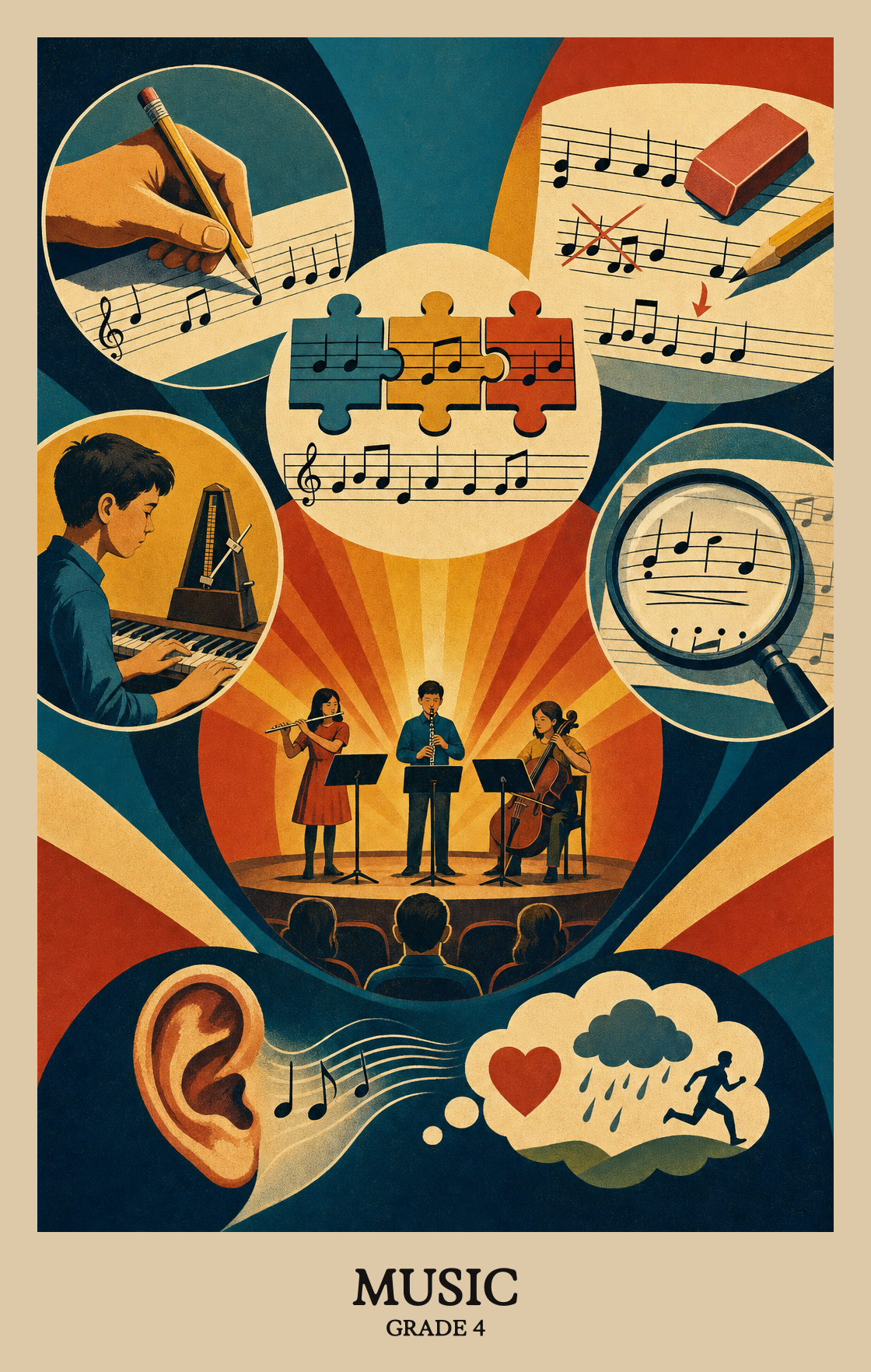
Students start the year tuning in to music more carefully. They notice how a song is built, what mood it sets, and why a composer might have made those choices.
Students come up with short musical ideas of their own, like a rhythm pattern or a simple melody. They try things out, keep what works, and shape it into something they can share.
Students pick music to perform and practice it with intent. They work on cleaner playing or singing, steady timing, and choices that help the audience feel what the song is about.
Students connect songs to the people, places, and times they come from. They talk about what a piece means to them and how it fits with stories, traditions, or moments from history.
Students connect what they've learned in music class to their own memories and experiences, then use that mix to shape a performance or composition.
Students look at a song or piece of music and figure out where it came from: what culture made it, when, and why. That context helps them understand what the music means beyond the notes.
| Standard | Definition | Code |
|---|---|---|
| Making music from personal experience | Students connect what they've learned in music class to their own memories and experiences, then use that mix to shape a performance or composition. | MU:Cn10.4 |
| Music and culture across time | Students look at a song or piece of music and figure out where it came from: what culture made it, when, and why. That context helps them understand what the music means beyond the notes. | MU:Cn11.4 |
Students come up with their own musical ideas, like inventing a short melody or rhythm pattern, and begin shaping those ideas into something they can perform or share.
Students take their musical ideas and shape them into a short piece or pattern, making choices about how notes, rhythms, and sounds fit together.
Students listen back to their own musical ideas, make changes to improve them, and bring a piece to a finished state.
| Standard | Definition | Code |
|---|---|---|
| Coming up with musical ideas | Students come up with their own musical ideas, like inventing a short melody or rhythm pattern, and begin shaping those ideas into something they can perform or share. | MU:Cr1.4 |
| Turning musical ideas into a song | Students take their musical ideas and shape them into a short piece or pattern, making choices about how notes, rhythms, and sounds fit together. | MU:Cr2.4 |
| Finish and improve a song | Students listen back to their own musical ideas, make changes to improve them, and bring a piece to a finished state. | MU:Cr3.4 |
Students choose a piece of music to perform and explain why it fits the occasion or audience. They think about what the music means before they play or sing it.
Students practice a song or piece until it sounds the way they want it to, then refine the rough spots before performing it for others.
Students perform a song or piece with intention, making choices about how to express the feeling or story in the music to an audience.
| Standard | Definition | Code |
|---|---|---|
| Choosing music to perform | Students choose a piece of music to perform and explain why it fits the occasion or audience. They think about what the music means before they play or sing it. | MU:Pr4.4 |
| Rehearse and improve a musical piece | Students practice a song or piece until it sounds the way they want it to, then refine the rough spots before performing it for others. | MU:Pr5.4 |
| Perform music that means something | Students perform a song or piece with intention, making choices about how to express the feeling or story in the music to an audience. | MU:Pr6.4 |
Students listen to a short piece of music and describe what they notice, like a repeated melody, a change in tempo, or how the instruments work together.
Students listen to a piece of music and explain what the composer or performer was trying to express, using details from the music itself to back up their thinking.
Students listen to a piece of music and use specific criteria, like rhythm, melody, or dynamics, to explain what works and what doesn't. They back up their opinion with reasons, not just "I liked it."
| Standard | Definition | Code |
|---|---|---|
| Listening closely to music and art | Students listen to a short piece of music and describe what they notice, like a repeated melody, a change in tempo, or how the instruments work together. | MU:Re7.4 |
| Reading meaning in music | Students listen to a piece of music and explain what the composer or performer was trying to express, using details from the music itself to back up their thinking. | MU:Re8.4 |
| Judging whether music is good | Students listen to a piece of music and use specific criteria, like rhythm, melody, or dynamics, to explain what works and what doesn't. They back up their opinion with reasons, not just "I liked it." | MU:Re9.4 |
Students sing, play simple instruments like recorders or xylophones, and start making up short pieces of their own. They also learn to listen carefully to music and talk about what they hear, why a composer might have written it, and what makes a performance work.
Play different kinds of music in the car and at dinner, then ask what students notice about the beat, the mood, or the instruments. Singing along, clapping rhythms, or tapping out a steady beat on the table is plenty. None of this requires reading music.
Students start reading basic rhythms and a few notes on the staff, but fluent music reading is not the goal yet. Recognizing a quarter note, a rest, and a simple melody pattern is a strong place to be heading into fifth grade.
Sing with them anyway, in the car or while cooking, and keep it low pressure. Voices at this age are still finding their range, and most students sound stronger by spring once they have had more practice matching pitch.
A common arc is rhythm and steady beat in the fall, melody and simple notation in the winter, and composing and performing short pieces in the spring. Listening and responding work fits in every unit, tied to whatever students are singing or playing that month.
Keeping a steady beat while others play a different part is the big one, along with telling the difference between beat and rhythm. Short, frequent practice with body percussion and call-and-response tends to move students faster than long drills.
Give a tight frame: four beats, two pitches, a set instrument. Have students draft, play it for a partner, revise one thing, then perform. The structure is what makes the creative part work, and it also gives a clear thing to assess.
By June, students should keep a steady beat in a group, read simple rhythms, sing in tune most of the time, and talk about a piece of music using words like tempo, dynamics, and mood. They should also be able to perform a short piece they helped create or rehearse.