Meeting world communities
Students learn what a community is and start looking at places around the world. They ask questions about where people live and notice what makes each community its own kind of place.
This is the year the world gets bigger. Students step outside their own neighborhood to study communities across the globe, looking at how geography, jobs, and government shape daily life in faraway places. They start using maps, photos, and short readings as clues, and they notice how one place can be both similar to and different from their own. By spring, students can pick a community somewhere in the world and explain how its land, work, and leaders fit together.
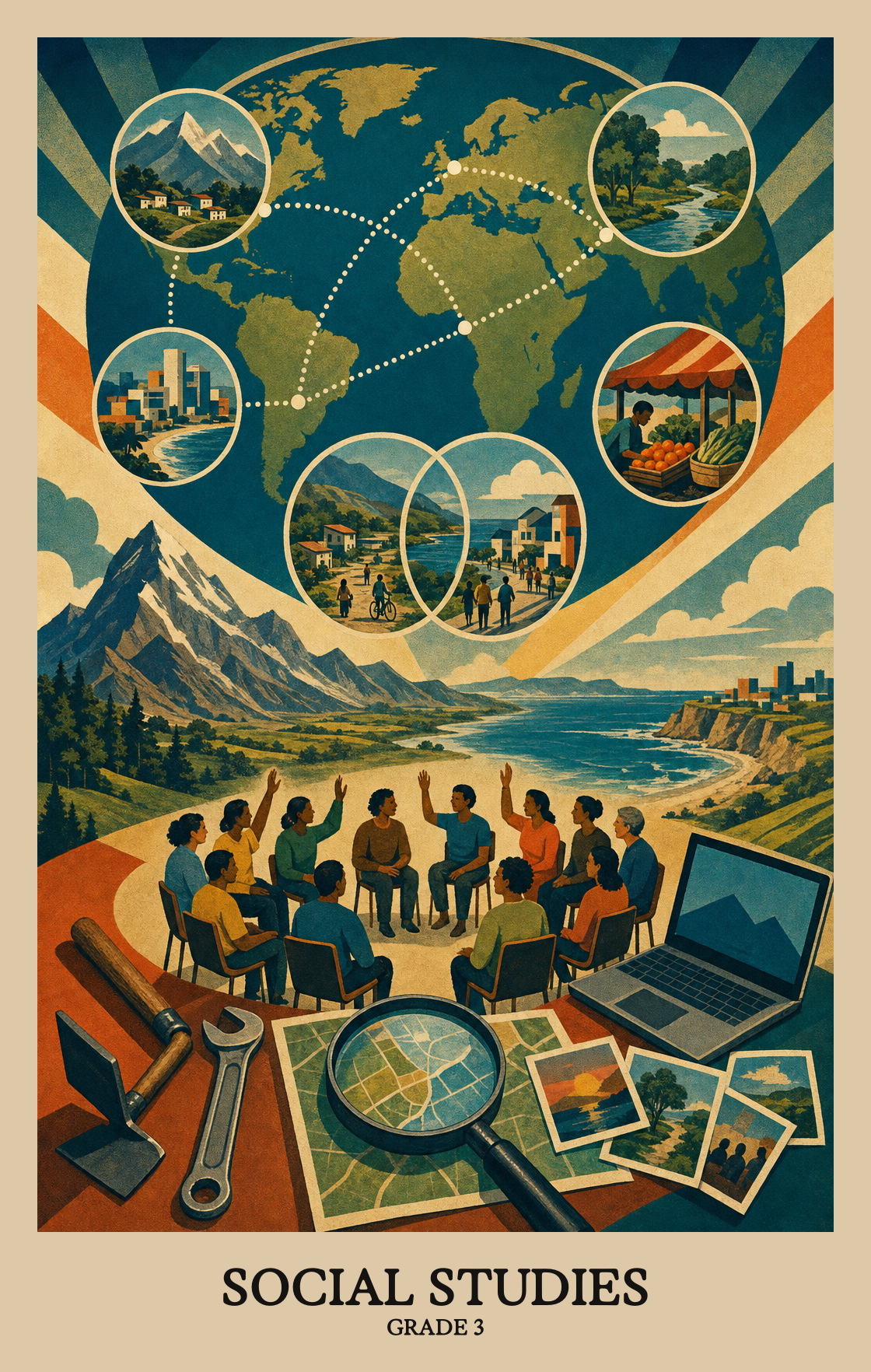
Students learn what a community is and start looking at places around the world. They ask questions about where people live and notice what makes each community its own kind of place.
Students dig into geography. They study how mountains, rivers, weather, and resources shape daily life in a world community, and how the people there shape the land back.
Students look at how families in a world community earn money, what they make or grow, and what they trade with other places. They compare jobs and goods to those at home.
Students learn how different world communities are governed and who leads them. They compare those leaders to the U.S. president and talk about the rights and jobs of citizens.
Students use timelines, photos, and stories to see how a world community has changed across decades and centuries. They notice what stayed the same and what shifted, and why.
Students come up with their own questions about a place or group of people in the world. This is the starting point for research and class discussion.
Students learn to read maps, study old photographs, and look at artifacts to piece together what happened in a place or time. These are the real tools historians use to figure out the past.
Students look at a source (a photo, map, article, or artifact) and figure out who made it, why they made it, and what kind of source it is. When it matters, they also consider whether the creator had a particular perspective or opinion.
Students read or listen to a position someone else holds and name what that person is arguing for or against.
Students look at a photo, map, or short text and explain what it suggests but does not say outright. This is the skill of reading between the lines.
Students piece together what happened in history by reading two kinds of sources: firsthand accounts (like a diary or letter) and later summaries (like a textbook or biography).
Students look at a group of historical events and explain how each one led to or connected with the others. The focus is on seeing a chain, not just a list.
Students use math to measure time in years and centuries, the way they might measure length with a ruler. They figure out how long ago something happened or how many years fit between two events.
Students look at something that happened and explain why it happened and what came next. They practice this with their own experiences, current events, or moments from history.
Students look at an event and sort out what started it long ago from what triggered it just before it happened, then trace what changed because of it.
Students look at how life in a community has stayed the same and how it has changed over time. They might compare what a neighborhood looked like decades ago with how it looks today.
Students learn what a decade (10 years) and a century (100 years) mean, then use those terms to place events in order on a timeline.
Students look at how a community has stayed the same over time and how it has changed, such as how buildings, jobs, or traditions shift across generations while some things stay put.
Students pick a region of the world and explain what ties its places together, such as a shared climate, language, or landscape.
Students look at how people in different parts of the world see the same situation differently. They compare those viewpoints to understand why people in one community might think or act differently from people in another.
Students pick a real event from a community somewhere in the world and describe what happened, when it happened, and why it mattered to the people there.
Students learn how a place's location and natural resources shape what people there buy, sell, and do for work, and how those patterns built up over time.
Students pick a real event from a world community and describe what happened, naming where it took place and roughly when. The details make the event feel grounded in a specific time and place, not just a vague story.
Students ask why cities, rivers, and landmarks sit where they do, then use maps or models to explain it. They also describe how two places relate, like which is farther north or what trade route connects them.
Students sort the world into two buckets: things nature made (mountains, rivers, weather) and things people built or changed (roads, farms, buildings). They practice spotting the difference on maps and in real places.
Students explain how people in a world community change their environment (by building roads or clearing land) and how that environment shapes what people there can do or grow.
Students look at where people live on a map and explain why they cluster in certain spots, like near rivers or flat land, and what that spread of people looks like as a pattern.
Students look at a neighborhood, farm, or forest and explain what people changed about it. They describe what the place looked like before and what human activity, like building roads or clearing land, made it different.
Scarcity means there is never enough of everything, so people and governments have to choose how to spend money and use resources. Students look at what is gained and what is given up when those choices are made.
Students look at a real community around the world and name the land, workers, tools, and materials that people there use to make goods or run businesses.
Students identify goods sold in communities around the world and look at how people in those places pay for them, whether with cash, cards, or other methods.
Students look at what different countries make or grow, and what services they offer. Then students explain what those countries buy from and sell to each other.
Students look at how different communities around the world are run and what their governments do for people, like building roads, running schools, or keeping neighborhoods safe.
Students practice listening to classmates who see things differently and responding without dismissing their ideas. The goal is learning to disagree without being disrespectful.
Students pick a real problem in their school or community and take part in doing something about it, like writing a letter, holding a discussion, or organizing a small project.
Students look at how different countries are governed, comparing places where one person holds power to places where citizens vote or make decisions together.
Students learn where and how one person can take part in decisions at school, in their neighborhood, or beyond. That might mean joining a class vote, attending a town meeting, or speaking up for a change they want to see.
Students practice working through disagreements with classmates by listening, giving a little ground, and finding a solution both sides can accept.
Students look at a real problem in their community and decide what people could do about it. This standard is about recognizing when something needs to change and naming a step someone could take.
Students name leaders from countries around the world and compare their jobs to what the U.S. president does. Some roles look similar, others work differently.
Students identify rights (like voting or going to school) and responsibilities (like following rules) that citizens have in their town, then compare those to rights and responsibilities people hold in other countries.
| Standard | Definition | Code |
|---|---|---|
| Asking questions about world communities | Students come up with their own questions about a place or group of people in the world. This is the starting point for research and class discussion. | NY-SS.3.A.1 |
| Reading maps, photos, and primary sources | Students learn to read maps, study old photographs, and look at artifacts to piece together what happened in a place or time. These are the real tools historians use to figure out the past. | NY-SS.3.A.2 |
| Who made this source and why | Students look at a source (a photo, map, article, or artifact) and figure out who made it, why they made it, and what kind of source it is. When it matters, they also consider whether the creator had a particular perspective or opinion. | NY-SS.3.A.3 |
| Spotting someone else's argument | Students read or listen to a position someone else holds and name what that person is arguing for or against. | NY-SS.3.A.4 |
| Spotting inferences in sources | Students look at a photo, map, or short text and explain what it suggests but does not say outright. This is the skill of reading between the lines. | NY-SS.3.A.5 |
| Learning history from primary sources | Students piece together what happened in history by reading two kinds of sources: firsthand accounts (like a diary or letter) and later summaries (like a textbook or biography). | NY-SS.3.A.6 |
| How events connect over time | Students look at a group of historical events and explain how each one led to or connected with the others. The focus is on seeing a chain, not just a list. | NY-SS.3.B.1 |
| Measuring time in years and centuries | Students use math to measure time in years and centuries, the way they might measure length with a ruler. They figure out how long ago something happened or how many years fit between two events. | NY-SS.3.B.2 |
| Causes and effects in history and daily life | Students look at something that happened and explain why it happened and what came next. They practice this with their own experiences, current events, or moments from history. | NY-SS.3.B.3 |
| Causes and effects: short-term vs. long-term | Students look at an event and sort out what started it long ago from what triggered it just before it happened, then trace what changed because of it. | NY-SS.3.B.4 |
| How things change and stay the same | Students look at how life in a community has stayed the same and how it has changed over time. They might compare what a neighborhood looked like decades ago with how it looks today. | NY-SS.3.B.5 |
| Decades and centuries | Students learn what a decade (10 years) and a century (100 years) mean, then use those terms to place events in order on a timeline. | NY-SS.3.B.6 |
| How world communities change over time | Students look at how a community has stayed the same over time and how it has changed, such as how buildings, jobs, or traditions shift across generations while some things stay put. | NY-SS.3.B.7 |
| What world regions have in common | Students pick a region of the world and explain what ties its places together, such as a shared climate, language, or landscape. | NY-SS.3.C.1 |
| Different views in world communities | Students look at how people in different parts of the world see the same situation differently. They compare those viewpoints to understand why people in one community might think or act differently from people in another. | NY-SS.3.C.2 |
| Describing a historical event | Students pick a real event from a community somewhere in the world and describe what happened, when it happened, and why it mattered to the people there. | NY-SS.3.C.3 |
| How place and resources shape communities | Students learn how a place's location and natural resources shape what people there buy, sell, and do for work, and how those patterns built up over time. | NY-SS.3.C.4 |
| Describing history with time and place details | Students pick a real event from a world community and describe what happened, naming where it took place and roughly when. The details make the event feel grounded in a specific time and place, not just a vague story. | NY-SS.3.C.5 |
| Where places are and why they're there | Students ask why cities, rivers, and landmarks sit where they do, then use maps or models to explain it. They also describe how two places relate, like which is farther north or what trade route connects them. | NY-SS.3.D.1 |
| Human-made vs. natural features | Students sort the world into two buckets: things nature made (mountains, rivers, weather) and things people built or changed (roads, farms, buildings). They practice spotting the difference on maps and in real places. | NY-SS.3.D.2 |
| How humans and environments shape each other | Students explain how people in a world community change their environment (by building roads or clearing land) and how that environment shapes what people there can do or grow. | NY-SS.3.D.3 |
| Population patterns and what causes them | Students look at where people live on a map and explain why they cluster in certain spots, like near rivers or flat land, and what that spread of people looks like as a pattern. | NY-SS.3.D.4 |
| How humans change places around them | Students look at a neighborhood, farm, or forest and explain what people changed about it. They describe what the place looked like before and what human activity, like building roads or clearing land, made it different. | NY-SS.3.D.5 |
| Why we can't have everything we want | Scarcity means there is never enough of everything, so people and governments have to choose how to spend money and use resources. Students look at what is gained and what is given up when those choices are made. | NY-SS.3.E.1 |
| Resources that make goods and services | Students look at a real community around the world and name the land, workers, tools, and materials that people there use to make goods or run businesses. | NY-SS.3.E.2 |
| Buying and paying for goods around the world | Students identify goods sold in communities around the world and look at how people in those places pay for them, whether with cash, cards, or other methods. | NY-SS.3.E.3 |
| World trade: goods and services | Students look at what different countries make or grow, and what services they offer. Then students explain what those countries buy from and sell to each other. | NY-SS.3.E.4 |
| Types of government and citizen services | Students look at how different communities around the world are run and what their governments do for people, like building roads, running schools, or keeping neighborhoods safe. | NY-SS.3.E.5 |
| Respecting others during classroom debates | Students practice listening to classmates who see things differently and responding without dismissing their ideas. The goal is learning to disagree without being disrespectful. | NY-SS.3.F.1 |
| Taking action on real community problems | Students pick a real problem in their school or community and take part in doing something about it, like writing a letter, holding a discussion, or organizing a small project. | NY-SS.3.F.2 |
| How governments work around the world | Students look at how different countries are governed, comparing places where one person holds power to places where citizens vote or make decisions together. | NY-SS.3.F.3 |
| How individuals participate in their community | Students learn where and how one person can take part in decisions at school, in their neighborhood, or beyond. That might mean joining a class vote, attending a town meeting, or speaking up for a change they want to see. | NY-SS.3.F.4 |
| Resolving disagreements with respect | Students practice working through disagreements with classmates by listening, giving a little ground, and finding a solution both sides can accept. | NY-SS.3.F.5 |
| When to speak up and take action | Students look at a real problem in their community and decide what people could do about it. This standard is about recognizing when something needs to change and naming a step someone could take. | NY-SS.3.F.6 |
| World leaders and what they do | Students name leaders from countries around the world and compare their jobs to what the U.S. president does. Some roles look similar, others work differently. | NY-SS.3.F.7 |
| Rights and responsibilities at home and abroad | Students identify rights (like voting or going to school) and responsibilities (like following rules) that citizens have in their town, then compare those to rights and responsibilities people hold in other countries. | NY-SS.3.F.8 |
The end-of-course exam students take after the second year of high school global history, usually in grade 10. Counts toward the social studies credits Regents diplomas require.
Students study world communities. They look at how people live in different places, how geography shapes daily life, how communities trade and govern themselves, and how communities change over time. Most lessons compare life in another part of the world with life closer to home.
Pull out a world map or globe and find places students are studying. Talk about where family members or friends have lived or visited. When a country comes up in the news or in a movie, ask what the weather, food, or jobs there might be like and why.
Students should describe a world community using real details about its land, climate, jobs, government, and history. They should compare it to their own community and explain how geography and resources shape the way people live.
Most plans pick three or four world communities on different continents and study each one in depth using the same lens: geography, economy, government, history, and culture. Repeating the lens makes it easier for students to compare communities by the spring.
Reading maps, using a timeline with centuries, and telling cause from effect tend to need extra practice. Short, frequent map and timeline warm-ups across the year hold up better than one big unit.
Tie it to food, music, sports, or holidays from the community being studied. Cook a simple recipe, watch a short clip of a soccer match, or look up photos of a market. Concrete things make the place feel real.
Students should be able to talk about a current event in plain language and point to where it is happening on a map. They do not need to follow politics. A few minutes a week with a kid-friendly news source is plenty.
Students look at photos, artifacts, maps, and short oral histories and say what they notice, who made the source, and why. Keep sources short and visual. The goal is asking good questions about evidence, not writing a full analysis.
Students should describe a world community with specific details, compare two communities, read a basic map and timeline, and explain a cause and its effect. They should also listen respectfully when classmates disagree and offer their own reasons.