Exponents and very large numbers
Students work with powers, square roots, and cube roots. They start writing huge and tiny numbers the short way scientists use, like the distance to a planet or the size of a cell.
This is the year math shifts from arithmetic into real algebra. Students work with lines on a graph, learning that the steepness of a line is its slope and that y = mx + b describes a straight line. They solve equations with variables on both sides, handle exponents and square roots, and use the Pythagorean theorem to find missing sides of right triangles. By spring, students can graph a line from an equation and solve for x in a multi-step problem.
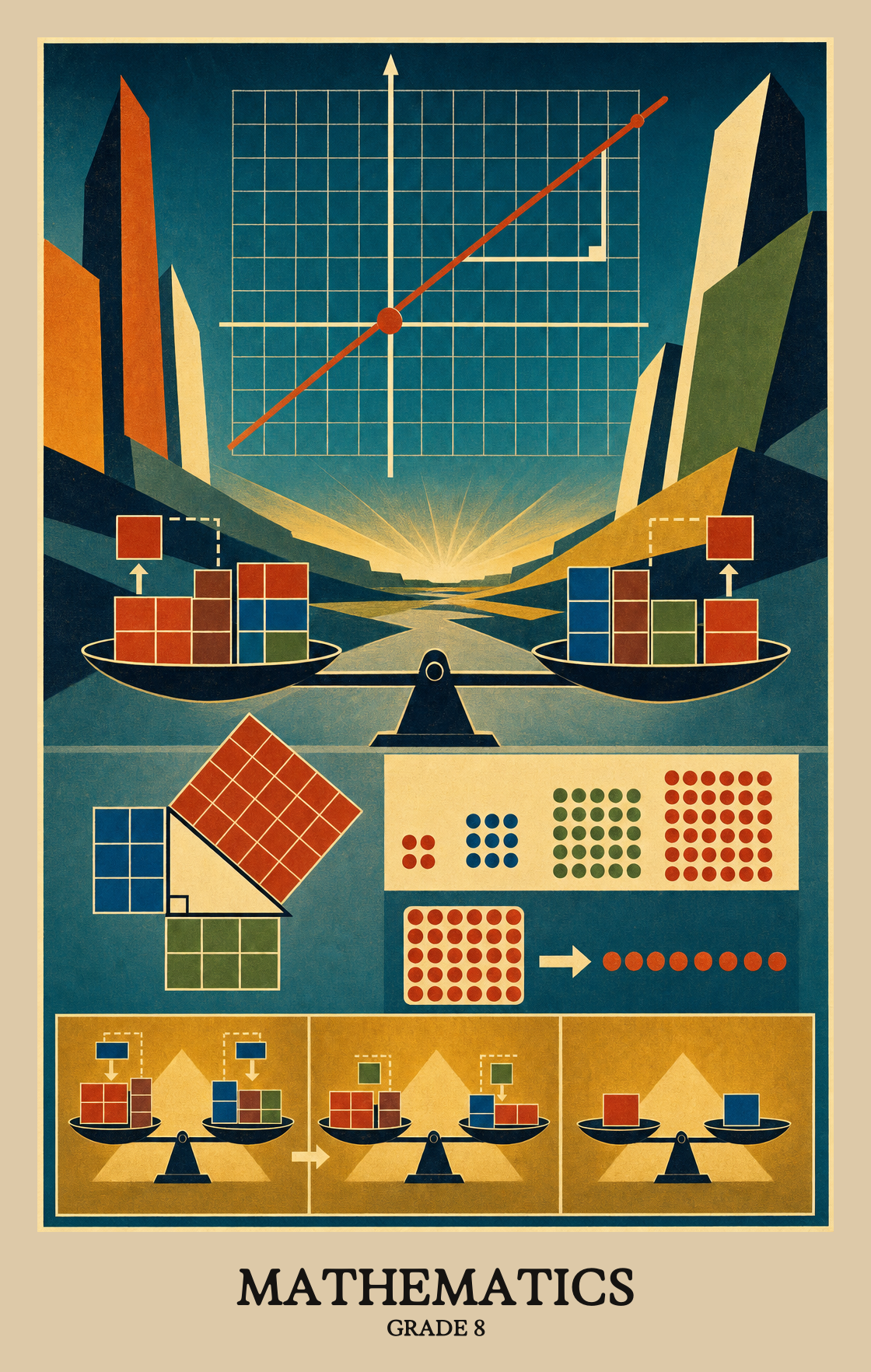
Students work with powers, square roots, and cube roots. They start writing huge and tiny numbers the short way scientists use, like the distance to a planet or the size of a cell.
Students learn the difference between numbers that end or repeat as decimals and numbers that go on forever without a pattern, like the square root of 2. They place these numbers on a number line.
Students graph straight lines and learn that slope tells how steep a line is. They solve equations with a variable on both sides, and find where two lines cross to answer real questions.
Students see a function as a rule that turns each input into one output. They compare rules shown as graphs, tables, and equations, and describe how a quantity grows or shrinks over time.
Students slide, flip, turn, and resize shapes on a grid and decide when two figures match. They use the Pythagorean theorem to find missing side lengths and distances between points.
Students plot pairs of measurements and draw a line that fits the trend, then use it to make predictions. They also find the volume of cylinders, cones, and spheres in everyday problems.
Students use the rules of exponents to rewrite and simplify expressions with repeated multiplication. For example, they learn why multiplying 3² by 3⁻⁵ gives the same result as 1/27.
Students learn to work backwards from a squared or cubed number to find its root, using the √ and ∛ symbols. They practice with simple perfect squares and cubes, and recognize that some roots, like √2, cannot be written as a clean fraction.
Students learn to write very large or very small numbers in scientific notation, like 3 x 10^8 for 300 million, then compare them to see how many times bigger one is than the other.
Students add, subtract, multiply, and divide numbers written in scientific notation, mixing that form with regular decimals when needed. They also read scientific notation produced by a calculator and pick sensible units when working with very large or very small measurements.
Students graph proportional relationships on a coordinate plane and read the slope as the unit rate. They compare two proportional relationships shown in different forms, such as a graph versus an equation, to find which represents a faster speed or steeper rate of change.
Students use matching triangle shapes to show why a line on a graph keeps a steady steepness all the way through, then write that steepness as an equation like y = mx + b.
Solving a linear equation means finding the one value that makes it true, or recognizing when no value works or every value works. Students practice with fractions and decimals, using distribution and combining like terms to simplify.
Students find the point where two straight lines cross on a graph, then confirm that point works in both equations. They practice this by graphing, by algebra, and by spotting cases where the lines never meet.
| Standard | Definition | Code |
|---|---|---|
| Know and apply the properties of integer exponents to generate equivalent… | Students use the rules of exponents to rewrite and simplify expressions with repeated multiplication. For example, they learn why multiplying 3² by 3⁻⁵ gives the same result as 1/27. | CA-8.EE.1 |
| Use square root and cube root symbols to represent solutions to equations of… | Students learn to work backwards from a squared or cubed number to find its root, using the √ and ∛ symbols. They practice with simple perfect squares and cubes, and recognize that some roots, like √2, cannot be written as a clean fraction. | CA-8.EE.2 |
| Use numbers expressed in the form of a single digit times an integer power of… | Students learn to write very large or very small numbers in scientific notation, like 3 x 10^8 for 300 million, then compare them to see how many times bigger one is than the other. | CA-8.EE.3 |
| Perform operations with numbers expressed in scientific notation, including… | Students add, subtract, multiply, and divide numbers written in scientific notation, mixing that form with regular decimals when needed. They also read scientific notation produced by a calculator and pick sensible units when working with very large or very small measurements. | CA-8.EE.4 |
| Graph proportional relationships, interpreting the unit rate as the slope of… | Students graph proportional relationships on a coordinate plane and read the slope as the unit rate. They compare two proportional relationships shown in different forms, such as a graph versus an equation, to find which represents a faster speed or steeper rate of change. | CA-8.EE.5 |
| Use similar triangles to explain why the slope m is the same between any two… | Students use matching triangle shapes to show why a line on a graph keeps a steady steepness all the way through, then write that steepness as an equation like y = mx + b. | CA-8.EE.6 |
| Solve linear equations in one variable | Solving a linear equation means finding the one value that makes it true, or recognizing when no value works or every value works. Students practice with fractions and decimals, using distribution and combining like terms to simplify. | CA-8.EE.7 |
| Analyze and solve pairs of simultaneous linear equations | Students find the point where two straight lines cross on a graph, then confirm that point works in both equations. They practice this by graphing, by algebra, and by spotting cases where the lines never meet. | CA-8.EE.8 |
A function is a rule where every input has exactly one output. Students read graphs and tables to check that each input value lines up with one result, not two or more.
Students compare two functions shown in different forms, like a table of numbers versus an equation, to decide which one changes faster or starts at a higher value.
Students learn that y = mx + b always produces a straight line on a graph. They also identify relationships that curve instead of staying straight, like how a square's area grows much faster than its side length.
Students write an equation that captures a straight-line relationship between two quantities, then explain what the slope and starting value mean in the real situation, whether they read those numbers from a graph, a table, or a word problem.
Students read a line graph and explain in plain terms what's happening: where values rise, fall, or level off. They also work the other way, sketching a rough graph to match a situation described in words.
| Standard | Definition | Code |
|---|---|---|
| Understand that a function is a rule that assigns to each input exactly one… | A function is a rule where every input has exactly one output. Students read graphs and tables to check that each input value lines up with one result, not two or more. | CA-8.F.1 |
| Compare properties of two functions each represented in a different way | Students compare two functions shown in different forms, like a table of numbers versus an equation, to decide which one changes faster or starts at a higher value. | CA-8.F.2 |
| Interpret the equation y = mx + b as defining a linear function, whose graph is… | Students learn that y = mx + b always produces a straight line on a graph. They also identify relationships that curve instead of staying straight, like how a square's area grows much faster than its side length. | CA-8.F.3 |
| Construct a function to model a linear relationship between two quantities | Students write an equation that captures a straight-line relationship between two quantities, then explain what the slope and starting value mean in the real situation, whether they read those numbers from a graph, a table, or a word problem. | CA-8.F.4 |
| Describe qualitatively the functional relationship between two quantities by… | Students read a line graph and explain in plain terms what's happening: where values rise, fall, or level off. They also work the other way, sketching a rough graph to match a situation described in words. | CA-8.F.5 |
Students slide, flip, and rotate shapes on a grid and check that the moved shape still has the same side lengths, angles, and parallel lines as the original.
Two shapes are congruent when one can be flipped, turned, or slid to land exactly on top of the other. Students identify those moves and describe them in order.
Students learn how sliding, spinning, flipping, or resizing a shape changes its position and size on a coordinate grid. They describe exactly where each point of the new shape lands using its coordinates.
Two shapes are similar when one can be turned, flipped, slid, or resized to match the other exactly. Students identify those moves and describe the steps that show how one shape becomes the other.
Students explain why the angles inside any triangle always add up to 180 degrees and use that reasoning to find missing angles. They also apply the Pythagorean Theorem to find unknown side lengths in right triangles.
Students explain why the Pythagorean Theorem works, not just how to use it. They walk through a logical argument showing why a² + b² = c² holds for any right triangle, and why the reverse is true too.
Students use the Pythagorean Theorem to find a missing side length in a right triangle. The problems can come from real situations, like finding the diagonal of a room, and can involve flat or three-dimensional shapes.
Students use the Pythagorean Theorem to find the straight-line distance between two points on a grid. They also calculate the volume of round 3-D shapes like cans, ice cream cones, and balls.
Students learn the volume formulas for cones, cylinders, and spheres, then use those formulas to solve problems. Think of finding how much water a tank holds or how much ice cream fits in a cone.
| Standard | Definition | Code |
|---|---|---|
| Verify experimentally the properties of rotations, reflections | Students slide, flip, and rotate shapes on a grid and check that the moved shape still has the same side lengths, angles, and parallel lines as the original. | CA-8.G.1 |
| Understand that a two-dimensional figure is congruent to another if the second… | Two shapes are congruent when one can be flipped, turned, or slid to land exactly on top of the other. Students identify those moves and describe them in order. | CA-8.G.2 |
| Describe the effect of dilations, translations, rotations | Students learn how sliding, spinning, flipping, or resizing a shape changes its position and size on a coordinate grid. They describe exactly where each point of the new shape lands using its coordinates. | CA-8.G.3 |
| Understand that a two-dimensional figure is similar to another if the second… | Two shapes are similar when one can be turned, flipped, slid, or resized to match the other exactly. Students identify those moves and describe the steps that show how one shape becomes the other. | CA-8.G.4 |
| Use informal arguments to establish facts about the angle sum and exterior… | Students explain why the angles inside any triangle always add up to 180 degrees and use that reasoning to find missing angles. They also apply the Pythagorean Theorem to find unknown side lengths in right triangles. | CA-8.G.5 |
| Explain a proof of the Pythagorean Theorem and its converse | Students explain why the Pythagorean Theorem works, not just how to use it. They walk through a logical argument showing why a² + b² = c² holds for any right triangle, and why the reverse is true too. | CA-8.G.6 |
| Apply the Pythagorean Theorem to determine unknown side lengths in right… | Students use the Pythagorean Theorem to find a missing side length in a right triangle. The problems can come from real situations, like finding the diagonal of a room, and can involve flat or three-dimensional shapes. | CA-8.G.7 |
| Apply the Pythagorean Theorem to find the distance between two points in a… | Students use the Pythagorean Theorem to find the straight-line distance between two points on a grid. They also calculate the volume of round 3-D shapes like cans, ice cream cones, and balls. | CA-8.G.8 |
| Know the formulas for the volumes of cones, cylinders | Students learn the volume formulas for cones, cylinders, and spheres, then use those formulas to solve problems. Think of finding how much water a tank holds or how much ice cream fits in a cone. | CA-8.G.9 |
Some numbers, like 1/3, turn into decimals that repeat forever (0.333...). Others, like the square root of 2, never settle into a pattern. Students learn to tell these two types apart and convert repeating decimals back into fractions.
Students learn to pin down messy numbers like √2 or π to a close decimal, then place them in the right spot on a number line. They narrow in on the value step by step, getting more precise each time.
| Standard | Definition | Code |
|---|---|---|
| Know that numbers that are not rational are called irrational | Some numbers, like 1/3, turn into decimals that repeat forever (0.333...). Others, like the square root of 2, never settle into a pattern. Students learn to tell these two types apart and convert repeating decimals back into fractions. | CA-8.NS.1 |
| Use rational approximations of irrational numbers to compare the size of… | Students learn to pin down messy numbers like √2 or π to a close decimal, then place them in the right spot on a number line. They narrow in on the value step by step, getting more precise each time. | CA-8.NS.2 |
Students make scatter plots by graphing two related measurements together, such as hours of sleep and test scores, then look for patterns: whether the dots cluster in groups, drift upward or downward, or spread out in a curve.
When a scatter plot shows that two sets of numbers rise or fall together, students draw a straight line that fits the pattern as closely as possible, then judge how well that line matches the actual data points.
Students use the equation of a trend line on a scatter plot to answer real questions, like predicting how much a plant grows with each extra hour of sunlight. They explain what the steepness of the line and its starting point actually mean in the situation.
Students read a graph, table, or equation and explain what each part means in context. The focus is on choosing the right tool for the job and understanding why the numbers or symbols are arranged the way they are.
Students read a two-way table and use the counts inside it to calculate relative frequencies, turning raw numbers into percentages that show how two categories relate.
Students learn to spot patterns in how polynomial and rational expressions are built, then use those patterns to simplify or solve problems faster. Recognizing the structure saves steps.
| Standard | Definition | Code |
|---|---|---|
| Construct and interpret scatter plots for bivariate measurement data to… | Students make scatter plots by graphing two related measurements together, such as hours of sleep and test scores, then look for patterns: whether the dots cluster in groups, drift upward or downward, or spread out in a curve. | CA-8.SP.1 |
| Know that straight lines are widely used to model relationships between two… | When a scatter plot shows that two sets of numbers rise or fall together, students draw a straight line that fits the pattern as closely as possible, then judge how well that line matches the actual data points. | CA-8.SP.2 |
| Use the equation of a linear model to solve problems in the context of… | Students use the equation of a trend line on a scatter plot to answer real questions, like predicting how much a plant grows with each extra hour of sunlight. They explain what the steepness of the line and its starting point actually mean in the situation. | CA-8.SP.3 |
| Use appropriate tools strategically | Students read a graph, table, or equation and explain what each part means in context. The focus is on choosing the right tool for the job and understanding why the numbers or symbols are arranged the way they are. | CA-8.SP.5 |
| Attend to precision. Write expressions in equivalent forms to solve problems | Students read a two-way table and use the counts inside it to calculate relative frequencies, turning raw numbers into percentages that show how two categories relate. | CA-8.SP.6 |
| Look for and make use of structure | Students learn to spot patterns in how polynomial and rational expressions are built, then use those patterns to simplify or solve problems faster. Recognizing the structure saves steps. | CA-8.SP.7 |
The grade 8 math test in the CAASPP suite. Adaptive computer-based questions plus a performance task covering the Common Core grade 8 math standards.
The state test for students with the most significant cognitive disabilities. Replaces Smarter Balanced math in grades 3-8 and 11 for the small group of students whose IEP teams qualify them.
Most of the year focuses on lines, slopes, and equations with x and y. Students also work with exponents, square roots, the Pythagorean Theorem, and the volume of cylinders, cones, and spheres. By spring, students should be solving equations and graphing lines without much help.
Ask students to explain each step out loud before checking the answer. If they get stuck, have them rewrite the problem on a fresh line and try again. Hearing themselves talk through the work catches more mistakes than a parent correcting them ever will.
Start with exponents and square roots, then move into solving equations and graphing lines. Functions and systems of equations come next, since they build on slope. Save geometry, the Pythagorean Theorem, and volume for the back half, and weave scatter plots in near the end.
Slope is how steep a line is, or how much one thing changes when another changes. Students see it in graphs, tables, equations, and word problems. Once slope clicks, most of the year's algebra gets easier.
Negative exponents, the difference between square roots and cube roots, and slope from two points tend to need a second pass. Solving equations with variables on both sides also trips up students who rushed through combining like terms. Plan in review days after each of those.
Pick one problem from the day's homework and work through it together on paper. Ask students to graph a line from an equation, or write an equation from a graph. Short and consistent beats long weekend sessions.
Yes. Students should know that a squared plus b squared equals c squared for right triangles, and be able to use it to find a missing side. They also use it to find the distance between two points on a graph.
By the end of the year, students should solve a linear equation, graph a line from an equation, and find slope from any two points without prompting. They should also recognize a function from a table or graph. If those feel automatic, students are ready for Algebra 1.