Forces, motion, and energy
Students study how pushes and pulls change the way objects move. They look at gravity, magnets, and static electricity, and they measure how speed and mass affect the energy something carries.
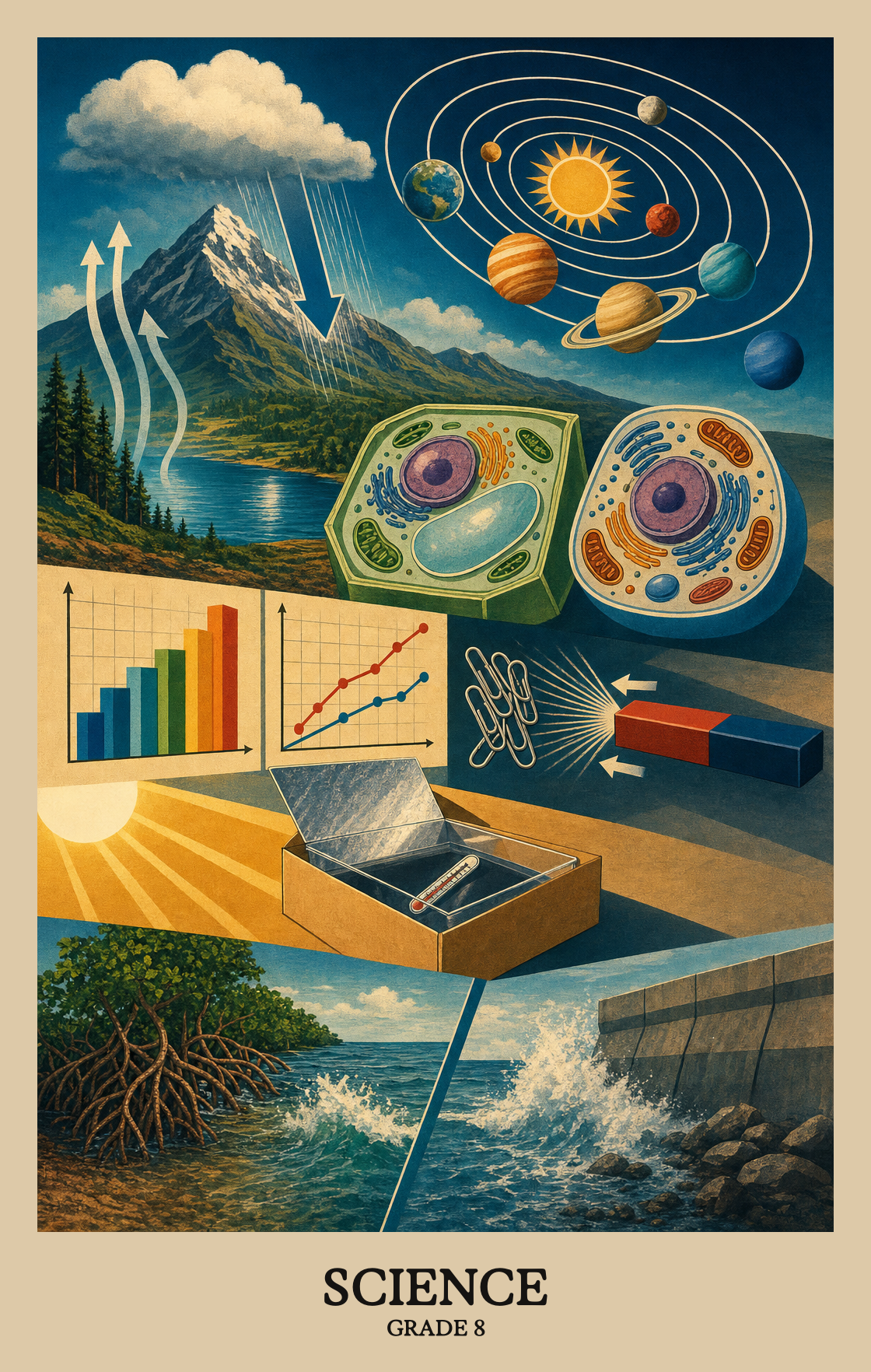
This is the year science stops being a tour of topics and starts asking students to explain how the world actually works. Students build models for big systems like the water cycle, the solar system, cells, and forces between objects, and back up their thinking with data and evidence. Hands-on design projects show up too, from testing a device that traps heat to comparing solutions for protecting an ecosystem. By spring, students can look at a graph or a diagram and explain the science behind it in their own words.
Students study how pushes and pulls change the way objects move. They look at gravity, magnets, and static electricity, and they measure how speed and mass affect the energy something carries.
Students build models of atoms and molecules to explain what matter is made of. They watch substances mix and react, track temperature changes, and see why mass stays the same even when materials look completely different.
Students explore how sound and light waves carry energy and bounce off, pass through, or get soaked up by different materials. They also compare how phones and computers send information as digital signals.
Students model the sun, moon, and planets to explain seasons, eclipses, and moon phases. They track how air, water, and heat move around the planet to shape weather, climate, and the surface of the land.
Students look at living things from the inside out, starting with cells and the jobs they do. They study how traits pass from parents to offspring, why offspring vary, and how fossils show life changing over long stretches of time.
Students trace how matter and energy move through food webs and what happens when a habitat changes. They weigh evidence on population growth, resource use, and warming temperatures, and design ways to reduce harm.
Students build or interpret a diagram showing how the Earth, sun, and moon move around each other to explain why the moon appears to change shape each month, why eclipses happen, and why seasons change.
Gravity pulls every planet, moon, and star toward other massive objects. Students model how that pull keeps planets orbiting the sun and holds the spinning arms of a galaxy together.
Students compare the sizes and distances of planets, moons, and the sun using real data. The numbers are so large that students practice converting them into scaled-down models to make sense of the spacing.
Rock layers act like pages in Earth's history book. Students use evidence from those layers to explain how scientists divide 4.6 billion years of Earth's past into named chunks of time.
Students map how rock, water, and other materials move through Earth over time, and trace the energy source (mostly heat from inside the planet and sunlight) that keeps the cycle going.
Rocks, landforms, and coastlines are always changing, just at different speeds. Students study how earthquakes reshape land in seconds while erosion carves canyons over millions of years, then use real evidence to explain why Earth's surface looks the way it does today.
Fossils, rock layers, and the jagged edges of continents all tell the same story. Students read that evidence to figure out how Earth's plates have shifted and drifted over millions of years.
Students trace how water moves from oceans to clouds to rain and back again. They build a diagram or model showing how sunlight and gravity keep that cycle running.
Students track how air masses move and collide to explain why weather changes. They gather real data, like temperature and pressure readings, to connect what's happening in the atmosphere to the forecast outside.
Students build a model showing why some parts of Earth get more sun than others, and how that uneven warmth, combined with Earth's spin, drives wind and ocean current patterns that shape the climate where you live.
Students explain why oil, gold, or clean water is plentiful in some places and scarce in others. The reason always comes back to geologic processes, like volcanic activity or erosion, that concentrated those resources over millions of years.
Students study real data from earthquakes, volcanoes, and floods to spot patterns that help predict where disasters are likely to strike next. That same evidence shapes the tools and warning systems communities build to reduce harm.
Students pick a real environmental problem, such as water pollution or habitat loss, and design a step-by-step plan to track and reduce that impact using science concepts they already know.
Students build a case, using real data, for how a growing human population and rising resource use put pressure on land, water, and air. The argument has to be backed by evidence, not opinion.
Students examine real data on global temperature changes and ask focused questions about what caused them. The goal is to understand which natural and human factors drove the warming trend seen over the last 100 years.
Students build or draw a model of Earth, the sun, and the moon to explain why the moon's shape appears to change each month, why eclipses happen, and why seasons shift throughout the year.
Gravity pulls every planet, moon, and star toward other massive objects. Students build or use a model to show how that pull keeps planets orbiting the sun and holds the stars of a galaxy together.
Students compare the actual sizes and distances of planets, moons, and the sun using real data. The numbers are so large that students practice converting them into scales that are easier to picture.
Rock layers act like pages in Earth's history book. Students read those layers to explain how scientists divide 4.6 billion years of Earth's past into named chunks of time.
Rocks, water, and soil move through slow cycles on Earth's surface and underground. Students model how heat from inside the Earth and energy from the sun keep those materials in motion.
Rocks, landforms, and coastlines change over time because of forces like erosion, earthquakes, and volcanic activity. Students study evidence to explain how those forces have reshaped Earth's surface over thousands of years or in a single storm.
Students study fossil locations, rock types, and the shapes of continents to figure out how Earth's plates have shifted over millions of years. The evidence shows that landmasses once fit together like puzzle pieces and have been moving ever since.
Students map how water moves through Earth: evaporating from oceans, falling as rain, and flowing back downhill. The driving forces are sunlight and gravity.
Students track how air masses move and collide to explain why the weather changes. They collect real data, like temperature or pressure readings, and use it as evidence for what's happening in the atmosphere.
Students map how uneven heating from the sun and Earth's spin drive wind and ocean current patterns. Those patterns shape whether a region ends up rainy, dry, warm, or cold.
Students explain why oil, coal, fresh water, and useful minerals aren't spread evenly across the planet. The explanation connects where those resources sit today to the geologic processes, like volcanic activity and erosion, that moved and concentrated them over millions of years.
Students study data from past earthquakes, volcanic eruptions, floods, and other natural disasters to predict where and when similar events might strike. That analysis also shapes the tools and warning systems built to reduce damage when disaster hits.
Students design a plan to track and reduce a real human impact on the environment, such as pollution or habitat loss, using scientific reasoning to explain why the plan would work.
Students build a written argument, backed by data, explaining how a growing human population and rising resource use put pressure on land, water, and air. The focus is on connecting real evidence to real effects on Earth's systems.
Students learn what has caused Earth to warm over the last hundred years. They look at data on greenhouse gases, fossil fuels, and natural factors, then ask questions about what the evidence shows.
| Standard | Definition | Code |
|---|---|---|
| Develop and use a model of the Earth-sun-moon system to describe the cyclic… Grades 6-8 | Students build or interpret a diagram showing how the Earth, sun, and moon move around each other to explain why the moon appears to change shape each month, why eclipses happen, and why seasons change. | CA-MS-ESS1-1.6-8 |
| Develop and use a model to describe the role of gravity in the motions within… Grades 6-8 | Gravity pulls every planet, moon, and star toward other massive objects. Students model how that pull keeps planets orbiting the sun and holds the spinning arms of a galaxy together. | CA-MS-ESS1-2.6-8 |
| Analyze and interpret data to determine scale properties of objects in the… Grades 6-8 | Students compare the sizes and distances of planets, moons, and the sun using real data. The numbers are so large that students practice converting them into scaled-down models to make sense of the spacing. | CA-MS-ESS1-3.6-8 |
| Construct a scientific explanation based on evidence from rock strata for how… Grades 6-8 | Rock layers act like pages in Earth's history book. Students use evidence from those layers to explain how scientists divide 4.6 billion years of Earth's past into named chunks of time. | CA-MS-ESS1-4.6-8 |
| Develop a model to describe the cycling of Earth’s materials and the flow of… Grades 6-8 | Students map how rock, water, and other materials move through Earth over time, and trace the energy source (mostly heat from inside the planet and sunlight) that keeps the cycle going. | CA-MS-ESS2-1.6-8 |
| Construct an explanation based on evidence for how geoscience processes have… Grades 6-8 | Rocks, landforms, and coastlines are always changing, just at different speeds. Students study how earthquakes reshape land in seconds while erosion carves canyons over millions of years, then use real evidence to explain why Earth's surface looks the way it does today. | CA-MS-ESS2-2.6-8 |
| Analyze and interpret data on the distribution of fossils and rocks… Grades 6-8 | Fossils, rock layers, and the jagged edges of continents all tell the same story. Students read that evidence to figure out how Earth's plates have shifted and drifted over millions of years. | CA-MS-ESS2-3.6-8 |
| Develop a model to describe the cycling of water through Earth’s systems driven… Grades 6-8 | Students trace how water moves from oceans to clouds to rain and back again. They build a diagram or model showing how sunlight and gravity keep that cycle running. | CA-MS-ESS2-4.6-8 |
| Collect data to provide evidence for how the motions and complex interactions… Grades 6-8 | Students track how air masses move and collide to explain why weather changes. They gather real data, like temperature and pressure readings, to connect what's happening in the atmosphere to the forecast outside. | CA-MS-ESS2-5.6-8 |
| Develop and use a model to describe how unequal heating and rotation of the… Grades 6-8 | Students build a model showing why some parts of Earth get more sun than others, and how that uneven warmth, combined with Earth's spin, drives wind and ocean current patterns that shape the climate where you live. | CA-MS-ESS2-6.6-8 |
| Construct a scientific explanation based on evidence for how the uneven… Grades 6-8 | Students explain why oil, gold, or clean water is plentiful in some places and scarce in others. The reason always comes back to geologic processes, like volcanic activity or erosion, that concentrated those resources over millions of years. | CA-MS-ESS3-1.6-8 |
| Analyze and interpret data on natural hazards to forecast future catastrophic… Grades 6-8 | Students study real data from earthquakes, volcanoes, and floods to spot patterns that help predict where disasters are likely to strike next. That same evidence shapes the tools and warning systems communities build to reduce harm. | CA-MS-ESS3-2.6-8 |
| Apply scientific principles to design a method for monitoring and minimizing a… Grades 6-8 | Students pick a real environmental problem, such as water pollution or habitat loss, and design a step-by-step plan to track and reduce that impact using science concepts they already know. | CA-MS-ESS3-3.6-8 |
| Construct an argument supported by evidence for how increases in human… Grades 6-8 | Students build a case, using real data, for how a growing human population and rising resource use put pressure on land, water, and air. The argument has to be backed by evidence, not opinion. | CA-MS-ESS3-4.6-8 |
| Ask questions to clarify evidence of the factors that have caused the rise in… Grades 6-8 | Students examine real data on global temperature changes and ask focused questions about what caused them. The goal is to understand which natural and human factors drove the warming trend seen over the last 100 years. | CA-MS-ESS3-5.6-8 |
| Develop and use a model of the Earth-sun-moon system to describe the cyclic… | Students build or draw a model of Earth, the sun, and the moon to explain why the moon's shape appears to change each month, why eclipses happen, and why seasons shift throughout the year. | CA-MS-ESS1-1.8 |
| Develop and use a model to describe the role of gravity in the motions within… | Gravity pulls every planet, moon, and star toward other massive objects. Students build or use a model to show how that pull keeps planets orbiting the sun and holds the stars of a galaxy together. | CA-MS-ESS1-2.8 |
| Analyze and interpret data to determine scale properties of objects in the… | Students compare the actual sizes and distances of planets, moons, and the sun using real data. The numbers are so large that students practice converting them into scales that are easier to picture. | CA-MS-ESS1-3.8 |
| Construct a scientific explanation based on evidence from rock strata for how… | Rock layers act like pages in Earth's history book. Students read those layers to explain how scientists divide 4.6 billion years of Earth's past into named chunks of time. | CA-MS-ESS1-4.8 |
| Develop a model to describe the cycling of Earth’s materials and the flow of… | Rocks, water, and soil move through slow cycles on Earth's surface and underground. Students model how heat from inside the Earth and energy from the sun keep those materials in motion. | CA-MS-ESS2-1.8 |
| Construct an explanation based on evidence for how geoscience processes have… | Rocks, landforms, and coastlines change over time because of forces like erosion, earthquakes, and volcanic activity. Students study evidence to explain how those forces have reshaped Earth's surface over thousands of years or in a single storm. | CA-MS-ESS2-2.8 |
| Analyze and interpret data on the distribution of fossils and rocks… | Students study fossil locations, rock types, and the shapes of continents to figure out how Earth's plates have shifted over millions of years. The evidence shows that landmasses once fit together like puzzle pieces and have been moving ever since. | CA-MS-ESS2-3.8 |
| Develop a model to describe the cycling of water through Earth’s systems driven… | Students map how water moves through Earth: evaporating from oceans, falling as rain, and flowing back downhill. The driving forces are sunlight and gravity. | CA-MS-ESS2-4.8 |
| Collect data to provide evidence for how the motions and complex interactions… | Students track how air masses move and collide to explain why the weather changes. They collect real data, like temperature or pressure readings, and use it as evidence for what's happening in the atmosphere. | CA-MS-ESS2-5.8 |
| Develop and use a model to describe how unequal heating and rotation of the… | Students map how uneven heating from the sun and Earth's spin drive wind and ocean current patterns. Those patterns shape whether a region ends up rainy, dry, warm, or cold. | CA-MS-ESS2-6.8 |
| Construct a scientific explanation based on evidence for how the uneven… | Students explain why oil, coal, fresh water, and useful minerals aren't spread evenly across the planet. The explanation connects where those resources sit today to the geologic processes, like volcanic activity and erosion, that moved and concentrated them over millions of years. | CA-MS-ESS3-1.8 |
| Analyze and interpret data on natural hazards to forecast future catastrophic… | Students study data from past earthquakes, volcanic eruptions, floods, and other natural disasters to predict where and when similar events might strike. That analysis also shapes the tools and warning systems built to reduce damage when disaster hits. | CA-MS-ESS3-2.8 |
| Apply scientific principles to design a method for monitoring and minimizing a… | Students design a plan to track and reduce a real human impact on the environment, such as pollution or habitat loss, using scientific reasoning to explain why the plan would work. | CA-MS-ESS3-3.8 |
| Construct an argument supported by evidence for how increases in human… | Students build a written argument, backed by data, explaining how a growing human population and rising resource use put pressure on land, water, and air. The focus is on connecting real evidence to real effects on Earth's systems. | CA-MS-ESS3-4.8 |
| Ask questions to clarify evidence of the factors that have caused the rise in… | Students learn what has caused Earth to warm over the last hundred years. They look at data on greenhouse gases, fossil fuels, and natural factors, then ask questions about what the evidence shows. | CA-MS-ESS3-5.8 |
Students spell out exactly what a solution must do and what it cannot do before any building starts. That means listing real-world limits like cost, materials, and safety alongside any science that rules certain designs out.
Students compare two or more design solutions side by side, using a clear set of criteria to judge which one best solves the problem within the given limits, such as cost, materials, or size.
Students compare test results from multiple design attempts to find what worked best in each one, then combine those strengths into a single improved design.
Students identify exactly what a solution must do and what stands in its way, including real-world limits like cost, materials, safety rules, and effects on people or the environment. Getting those boundaries clear before building is what separates a workable design from a failed one.
Students compare different design solutions side by side, using a clear set of criteria to decide which one best solves the problem within the given limits.
Students compare test results from multiple design solutions, then mix the best features of each into one improved design that better solves the original problem.
| Standard | Definition | Code |
|---|---|---|
| Define the criteria and constraints of a design problem with sufficient… Grades 6-8 | Students spell out exactly what a solution must do and what it cannot do before any building starts. That means listing real-world limits like cost, materials, and safety alongside any science that rules certain designs out. | CA-MS-ETS1-1.6-8 |
| Evaluate competing design solutions using a systematic process to determine how… Grades 6-8 | Students compare two or more design solutions side by side, using a clear set of criteria to judge which one best solves the problem within the given limits, such as cost, materials, or size. | CA-MS-ETS1-2.6-8 |
| Analyze data from tests to determine similarities and differences among several… Grades 6-8 | Students compare test results from multiple design attempts to find what worked best in each one, then combine those strengths into a single improved design. | CA-MS-ETS1-3.6-8 |
| Define the criteria and constraints of a design problem with sufficient… | Students identify exactly what a solution must do and what stands in its way, including real-world limits like cost, materials, safety rules, and effects on people or the environment. Getting those boundaries clear before building is what separates a workable design from a failed one. | CA-MS-ETS1-1.8 |
| Evaluate competing design solutions using a systematic process to determine how… | Students compare different design solutions side by side, using a clear set of criteria to decide which one best solves the problem within the given limits. | CA-MS-ETS1-2.8 |
| Analyze data from tests to determine similarities and differences among several… | Students compare test results from multiple design solutions, then mix the best features of each into one improved design that better solves the original problem. | CA-MS-ETS1-3.8 |
Students investigate whether living things are made of one cell or many by examining real specimens or slides. The goal is to find direct evidence, not just read about it.
Students build or label a diagram of a cell and explain what each part does. The goal is to show how the parts work together to keep the whole cell running.
Students build an argument, using real evidence, for why the body is made of smaller systems (like the digestive or nervous system) that work together. They explain how groups of cells form tissues and organs, and how those parts depend on each other to keep the body running.
Students study why certain animal behaviors and plant structures make reproduction more likely to succeed. They back their explanations with real evidence, showing how a bird's mating call or a flower's shape helps the species keep going.
Students explain why two plants or animals of the same species can grow up very differently, using evidence that points to causes like diet, sunlight, or traits passed down from parents.
Students explain how plants use sunlight, water, and carbon dioxide to make food, and how that process moves energy and materials through living things. This is the foundation for understanding why plants matter to nearly every food chain.
Students trace how food breaks down inside the body and gets rebuilt into new molecules that fuel growth and movement. The atoms in food don't disappear; they rearrange through chemical reactions to keep the body running.
Sensory receptors pick up signals from the world around us and send messages to the brain. The brain either acts on those messages right away or stores them as memories.
Students look at real data, like population counts or food supply records, and explain how a shortage or surplus of food, water, or shelter affects how many organisms survive in an ecosystem.
Students study how living things affect each other, like predators and prey or plants and pollinators, then explain why those same patterns show up across different ecosystems.
Students draw or diagram how matter (like water, carbon, or nutrients) moves through an ecosystem and how energy flows from the sun through plants, animals, and decomposers. The model shows how living things depend on nonliving parts like soil, air, and water.
When part of an ecosystem changes, such as a drought drying up a river or a new predator moving in, other species in that area grow, shrink, or disappear. Students use real data to build an argument explaining why.
Students compare different real-world plans for protecting wildlife and healthy ecosystems, then judge which approach works best and why. The focus is on trade-offs, not just picking a favorite.
A mutation is a change in a gene's instructions. Students learn how that small change can alter the proteins a cell builds, and why the result might harm the organism, help it, or make no difference at all.
Students model how living things pass on genetic information, showing why offspring from asexual reproduction are genetic copies of one parent while offspring from sexual reproduction inherit a mix from two parents.
Fossils reveal which creatures lived long ago, which died out, and how life has changed over millions of years. Students study fossil data to find patterns that explain why some species survived and others disappeared.
Students compare body structures across living animals and fossils to explain how species are related and how they changed over time.
Students look at drawings of animal embryos at different growth stages and find similarities that don't show up once the animals are fully grown. Those hidden patterns help scientists figure out which species are more closely related than they appear as adults.
Students explain, using real examples, why some individuals in a species survive and reproduce more than others. The key is genetic variation: small inherited differences can make certain individuals better suited to their environment.
Students research technologies like selective breeding and genetic engineering to understand how humans shape which traits get passed down in plants and animals.
Students use graphs or data to explain how a useful trait spreads through a population over generations, and how a harmful one fades. The math shows why some traits survive and others disappear.
Students investigate whether living things are made of one cell or many. They gather evidence from real specimens or slides to show that all living things share this basic building block.
Students build or label a model of a cell and explain what each part does. The goal is understanding how the parts work together to keep the whole cell running.
Students explain how cells group together to form tissues, organs, and body systems, and back that explanation with evidence. The focus is on how those parts work together, not in isolation.
Students study why certain animal behaviors and plant structures make reproduction more likely to succeed. They use real evidence to explain how a bird's mating call or a flower's shape helps pass traits to the next generation.
Students explain why two plants or animals of the same species can grow differently, pointing to causes like available food, sunlight, or traits passed down from parents.
Students explain how plants use sunlight, water, and carbon dioxide to make food, and how that process moves matter and energy through living things.
Students map out how the body breaks food down into smaller molecules, rearranges them through chemical reactions, and uses the results to build new tissue or release energy for daily activity.
Sensory receptors pick up signals from the world around us and send messages to the brain. The brain either acts on them right away or stores them as memories.
Students look at real data, like food supply or water levels, to explain why animal and plant populations grow, shrink, or stay stable. When resources run low, populations feel it.
Students predict how living things affect each other, such as how predators, prey, and plants create patterns that show up the same way across different ecosystems.
Students map how matter (like water and carbon) moves through an ecosystem and how energy flows from the sun through plants, animals, and soil. The model shows what happens to nutrients when organisms eat, die, or decompose.
When something in an ecosystem changes (a drought, a new predator, a disease), populations of living things grow, shrink, or disappear. Students use real data and observations to build an argument explaining why.
Students look at different real-world plans for protecting wildlife and healthy ecosystems, then weigh the tradeoffs to decide which approach works best.
A mutation is a change in a gene that can alter the protein a cell builds. Students model how those protein changes can harm the body, help it, or make no difference at all.
Students model how asexual reproduction copies genetic information exactly, while sexual reproduction mixes it, producing offspring that differ from both parents. The model explains why siblings look similar but not identical.
Students study fossil evidence to find patterns in how life on Earth has changed over time, including which species appeared, which died out, and how living things have shifted across millions of years.
Students compare body parts across living animals and fossils to figure out which species share a common ancestor. A whale's flipper and a human arm, for example, have the same bones arranged in the same way.
Students compare drawings of animal embryos at early stages of development to spot similarities that disappear by the time the animals are fully grown. Those shared early traits reveal connections between species that adult bodies don't show.
Some animals are born with traits that help them survive better than others in their environment. Students explain, using evidence, why those individuals are more likely to live long enough to reproduce and pass those traits on.
Students research how technologies like selective breeding and genetic modification let humans shape which traits animals or plants pass on to the next generation.
Students use graphs and data to explain why certain traits become more or less common in a population over generations. They connect the math to the idea that some traits help organisms survive long enough to pass those traits on.
| Standard | Definition | Code |
|---|---|---|
| Conduct an investigation to provide evidence that living things are made of… Grades 6-8 | Students investigate whether living things are made of one cell or many by examining real specimens or slides. The goal is to find direct evidence, not just read about it. | CA-MS-LS1-1.6-8 |
| Develop and use a model to describe the function of a cell as a whole and ways… Grades 6-8 | Students build or label a diagram of a cell and explain what each part does. The goal is to show how the parts work together to keep the whole cell running. | CA-MS-LS1-2.6-8 |
| Use argument supported by evidence for how the body is a system of interacting… Grades 6-8 | Students build an argument, using real evidence, for why the body is made of smaller systems (like the digestive or nervous system) that work together. They explain how groups of cells form tissues and organs, and how those parts depend on each other to keep the body running. | CA-MS-LS1-3.6-8 |
| Use argument based on empirical evidence and scientific reasoning to support an… Grades 6-8 | Students study why certain animal behaviors and plant structures make reproduction more likely to succeed. They back their explanations with real evidence, showing how a bird's mating call or a flower's shape helps the species keep going. | CA-MS-LS1-4.6-8 |
| Construct a scientific explanation based on evidence for how environmental and… Grades 6-8 | Students explain why two plants or animals of the same species can grow up very differently, using evidence that points to causes like diet, sunlight, or traits passed down from parents. | CA-MS-LS1-5.6-8 |
| Construct a scientific explanation based on evidence for the role of… Grades 6-8 | Students explain how plants use sunlight, water, and carbon dioxide to make food, and how that process moves energy and materials through living things. This is the foundation for understanding why plants matter to nearly every food chain. | CA-MS-LS1-6.6-8 |
| Develop a model to describe how food is rearranged through chemical reactions… Grades 6-8 | Students trace how food breaks down inside the body and gets rebuilt into new molecules that fuel growth and movement. The atoms in food don't disappear; they rearrange through chemical reactions to keep the body running. | CA-MS-LS1-7.6-8 |
| Gather and synthesize information that sensory receptors respond to stimuli by… Grades 6-8 | Sensory receptors pick up signals from the world around us and send messages to the brain. The brain either acts on those messages right away or stores them as memories. | CA-MS-LS1-8.6-8 |
| Analyze and interpret data to provide evidence for the effects of resource… Grades 6-8 | Students look at real data, like population counts or food supply records, and explain how a shortage or surplus of food, water, or shelter affects how many organisms survive in an ecosystem. | CA-MS-LS2-1.6-8 |
| Construct an explanation that predicts patterns of interactions among organisms… Grades 6-8 | Students study how living things affect each other, like predators and prey or plants and pollinators, then explain why those same patterns show up across different ecosystems. | CA-MS-LS2-2.6-8 |
| Develop a model to describe the cycling of matter and flow of energy among… Grades 6-8 | Students draw or diagram how matter (like water, carbon, or nutrients) moves through an ecosystem and how energy flows from the sun through plants, animals, and decomposers. The model shows how living things depend on nonliving parts like soil, air, and water. | CA-MS-LS2-3.6-8 |
| Construct an argument supported by empirical evidence that changes to physical… Grades 6-8 | When part of an ecosystem changes, such as a drought drying up a river or a new predator moving in, other species in that area grow, shrink, or disappear. Students use real data to build an argument explaining why. | CA-MS-LS2-4.6-8 |
| Evaluate competing design solutions for maintaining biodiversity and ecosystem… Grades 6-8 | Students compare different real-world plans for protecting wildlife and healthy ecosystems, then judge which approach works best and why. The focus is on trade-offs, not just picking a favorite. | CA-MS-LS2-5.6-8 |
| Develop and use a model to describe why structural changes to genes Grades 6-8 | A mutation is a change in a gene's instructions. Students learn how that small change can alter the proteins a cell builds, and why the result might harm the organism, help it, or make no difference at all. | CA-MS-LS3-1.6-8 |
| Develop and use a model to describe why asexual reproduction results in… Grades 6-8 | Students model how living things pass on genetic information, showing why offspring from asexual reproduction are genetic copies of one parent while offspring from sexual reproduction inherit a mix from two parents. | CA-MS-LS3-2.6-8 |
| Analyze and interpret data for patterns in the fossil record that document the… Grades 6-8 | Fossils reveal which creatures lived long ago, which died out, and how life has changed over millions of years. Students study fossil data to find patterns that explain why some species survived and others disappeared. | CA-MS-LS4-1.6-8 |
| Apply scientific ideas to construct an explanation for the anatomical… Grades 6-8 | Students compare body structures across living animals and fossils to explain how species are related and how they changed over time. | CA-MS-LS4-2.6-8 |
| Analyze displays of pictorial data to compare patterns of similarities in the… Grades 6-8 | Students look at drawings of animal embryos at different growth stages and find similarities that don't show up once the animals are fully grown. Those hidden patterns help scientists figure out which species are more closely related than they appear as adults. | CA-MS-LS4-3.6-8 |
| Construct an explanation based on evidence that describes how genetic… Grades 6-8 | Students explain, using real examples, why some individuals in a species survive and reproduce more than others. The key is genetic variation: small inherited differences can make certain individuals better suited to their environment. | CA-MS-LS4-4.6-8 |
| Gather and synthesize information about technologies that have changed the way… Grades 6-8 | Students research technologies like selective breeding and genetic engineering to understand how humans shape which traits get passed down in plants and animals. | CA-MS-LS4-5.6-8 |
| Use mathematical representations to support explanations of how natural… Grades 6-8 | Students use graphs or data to explain how a useful trait spreads through a population over generations, and how a harmful one fades. The math shows why some traits survive and others disappear. | CA-MS-LS4-6.6-8 |
| Conduct an investigation to provide evidence that living things are made of… | Students investigate whether living things are made of one cell or many. They gather evidence from real specimens or slides to show that all living things share this basic building block. | CA-MS-LS1-1.8 |
| Develop and use a model to describe the function of a cell as a whole and ways… | Students build or label a model of a cell and explain what each part does. The goal is understanding how the parts work together to keep the whole cell running. | CA-MS-LS1-2.8 |
| Use argument supported by evidence for how the body is a system of interacting… | Students explain how cells group together to form tissues, organs, and body systems, and back that explanation with evidence. The focus is on how those parts work together, not in isolation. | CA-MS-LS1-3.8 |
| Use argument based on empirical evidence and scientific reasoning to support an… | Students study why certain animal behaviors and plant structures make reproduction more likely to succeed. They use real evidence to explain how a bird's mating call or a flower's shape helps pass traits to the next generation. | CA-MS-LS1-4.8 |
| Construct a scientific explanation based on evidence for how environmental and… | Students explain why two plants or animals of the same species can grow differently, pointing to causes like available food, sunlight, or traits passed down from parents. | CA-MS-LS1-5.8 |
| Construct a scientific explanation based on evidence for the role of… | Students explain how plants use sunlight, water, and carbon dioxide to make food, and how that process moves matter and energy through living things. | CA-MS-LS1-6.8 |
| Develop a model to describe how food is rearranged through chemical reactions… | Students map out how the body breaks food down into smaller molecules, rearranges them through chemical reactions, and uses the results to build new tissue or release energy for daily activity. | CA-MS-LS1-7.8 |
| Gather and synthesize information that sensory receptors respond to stimuli by… | Sensory receptors pick up signals from the world around us and send messages to the brain. The brain either acts on them right away or stores them as memories. | CA-MS-LS1-8.8 |
| Analyze and interpret data to provide evidence for the effects of resource… | Students look at real data, like food supply or water levels, to explain why animal and plant populations grow, shrink, or stay stable. When resources run low, populations feel it. | CA-MS-LS2-1.8 |
| Construct an explanation that predicts patterns of interactions among organisms… | Students predict how living things affect each other, such as how predators, prey, and plants create patterns that show up the same way across different ecosystems. | CA-MS-LS2-2.8 |
| Develop a model to describe the cycling of matter and flow of energy among… | Students map how matter (like water and carbon) moves through an ecosystem and how energy flows from the sun through plants, animals, and soil. The model shows what happens to nutrients when organisms eat, die, or decompose. | CA-MS-LS2-3.8 |
| Construct an argument supported by empirical evidence that changes to physical… | When something in an ecosystem changes (a drought, a new predator, a disease), populations of living things grow, shrink, or disappear. Students use real data and observations to build an argument explaining why. | CA-MS-LS2-4.8 |
| Evaluate competing design solutions for maintaining biodiversity and ecosystem… | Students look at different real-world plans for protecting wildlife and healthy ecosystems, then weigh the tradeoffs to decide which approach works best. | CA-MS-LS2-5.8 |
| Develop and use a model to describe why structural changes to genes | A mutation is a change in a gene that can alter the protein a cell builds. Students model how those protein changes can harm the body, help it, or make no difference at all. | CA-MS-LS3-1.8 |
| Develop and use a model to describe why asexual reproduction results in… | Students model how asexual reproduction copies genetic information exactly, while sexual reproduction mixes it, producing offspring that differ from both parents. The model explains why siblings look similar but not identical. | CA-MS-LS3-2.8 |
| Analyze and interpret data for patterns in the fossil record that document the… | Students study fossil evidence to find patterns in how life on Earth has changed over time, including which species appeared, which died out, and how living things have shifted across millions of years. | CA-MS-LS4-1.8 |
| Apply scientific ideas to construct an explanation for the anatomical… | Students compare body parts across living animals and fossils to figure out which species share a common ancestor. A whale's flipper and a human arm, for example, have the same bones arranged in the same way. | CA-MS-LS4-2.8 |
| Analyze displays of pictorial data to compare patterns of similarities in the… | Students compare drawings of animal embryos at early stages of development to spot similarities that disappear by the time the animals are fully grown. Those shared early traits reveal connections between species that adult bodies don't show. | CA-MS-LS4-3.8 |
| Construct an explanation based on evidence that describes how genetic… | Some animals are born with traits that help them survive better than others in their environment. Students explain, using evidence, why those individuals are more likely to live long enough to reproduce and pass those traits on. | CA-MS-LS4-4.8 |
| Gather and synthesize information about technologies that have changed the way… | Students research how technologies like selective breeding and genetic modification let humans shape which traits animals or plants pass on to the next generation. | CA-MS-LS4-5.8 |
| Use mathematical representations to support explanations of how natural… | Students use graphs and data to explain why certain traits become more or less common in a population over generations. They connect the math to the idea that some traits help organisms survive long enough to pass those traits on. | CA-MS-LS4-6.8 |
Students draw or build models showing how atoms link together to form molecules like water or table salt. The goal is to see how the type and arrangement of atoms determine what a substance is.
Students look at the properties of materials before and after mixing or heating them to decide if a new substance was formed. A color change, gas bubbles, or a new smell are the kinds of clues that signal a chemical reaction happened.
Students trace everyday synthetic materials, like plastic or nylon, back to the natural resources they came from, then think through the trade-offs those materials create for people and the environment.
Students build a diagram or model showing what happens to the particles inside a substance as it heats up or cools down, predicting when it will melt, freeze, or boil.
Students build a model showing that atoms rearrange during a chemical reaction but none appear or disappear. Because the atom count stays the same, the total mass before and after the reaction is equal.
Students design and build a device that uses a chemical reaction to produce heat or cold, then test it and improve it based on what they find. Think hand warmers or instant ice packs.
Students learn that every push or pull has an equal push or pull in the opposite direction, then use that rule to solve a real problem, like designing a bumper or padding that controls what happens when two moving objects collide.
Students plan and run an experiment to show that how much an object speeds up or slows down depends on how hard it's pushed or pulled and how heavy it is. A heavier object needs more force to change direction than a lighter one.
Students look at data to figure out what makes electric and magnetic forces stronger or weaker. They ask questions about patterns in the data to find the key factors at work.
Students build an argument, using data and examples, for why gravity pulls objects together and why heavier objects pull on each other more strongly than lighter ones do.
Students test how magnets or electrically charged objects push and pull each other without touching. The investigation shows that invisible force fields exist in the space between objects.
Students read and build graphs that show how a moving object's energy changes when it gets heavier or faster. A heavier car rolling downhill carries more energy than a lighter one, and a faster ball hits harder than a slower one.
When objects that push or pull on each other from a distance move closer together or farther apart, the amount of stored energy in the system changes. Students build a model to show how that stored energy grows or shrinks as the arrangement shifts.
Students design and build a device to control heat transfer, then test whether it actually works. Think of an insulated lunch bag that keeps food warm or a solar cooker that traps heat on purpose.
Students design an experiment to figure out how heating different materials changes their temperature. They test how the type of material and its mass affect how much heat it takes to warm something up.
When a moving object speeds up or slows down, energy has moved into or out of it. Students build an argument explaining where that energy came from or went, using real examples like a rolling ball or a braking bike.
Students use math to describe how waves work, focusing on one key relationship: a wave with a bigger amplitude carries more energy. Think of it like sound getting louder as the wave grows taller.
Waves (like light or sound) behave differently depending on what material they hit. Students model how a wave can bounce off a surface, pass through it, or get soaked up by it, and explain what determines which happens.
Students compare digital and analog signals, then use science and technical sources to explain why digital signals are less likely to scramble or lose information during transmission.
Students draw or build models to show how atoms link together to form substances like water, salt, or metals. The model reveals what atoms are present and how they connect.
Students look at measurements and observations from before and after two substances mix, then decide whether a chemical reaction happened. Signs like a color change, gas bubbles, or a new solid forming are the clues they use.
Students trace everyday synthetic materials like plastic, nylon, or medicine back to the natural resources they came from. They also look at how those materials affect people and the environment.
Students build a diagram or model showing what happens to water (or another pure substance) when it heats up or cools down: particles speed up or slow down, temperature rises or falls, and the substance shifts between solid, liquid, and gas.
In a chemical reaction, no atoms appear or disappear. Students model how the same atoms just rearrange into new substances, which is why the mass before and after a reaction stays the same.
Students design and build a device that uses a chemical reaction to produce heat or cold, then test it and improve it based on what they find.
Students apply Newton's Third Law (when two objects collide, each pushes back on the other with equal force) to design a solution to a real motion problem, like reducing the impact between two colliding carts or vehicles.
Students plan and run an experiment to show how the total push or pull on an object, and how heavy that object is, determines how fast it speeds up or slows down.
Students look at data to figure out what makes electric and magnetic forces stronger or weaker. They practice asking the right questions about what changes when you move magnets closer together or change the amount of electrical charge.
Students build an argument, using evidence, for why gravity pulls objects together rather than pushing them apart, and why heavier objects pull on each other more strongly than lighter ones do.
Students test how magnets or charged objects push and pull each other without touching. They also judge whether the experiment was set up in a way that gives reliable results.
Students read and build graphs that show how a moving object's energy changes when it gets heavier or faster. A heavier car rolling downhill carries more energy than a lighter one; a faster ball hits harder than a slower one.
Students sketch or diagram how changing the distance between objects (like magnets pulling toward each other or a ball rising away from Earth) stores more or less energy in the system. The closer or farther apart objects are, the more the stored energy shifts.
Students design and build a device to control heat, then test whether it actually works. The goal is to either trap heat in or let it escape, using what they know about how heat moves.
Students plan an experiment to figure out how heat moves into different materials. They test how the type of material, its mass, and the amount of heat added all affect how much the temperature changes.
When a moving object speeds up or slows down, energy is moving into or out of it. Students practice building and explaining that argument using real examples, like a rolling ball or a braking bike.
Students practice describing waves with numbers and equations, focusing on how a taller wave (higher amplitude) carries more energy than a shorter one.
Students learn that when a wave (like light or sound) hits a material, it can bounce back, pass through, or be soaked up. They use diagrams or models to show which happens and why the material matters.
Students compare digital and analog signals to explain why digital is the more reliable way to send information. They pull from scientific readings, diagrams, and technical sources to back up that conclusion.
| Standard | Definition | Code |
|---|---|---|
| Develop models to describe the atomic composition of simple molecules and… Grades 6-8 | Students draw or build models showing how atoms link together to form molecules like water or table salt. The goal is to see how the type and arrangement of atoms determine what a substance is. | CA-MS-PS1-1.6-8 |
| Analyze and interpret data on the properties of substances before and after the… Grades 6-8 | Students look at the properties of materials before and after mixing or heating them to decide if a new substance was formed. A color change, gas bubbles, or a new smell are the kinds of clues that signal a chemical reaction happened. | CA-MS-PS1-2.6-8 |
| Gather and make sense of information to describe that synthetic materials come… Grades 6-8 | Students trace everyday synthetic materials, like plastic or nylon, back to the natural resources they came from, then think through the trade-offs those materials create for people and the environment. | CA-MS-PS1-3.6-8 |
| Develop a model that predicts and describes changes in particle motion… Grades 6-8 | Students build a diagram or model showing what happens to the particles inside a substance as it heats up or cools down, predicting when it will melt, freeze, or boil. | CA-MS-PS1-4.6-8 |
| Develop and use a model to describe how the total number of atoms does not… Grades 6-8 | Students build a model showing that atoms rearrange during a chemical reaction but none appear or disappear. Because the atom count stays the same, the total mass before and after the reaction is equal. | CA-MS-PS1-5.6-8 |
| Undertake a design project to construct, test Grades 6-8 | Students design and build a device that uses a chemical reaction to produce heat or cold, then test it and improve it based on what they find. Think hand warmers or instant ice packs. | CA-MS-PS1-6.6-8 |
| Apply Newton’s Third Law to design a solution to a problem involving the motion… Grades 6-8 | Students learn that every push or pull has an equal push or pull in the opposite direction, then use that rule to solve a real problem, like designing a bumper or padding that controls what happens when two moving objects collide. | CA-MS-PS2-1.6-8 |
| Plan an investigation to provide evidence that the change in an object’s motion… Grades 6-8 | Students plan and run an experiment to show that how much an object speeds up or slows down depends on how hard it's pushed or pulled and how heavy it is. A heavier object needs more force to change direction than a lighter one. | CA-MS-PS2-2.6-8 |
| Ask questions about data to determine the factors that affect the strength of… Grades 6-8 | Students look at data to figure out what makes electric and magnetic forces stronger or weaker. They ask questions about patterns in the data to find the key factors at work. | CA-MS-PS2-3.6-8 |
| Construct and present arguments using evidence to support the claim that… Grades 6-8 | Students build an argument, using data and examples, for why gravity pulls objects together and why heavier objects pull on each other more strongly than lighter ones do. | CA-MS-PS2-4.6-8 |
| Conduct an investigation and evaluate the experimental design to provide… Grades 6-8 | Students test how magnets or electrically charged objects push and pull each other without touching. The investigation shows that invisible force fields exist in the space between objects. | CA-MS-PS2-5.6-8 |
| Construct and interpret graphical displays of data to describe the… Grades 6-8 | Students read and build graphs that show how a moving object's energy changes when it gets heavier or faster. A heavier car rolling downhill carries more energy than a lighter one, and a faster ball hits harder than a slower one. | CA-MS-PS3-1.6-8 |
| Develop a model to describe that when the arrangement of objects interacting at… Grades 6-8 | When objects that push or pull on each other from a distance move closer together or farther apart, the amount of stored energy in the system changes. Students build a model to show how that stored energy grows or shrinks as the arrangement shifts. | CA-MS-PS3-2.6-8 |
| Apply scientific principles to design, construct Grades 6-8 | Students design and build a device to control heat transfer, then test whether it actually works. Think of an insulated lunch bag that keeps food warm or a solar cooker that traps heat on purpose. | CA-MS-PS3-3.6-8 |
| Plan an investigation to determine the relationships among the energy… Grades 6-8 | Students design an experiment to figure out how heating different materials changes their temperature. They test how the type of material and its mass affect how much heat it takes to warm something up. | CA-MS-PS3-4.6-8 |
| Construct, use, and present arguments to support the claim that when the… Grades 6-8 | When a moving object speeds up or slows down, energy has moved into or out of it. Students build an argument explaining where that energy came from or went, using real examples like a rolling ball or a braking bike. | CA-MS-PS3-5.6-8 |
| Use mathematical representations to describe a simple model for waves that… Grades 6-8 | Students use math to describe how waves work, focusing on one key relationship: a wave with a bigger amplitude carries more energy. Think of it like sound getting louder as the wave grows taller. | CA-MS-PS4-1.6-8 |
| Develop and use a model to describe that waves are reflected, absorbed Grades 6-8 | Waves (like light or sound) behave differently depending on what material they hit. Students model how a wave can bounce off a surface, pass through it, or get soaked up by it, and explain what determines which happens. | CA-MS-PS4-2.6-8 |
| Integrate qualitative scientific and technical information to support the claim… Grades 6-8 | Students compare digital and analog signals, then use science and technical sources to explain why digital signals are less likely to scramble or lose information during transmission. | CA-MS-PS4-3.6-8 |
| Develop models to describe the atomic composition of simple molecules and… | Students draw or build models to show how atoms link together to form substances like water, salt, or metals. The model reveals what atoms are present and how they connect. | CA-MS-PS1-1.8 |
| Analyze and interpret data on the properties of substances before and after the… | Students look at measurements and observations from before and after two substances mix, then decide whether a chemical reaction happened. Signs like a color change, gas bubbles, or a new solid forming are the clues they use. | CA-MS-PS1-2.8 |
| Gather and make sense of information to describe that synthetic materials come… | Students trace everyday synthetic materials like plastic, nylon, or medicine back to the natural resources they came from. They also look at how those materials affect people and the environment. | CA-MS-PS1-3.8 |
| Develop a model that predicts and describes changes in particle motion… | Students build a diagram or model showing what happens to water (or another pure substance) when it heats up or cools down: particles speed up or slow down, temperature rises or falls, and the substance shifts between solid, liquid, and gas. | CA-MS-PS1-4.8 |
| Develop and use a model to describe how the total number of atoms does not… | In a chemical reaction, no atoms appear or disappear. Students model how the same atoms just rearrange into new substances, which is why the mass before and after a reaction stays the same. | CA-MS-PS1-5.8 |
| Undertake a design project to construct, test | Students design and build a device that uses a chemical reaction to produce heat or cold, then test it and improve it based on what they find. | CA-MS-PS1-6.8 |
| Apply Newton’s Third Law to design a solution to a problem involving the motion… | Students apply Newton's Third Law (when two objects collide, each pushes back on the other with equal force) to design a solution to a real motion problem, like reducing the impact between two colliding carts or vehicles. | CA-MS-PS2-1.8 |
| Plan an investigation to provide evidence that the change in an object’s motion… | Students plan and run an experiment to show how the total push or pull on an object, and how heavy that object is, determines how fast it speeds up or slows down. | CA-MS-PS2-2.8 |
| Ask questions about data to determine the factors that affect the strength of… | Students look at data to figure out what makes electric and magnetic forces stronger or weaker. They practice asking the right questions about what changes when you move magnets closer together or change the amount of electrical charge. | CA-MS-PS2-3.8 |
| Construct and present arguments using evidence to support the claim that… | Students build an argument, using evidence, for why gravity pulls objects together rather than pushing them apart, and why heavier objects pull on each other more strongly than lighter ones do. | CA-MS-PS2-4.8 |
| Conduct an investigation and evaluate the experimental design to provide… | Students test how magnets or charged objects push and pull each other without touching. They also judge whether the experiment was set up in a way that gives reliable results. | CA-MS-PS2-5.8 |
| Construct and interpret graphical displays of data to describe the… | Students read and build graphs that show how a moving object's energy changes when it gets heavier or faster. A heavier car rolling downhill carries more energy than a lighter one; a faster ball hits harder than a slower one. | CA-MS-PS3-1.8 |
| Develop a model to describe that when the arrangement of objects interacting at… | Students sketch or diagram how changing the distance between objects (like magnets pulling toward each other or a ball rising away from Earth) stores more or less energy in the system. The closer or farther apart objects are, the more the stored energy shifts. | CA-MS-PS3-2.8 |
| Apply scientific principles to design, construct | Students design and build a device to control heat, then test whether it actually works. The goal is to either trap heat in or let it escape, using what they know about how heat moves. | CA-MS-PS3-3.8 |
| Plan an investigation to determine the relationships among the energy… | Students plan an experiment to figure out how heat moves into different materials. They test how the type of material, its mass, and the amount of heat added all affect how much the temperature changes. | CA-MS-PS3-4.8 |
| Construct, use, and present arguments to support the claim that when the… | When a moving object speeds up or slows down, energy is moving into or out of it. Students practice building and explaining that argument using real examples, like a rolling ball or a braking bike. | CA-MS-PS3-5.8 |
| Use mathematical representations to describe a simple model for waves that… | Students practice describing waves with numbers and equations, focusing on how a taller wave (higher amplitude) carries more energy than a shorter one. | CA-MS-PS4-1.8 |
| Develop and use a model to describe that waves are reflected, absorbed | Students learn that when a wave (like light or sound) hits a material, it can bounce back, pass through, or be soaked up. They use diagrams or models to show which happens and why the material matters. | CA-MS-PS4-2.8 |
| Integrate qualitative scientific and technical information to support the claim… | Students compare digital and analog signals to explain why digital is the more reliable way to send information. They pull from scientific readings, diagrams, and technical sources to back up that conclusion. | CA-MS-PS4-3.8 |
The grade 8 CAST in the CAASPP suite, based on the California NGSS. Online test covering Physical, Life, Earth and Space, and Engineering science.
The state science test for students with the most significant cognitive disabilities. Replaces the CAST in grades 5, 8, and once during high school for the small group of students whose IEP teams qualify them.
Students cover a wide range: how the Earth, sun, and moon move, how cells and ecosystems work, atoms and chemical reactions, forces and energy, and how humans affect the planet. The year is built around explaining things with evidence, not just memorizing facts.
Ask students to explain what they learned using a quick sketch or a household example. Watching the moon over a month, cooking, or noticing weather changes all connect to topics covered this year. The goal is curiosity and explanation, not getting the right answer fast.
A lot of this year uses graphs, ratios, and basic algebra to describe energy, motion, and populations. Practicing reading graphs from news articles or sports stats helps. If the math is the block, separate it from the science so confidence in one does not drag down the other.
Most teachers cluster the standards into a few big units rather than marching through them one by one. A common path is matter and energy first, then forces and waves, then life systems, then Earth and space, with engineering design woven in. Save human impact topics for later so students have the science to back up their arguments.
Energy transfer, the difference between weather and climate, and natural selection trip up the most students. Plate tectonics and cell function also need more time than the pacing guide suggests. Build in short review checks before each new unit instead of waiting for a test to find the gaps.
Not the whole table. Students should know what atoms and molecules are, recognize signs of a chemical reaction, and explain what the main parts of a cell do. Understanding why mass is conserved matters more than naming every element.
Many standards say investigate, plan, or collect data, so labs and demos are central. Aim for at least one investigation per unit where students gather their own evidence. Even simple setups with ramps, balloons, or pond water count if students design part of the test.
By the end of the year, students should be able to read a science article, pull out the evidence, and explain a claim in their own words. They should also be comfortable building a simple model or graph to show how something works. If they can do that, they are ready.
Mastery shows up when students explain phenomena using evidence and a model, not just vocabulary. A student who can sketch the water cycle, predict what happens when forces are unbalanced, and argue from data about an ecosystem change is on track for high school biology and physical science.