Knowing yourself in middle school
Students notice what they feel and why, and how those feelings shape what they say and do. They start to name their strengths, their values, and the moments that throw them off.
This is the stretch when students start naming what they feel instead of just reacting to it. Middle schoolers learn to notice their own moods, see how friends and classmates might see things differently, and work through conflict without blowing up or shutting down. They also practice setting goals and making choices they can stand behind, even when the group is pushing the other way. By spring, students can talk through a disagreement calmly and explain why they made a hard decision.
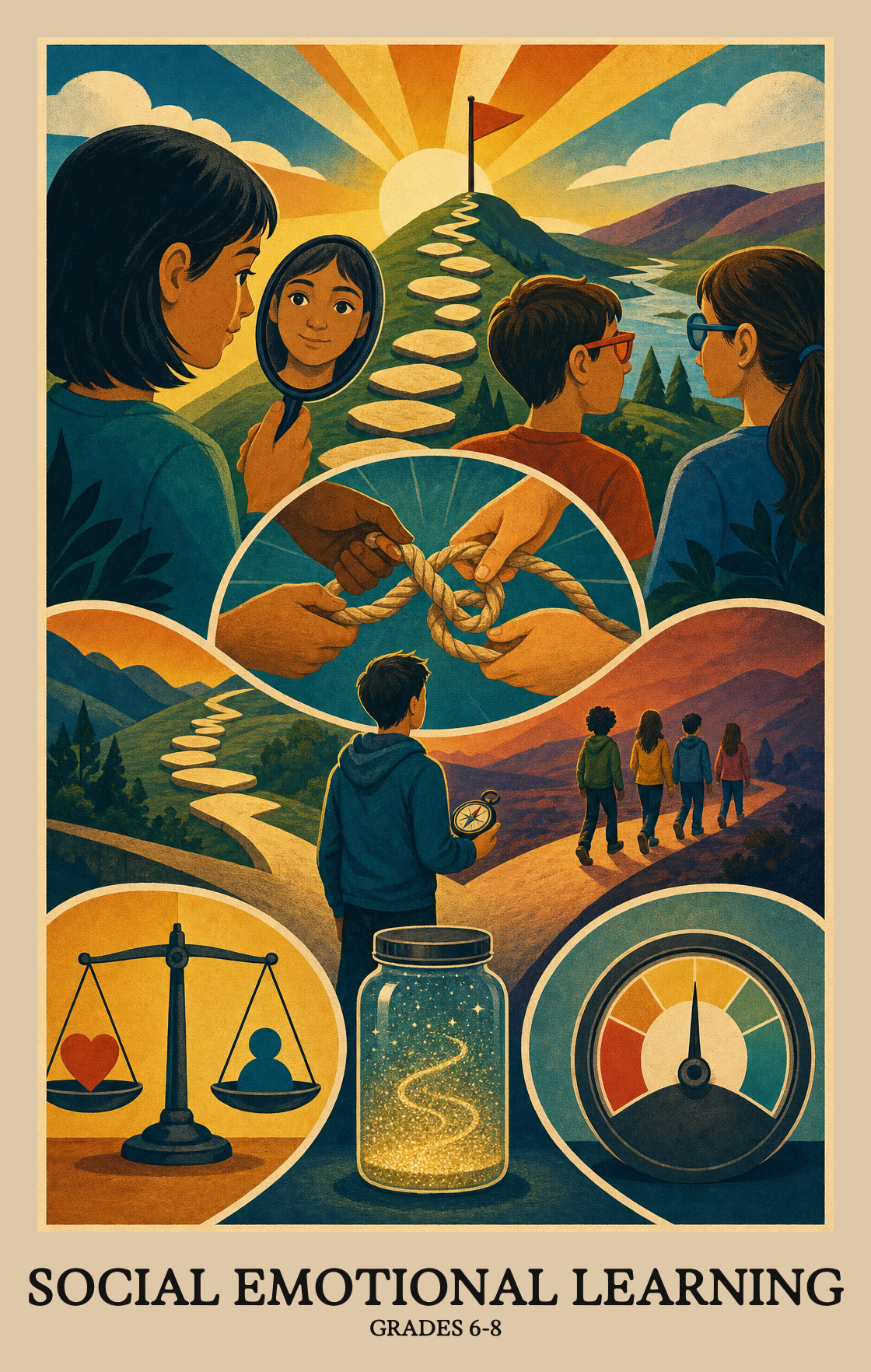
Students notice what they feel and why, and how those feelings shape what they say and do. They start to name their strengths, their values, and the moments that throw them off.
Students practice calming down before reacting, setting goals they actually care about, and sticking with hard tasks. They learn small habits that help when stress, frustration, or distraction shows up.
Students work on understanding how classmates from different backgrounds and families see the same situation. They practice listening past first reactions and noticing what they might be missing.
Students build skills for the social tangle of middle school. They practice clear communication, working through conflict, asking for help, and stepping in when someone is being treated badly.
Students think through decisions before acting, in person and online. They weigh consequences for themselves and others, and look at how their choices fit with the kind of person they want to be.
Students learn to notice their own emotions and values, then trace how those feelings shape their choices at school, at home, and with friends.
Students practice recognizing when emotions or stress are pulling them off track and build habits for getting back on course. The goal is to handle different situations steadily and follow through on what they set out to do.
Students practice seeing situations from someone else's point of view, especially people whose backgrounds or experiences differ from their own.
Students practice building relationships that are honest and kind, and learn how to work well with people whose backgrounds and experiences differ from their own.
Students practice thinking through how their choices affect other people, then pick the option that is fair and considerate. This applies at school, at home, and in situations where the right call isn't obvious.
| Standard | Definition | Code |
|---|---|---|
| Knowing yourself and why you act the way you do Grades 6-8 | Students learn to notice their own emotions and values, then trace how those feelings shape their choices at school, at home, and with friends. | CA-SEL.1.6-8 |
| Managing emotions and behavior to reach goals Grades 6-8 | Students practice recognizing when emotions or stress are pulling them off track and build habits for getting back on course. The goal is to handle different situations steadily and follow through on what they set out to do. | CA-SEL.2.6-8 |
| Seeing things from someone else's point of view Grades 6-8 | Students practice seeing situations from someone else's point of view, especially people whose backgrounds or experiences differ from their own. | CA-SEL.3.6-8 |
| Building healthy relationships with different people Grades 6-8 | Students practice building relationships that are honest and kind, and learn how to work well with people whose backgrounds and experiences differ from their own. | CA-SEL.4.6-8 |
| Making choices that respect others Grades 6-8 | Students practice thinking through how their choices affect other people, then pick the option that is fair and considerate. This applies at school, at home, and in situations where the right call isn't obvious. | CA-SEL.5.6-8 |
Students learn to name what they are feeling, calm down when stressed, see things from someone else's point of view, and make better choices with friends. The work shows up in how students handle group projects, conflicts at lunch, and pressure before a test.
When students are upset, give them a few minutes before talking it through. Later, ask what set it off, what they did, and what they might try next time. Naming the feeling out loud is half the work at this age.
Students should be able to describe their own moods, take a breath instead of reacting, listen to a different opinion without shutting down, and repair a friendship after a fight. They should also set a small goal and stick with it for a few weeks.
Most of it lives inside what is already happening. A two-minute check-in at the start of class, clear group-work roles, and a short reset routine after conflicts cover a lot of ground without adding a separate block.
That is a normal middle school feeling, not a crisis. Ask what part feels pointless and listen without fixing it right away. Then help connect one class or activity to something the student actually cares about, even loosely.
Managing frustration in the moment and taking another person's perspective are the two that come up again and again. Plan to revisit both several times across the year, with short practice tied to real situations in the classroom.
Give each student a turn to say what happened and what they were feeling, then ask what each could do differently. The goal is for students to practice the repair, not to win a ruling. Step in only when safety or respect is on the line.
Phones are part of the picture, but the bigger issue is sleep, time with friends in person, and whether students can step away when something online upsets them. Talk about what they saw and how it landed, not just how long they were on.